


TL;DR: Where AI video compliance stands today
- The market is scaling faster than its standards. According to G2’s analysis of 10,900+ verified AI Video Generators reviews, the number of new products listed in the category grew from 52 in 2024 to over 500 in 2025.
- Review volume tells the same story as product count. Verified reviews for AI video generators have climbed steadily for four straight years, reflecting consistent and growing buyer activity in the category
- Usability is solved. Support isn’t. Quality of support varies far more across AI video vendors than ease of use does. That means the product experience has stabilized, while the support meant to back it up hasn’t caught up.
- Compliance measurement hasn’t caught up to where vendors say the market is heading. Of the 43 feature capabilities G2 tracks for AI Video Generators, only one, watermarking, touches how content origin or authenticity is verified.
- Vendor demand signals are trending up, but aren’t unanimous. Two of the three surveyed vendors report growing demand for disclosure and provenance, especially from regulated industries and large brands. At the same time, the third says it comes up in conversation but doesn’t yet sway purchase decisions.
AI video generation moved from a niche experiment to a category with hundreds of vendors in under two years, and the reviews have piled up just as fast. What hasn’t kept pace is agreement on who’s responsible when something goes wrong. Drawing on more than 10,900 verified G2 reviews and input from three AI video vendors, this report looks at where the category delivers consistently, where it doesn’t, and where the line between vendor responsibility and customer accountability actually falls.
Methodology: How did I evaluate the tools for AI video generation ethics and compliance
- G2 Review Data:
- Reviews analyzed: 10,900+ verified reviews | Period: January 2023 – mid-September 2026 | Category: AI Video Generators
- Snapshot taken mid-September 2026. The count reflects reviews submitted through that date and won’t update retroactively as new reviews come in.
- Rating scale: G2’s sub-ratings (Ease of Use, Quality of Support, Meets Requirements, etc.) are collected on a 1–10 scale. This report treats a score of 5 or below as a low rating.
- Feature coverage: G2 tracks 43 feature/capability questions for the AI Video Generators category as of September 2026. Only one, watermarking, addresses content origin or authenticity.
- Vendor Research:
- Vendors contributed: Akool, invideo, VEED
- Method: Structured written survey, completed September 2026
- Attribution: Vendor quotes are attributed by name and title. Unattributed vendor statements represent platform-level observations, not independently verified claims.
This report combines G2’s proprietary review data with structured input from 3 AI Video Generators vendors. Vendor insights are clearly attributed throughout and represent platform-level observations.
How fast is the AI video generation market actually growing?
Very fast, and still accelerating. According to G2’s analysis of 10,900+ verified AI Video Generators reviews, the number of new products listed in the category grew from 52 in 2024 to over 500 in 2025, nearly tenfold in a single year, with 2026 listings already on pace to exceed that.
Verified product reviews tell the same story. Review volume has climbed steadily for four straight years, a sign of strong, ongoing adoption. That kind of growth curve rarely leaves room for shared standards to form at the same pace. New entrants are typically busy competing on generation quality and price, not on the compliance groundwork that mature categories eventually settle into.
With this pace of growth, the real question is how vendors are responding to shifting attitudes and emerging regulations around responsible AI use. The growth raises a direct question about where vendors are centering their resources.
How much has regulation and disclosure actually shaped AI video vendors’ roadmaps?
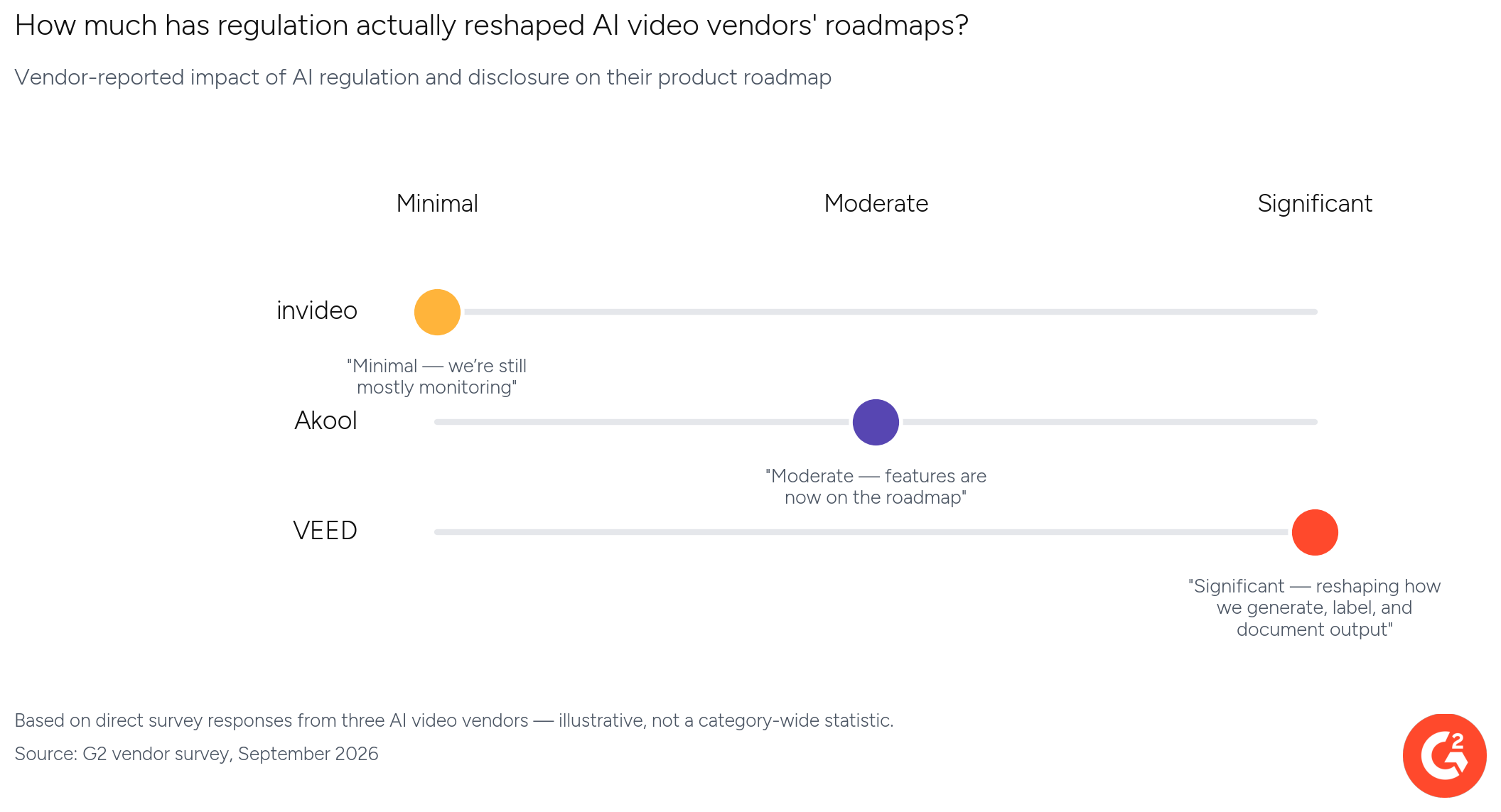
The answer ranges from minimal to significant, with no consensus yet. When three AI video generator vendors were asked how significantly AI regulation and disclosure had impacted their product roadmap, the responses spanned the full spectrum. One called the impact minimal, saying they’re still mostly monitoring. Another called it moderate, with disclosure and provenance features now on the roadmap.
A third called it significant, saying it’s reshaping how they generate, label, and document output. That spread is itself the finding. Three vendors, three different answers. There’s no shared read yet on how seriously regulation should factor into product decisions, even among vendors competing in the same category at the same moment.
If responses to AI regulation are this varied, why? The answer lies in customer demand.
Is customer demand for provenance and disclosure real, or still theoretical?
Real and growing, for most vendors. When G2 asked the same three vendors, “Are your customers actually asking for provenance (C2PA / SynthID), AI-content disclosure, likeness/identity rights, and content safety, or is it still a theoretical demand?”, two of three said demand is growing, especially in regulated industries and large brands. The third said it comes up in conversation but doesn’t yet sway purchase decisions.
That points to a market leaning on customer demand to shape product roadmaps ahead of regulation, at least in part. “Growing demand” doesn’t equal well-defined policy or compliance with emerging regulatory requirements. A vendor hearing about compliance in a passing conversation and a vendor building it into the roadmap are responding to the same market signal at very different speeds. Buyers evaluating the category should expect that gap to show up in what’s actually shipped, not just what’s promised in a sales call.
Key regulatory and legal frameworks shaping AI video disclosure
One date now anchors the compliance calendar for AI video generators: August 2, 2026. That’s when both California’s SB 942 (the California AI Transparency Act) and Article 50 of the EU AI Act took effect, requiring machine-readable watermarking and disclosure on AI-generated video, image, and audio content.
Most vendors are converging on C2PA, an industry provenance standard rather than a law, as the practical way to meet both requirements at once. For AI video vendors and buyers, the upshot is the same: provenance and disclosure are moving from trust-and-safety nice-to-haves to legal requirements with real penalties attached.
If compliance isn’t a formal feature yet, who’s handling it?
Right now, it’s a shared, unevenly defined responsibility, split between vendors and customers, and worked out on a case-by-case basis rather than by fixed policy. G2 review data points to why. Ease of use and quality of support represent two halves of vendor responsibility: one is the product giving customers clarity and control, the other is the vendor actually showing up when something goes wrong.
These aren’t equally reliable. Only 11.4% of reviews rate ease of use 5 or below, compared with 13.7% for quality of support. That inconsistency is where the line between vendor responsibility and customer accountability stops being fixed and starts getting negotiated case by case. A customer who understands the tool but can’t get a straight answer when something goes wrong is exactly the scenario where responsibility gets litigated after the fact instead of being defined up front. That gap is the compliance risk hiding inside an otherwise solid usability story.

We can see this tension play out today. When asked, “Where does vendor responsibility for AI video end, and where does customer accountability begin?” vendors responded:
“Vendors are responsible for building reasonable safeguards, transparency, and controls into their platforms. Customers are responsible for how generated content is ultimately used, including obtaining appropriate rights and consent and complying with applicable laws and platform policies. Responsible AI video requires accountability on both sides.”
Elina Lipkin
VP of Marketing, Akool
“Vendor responsibility ends where the tool has given the customer reasonable control, clarity, safeguards, and remediation paths. Customer accountability begins where the customer makes the creative, commercial, legal, or publishing decision.”
Sanket Shah
Founder & CEO, invideo
“Customers are responsible for what they create and share, and for using the tool lawfully. Our job is to build real safeguards, set clear rules, and be upfront about what the tool can and can’t do, so people can make that call with confidence.”
Céline Daley
Chief Revenue Officer, VEED (Veed Limited)
Are buyers actually asking about AI video compliance?
Increasingly yes, though unevenly. Two of the three surveyed vendors reported growing demand for AI video compliance as a rising priority. At the same time, the third said it comes up in conversation without yet swaying purchase decisions. That split raises a further question: are buyers placing enough emphasis on compliance, regulatory adherence, and ethical AI use, or are product roadmap updates still largely reactionary rather than shaped by customer input?
That question is worth checking against something more concrete than a survey response. G2’s feature questions represent the capabilities buyers are expected to compare products on, so it’s worth seeing whether compliance already shows up there, or whether the feature set simply hasn’t caught up yet to demand that’s only recently picked up.
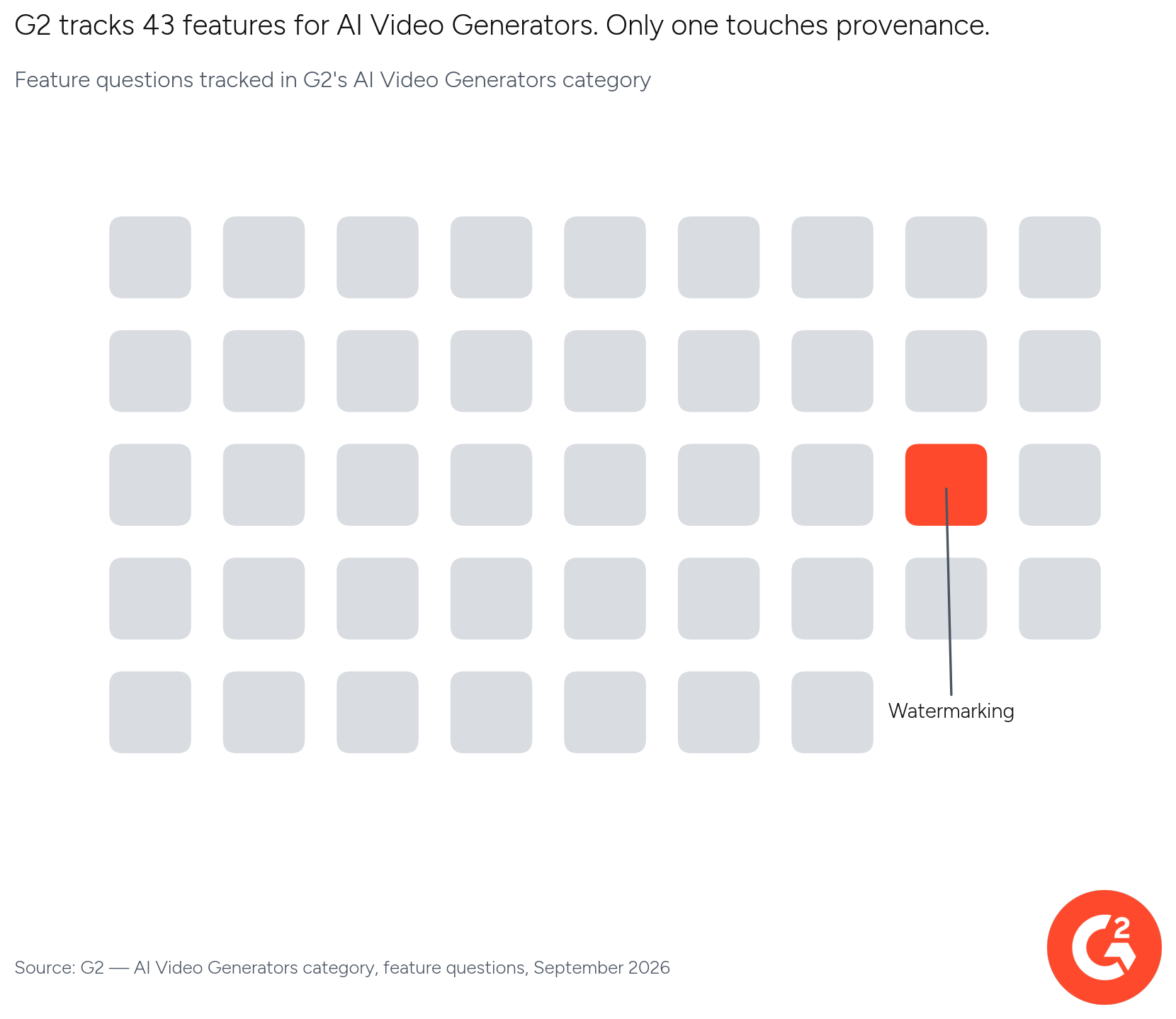
G2 category feature questions capture common capabilities for products in a given category, selected from market research on functions vendors commonly offer, giving prospective buyers additional points of comparison. One of the 43 tracked feature questions for AI Video Generators is watermarking, but as of September 2026, none cover content disclosure, consent, likeness rights, or content-safety moderation. That timing checks out.
Feature questions capture what’s already common practice, and compliance demand is recent enough that it hasn’t settled into common practice yet. Now that this demand is visible, the practical next step is straightforward: vendors that ask customers directly, rather than wait for it to surface in feature requests, will have a head start once compliance becomes a differentiator.
What would it take for compliance to become a measurable buying criterion?
It would take vendors moving from ad hoc responses to standard practice: normalizing conversations about responsible AI use, publishing clear AI-use statements on their websites, and building regulatory and compliance considerations into their product feedback loops. Survey responses point to rising demand for AI regulatory compliance, real enough that vendors cannot treat it as purely theoretical, but not yet unanimous or fully mature.
Frequently asked questions (FAQs) about AI video generators
Q1. What are the biggest compliance risks with AI-generated video?
Four risks come up most often: unclear ownership (AI output generally isn’t copyrightable under current U.S. law), missing disclosure (a growing list of laws now need labeling AI-generated content), unauthorized likeness or voice use (a separate legal exposure from disclosure rules), and industry-specific gaps like the lack of HIPAA-ready options for healthcare use cases. None of these makes AI video unusable, but each shifts real risk onto the buyer if it’s not addressed before content goes out the door.
Q2. Who owns the rights to AI-generated video content?
It’s murkier than most creators assume. In March 2026, the U.S. Supreme Court declined to hear Thaler v. Perlmutter, leaving in place lower-court rulings that copyright requires genuine human authorship, meaning AI cannot hold copyright, and a prompt alone doesn’t make the user the legal “author” of the output. In practice, a purely AI-generated clip with no further human editing likely isn’t copyright-protected in the U.S., so ownership comes down to the platform’s commercial-use license terms, not copyright law, until a person adds substantial editing, selection, or original creative input on top of the AI output.
Q3. Are AI video generators required to disclose AI-generated content?
Increasingly, yes. California’s SB 942 and the EU AI Act’s Article 50 both took effect August 2, 2026, requiring some form of disclosure or machine-readable marking for AI-generated media, though requirements still vary by jurisdiction.
Q4. How are AI videos legal?
AI-generated video is legal to create and use in most jurisdictions; there’s no blanket ban on the technology. What varies is the disclosure and consent layer on top of it. The EU AI Act’s Article 50, California’s SB 942, New York’s S8420A, and Texas’s TRAIGA are among the disclosure laws creative and marketing teams now have to plan around, and separately, using someone’s real likeness or voice without consent can trigger its own legal exposure regardless of disclosure compliance. In practice, legality hinges less on the video being AI-made and more on whether it’s properly disclosed, whose likeness it uses, and what it claims to depict.
Q5. Are AI videos banned on YouTube?
No. YouTube requires creators to disclose “altered or synthetic content” that appears realistic, including content that digitally alters a person’s likeness or synthetically generates their voice, rather than banning AI-generated video outright. Since early 2026, YouTube has enforced this with automatic detection that can apply a “Modified or Synthetic” label that creators can’t remove, with escalating penalties for undisclosed content up to channel termination in severe, repeat cases. Content that’s clearly stylized or animated, or that uses AI only for “production assistance,” like scripts and titles, is exempt.
Q6. What video apps are HIPAA compliant?
As of 2026, this remains a gap across most mainstream AI video generation platforms rather than something buyers can assume by default. Neither HeyGen nor Synthesia, two of the category’s largest players, publish HIPAA compliance documentation or offer a standard Business Associate Agreement (BAA) as of early to mid-2026, meaning healthcare buyers need a direct enterprise conversation and a signed BAA before sending any protected health information through these tools. Vendor posture on this shifts quickly, so this is worth confirming directly with a vendor’s security or sales team rather than relying on marketing copy alone.
What should content, marketing, and creative leaders expect from AI video vendors in 2026?
Expect the shift already underway to continue. Responsible AI use policies are emerging from vendors to meet growing customer demand, and questions about AI regulation aren’t going anywhere. Smart vendors will keep developing and refining flexible, meaningful AI-use policies.
That timeline is no longer hypothetical. August 2, 2026, has already passed, and the vendors covered in this report are living under SB 942 and Article 50 obligations right now, not preparing for some future deadline. The category’s watermarking gap, one tracked feature question out of 43, is the clearest evidence that product roadmaps haven’t fully caught up to what the law already requires.
Ease of use likely won’t stay the differentiator it’s been. As disclosure and provenance move from vendor talking points to legal requirements, vendors that treat compliance as a core capability, not something bolted on to satisfy procurement, are the ones likely to pull ahead with buyers in regulated industries. The rest will keep negotiating responsibility on a case-by-case basis, the way most of the category still does today.
Explore the top-rated AI Video Generators on G2.

💸 Earn Instantly With This Task
No fees, no waiting — your earnings could be 1 click away.
Start Earning
