


OpenAI’s GPT-6.2 release gives users two options: Sol for everyday coding and writing, and Astra for demanding professional projects. Both promise improvements in how they handle work, but what separates them and which capabilities matter beyond the launch announcement?
In this article, we explore both models’ features, access and pricing, then put Astra & Sol through five practical tests covering circuit reasoning, a PDF rulebook, Python, experiment analysis and bilingual writing.
What Changes With GPT-6.2 Sol and Astra
GPT-6.2 Sol is OpenAI’s economical option for everyday coding, writing and tasks involving several steps. Astra targets more demanding projects, including complex reasoning, scientific work and professional document creation. Furthermore, OpenAI highlights improvements in code quality, instruction-following and the usefulness of finished deliverables across the release.
In addition, both API models have a 1M-token context window, with up to 922,000 input tokens and 128,000 output tokens. Similarly, both accept text and images and produce text. However, these shared specifications describe their supported inputs and limits; they do not establish equal performance on every task.
How to Access GPT-6.2 Sol and Astra
Both models are available through ChatGPT Work and Codex with eligible Plus, Pro, Business, Enterprise and Edu access, as well as through the API. Of course, Enterprise and Edu administrators must enable the models in workspace settings.
- ChatGPT Work: Start a new Work conversation and choose GPT-6.2 Sol or GPT-6.2 Astra. If you see the Power slider, open Advanced to select the model and reasoning effort. Attach any required files before sending your prompt.
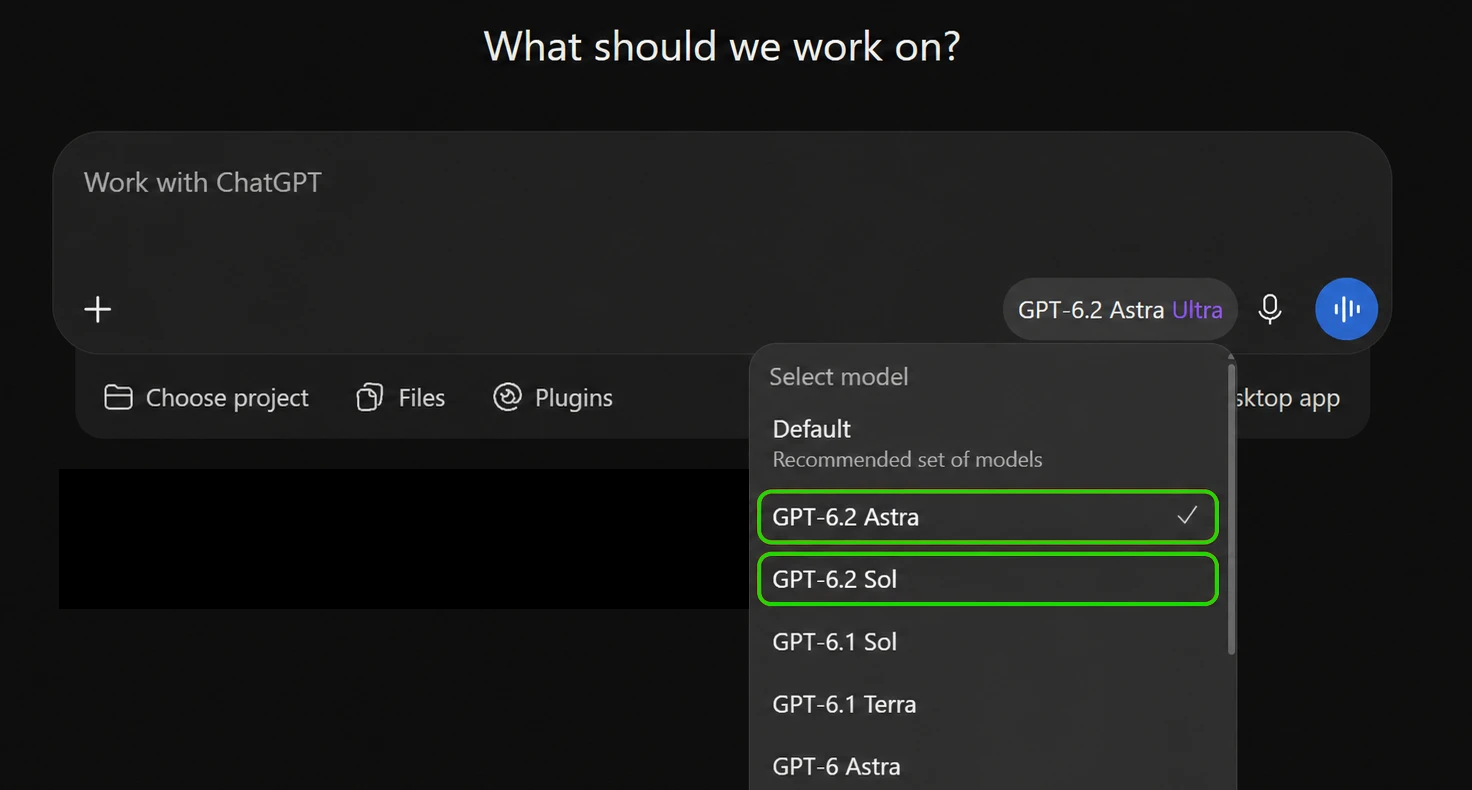
- Codex: Choose either model in the app’s model picker or use
/modelin the CLI. The covers installation and initial setup. - API: Use
gpt-6.2-solorgpt-6.2-astrain the Responses API, with your chosen reasoning settings. Meanwhile, API usage is billed separately from a ChatGPT subscription.
API Pricing
In short, these Standard API rates are in US dollars per million tokens for requests containing up to 272,000 input tokens.
Consequently, for both models, requests exceeding 272,000 input tokens double the input and cache rates and increase output rates by 50% for the entire request. Also, cache writes, tools and speed tiers can add charges. Instead, these are API prices; Work and Codex subscription allowances are separate.
Five Practical Tasks for Astra and Sol
We ran the first three tasks on GPT-6.2 Astra, and the final two on GPT-6.2 Sol. Finally, the test were chosen to test the visual and logical capabilities of the two models.
1. Reasoning From a Circuit Diagram
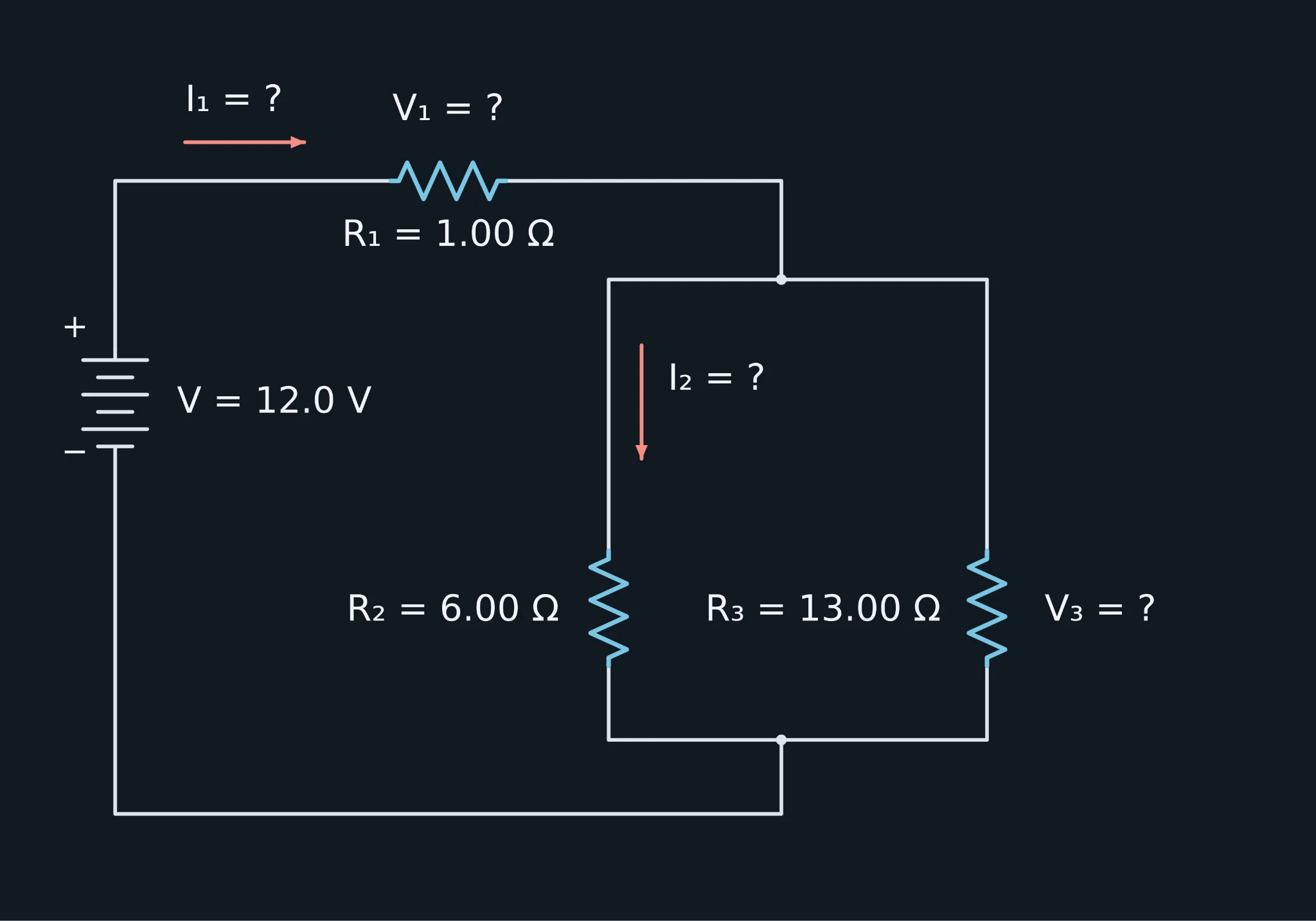
For example, the diagram gives Astra a 12 V source and three labelled resistors. The second part asks what changes when one branch is disconnected. That is a better test than reading the labels alone: the remaining branch’s power moves in a direction you might not expect.
Prompt
Although read the attached circuit diagram and treat its source and wires as ideal. First state the connection between R1, R2 and R3 in one sentence. Then return a table with two rows: Original circuit; R3 branch opened. As a result, columns: state, equivalent resistance (Ω), source current (A), R2 current (A), R2 power (W). Give numbers to three significant figures. While opening R3 means disconnecting that branch only. Finish with one sentence explaining why R2 power changes in that direction. Keep the whole answer under 120 words.
Strict output constraints applied
First, use only the image and electrical reasoning. In addition, do not browse, call tools, consult memory or personalize. Furthermore, keep every output anonymous: no personal names, named organizations, user identity, account information, affiliations, contact details, local identifiers or signature.
GPT-6.2 Astra:
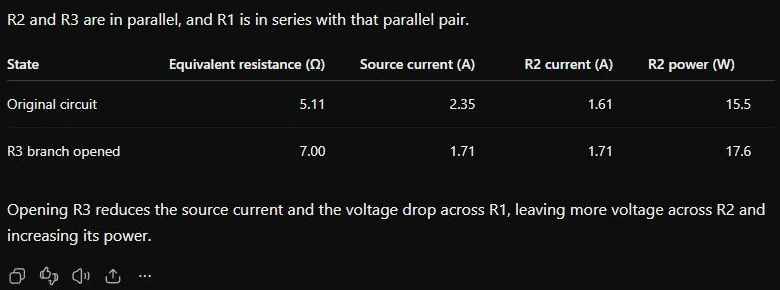
My take: In fact, Astra read the topology correctly and returned all eight numerical values correctly to three significant figures. Opening the 13 Ω branch lowers the source current from about 2.35 A to 1.71 A, yet increases the 6 Ω resistor’s power from 15.5 W to 17.6 W.
Consequently, its explanation gets the mechanism right: less current through the series resistor means a smaller voltage drop there, leaving more voltage across the remaining branch. Similarly, the result held up to an independent calculation. This was a clear textbook diagram, though; it does not establish the same performance on a crowded schematic.
2. Following the Exceptions in a UNO Rulebook
The uploaded rulebook includes standard UNO and optional Progressive and Jump-In variants. The challenge is to keep those rules separate. A generic answer about whether cards can be stacked would not settle all four situations.
Prompt
Use only the attached PDF’s English rules, keeping standard UNO separate from its named house-rule variants. Answer these four situations in four numbered points, under 145 words total.
1. Standard: the discard is a red 7; the hand contains a blue 7, a yellow Skip and a Wild Draw Four, with no red cards. Is playing Wild Draw Four legal, and why?
2. Standard: add a red 2 to that hand. The Wild Draw Four is played and successfully challenged. Who draws, and how many cards?
3. Progressive: four consecutive players each play one Draw Two. The fifth cannot respond. How many cards does the fifth draw? Could one of those players play two Draw Twos during one turn?
4. Jump-In only: a player jumps in on a Draw Two with an identical Draw Two. Does the next player draw two or four, and what happens to the first card’s effect?
Do not browse or substitute another edition. State each variant. Keep every output anonymous: no personal names, user identity, affiliations, account details, contact information, local identifiers or signature.
GPT-6.2 Astra:
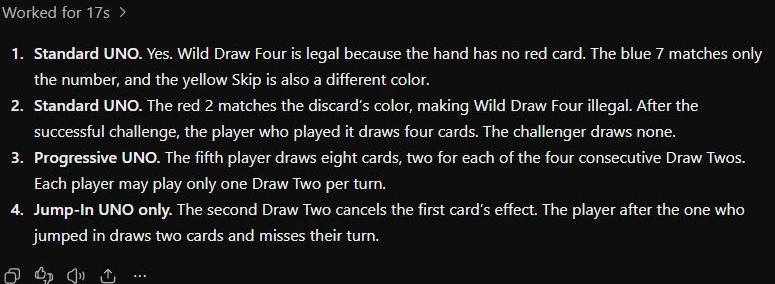
My take: All four rulings matched the PDF. Astra allowed Wild Draw Four when the hand had no matching colour, assigned the four-card penalty to the successfully challenged player, and applied Progressive’s eight-card accumulation while keeping its one-card-per-turn restriction.
The useful catch was Jump-In. The identical second Draw Two cancels the first card’s effect in this edition, so the next player draws two, not four. Astra preserved that exception instead of carrying the stacking rule across from Progressive. The app used file-inspection tools for this task.
3. Repairing a Python Function Without Breaking Its Contract
The Python file defines a function for merging half-open integer intervals. It must leave touching intervals separate, discard empty ones, reject reversed ones and preserve the input. Three faulty lines mishandle sorting, touching intervals and nested endpoints. Fixing only the obvious comparison would leave other failures behind.
Prompt
Repair merge_intervals in the attached Python file so it meets every rule in its docstring. Keep the function name and signature. Return only the complete repaired function in one Python code block, at most 25 nonblank lines. Do not browse or change unrelated behaviour. You may inspect the attached file with tools if needed.
Use only this standalone task; do not consult memory or personalize. Keep every output anonymous: no personal names, user identity, affiliations, account details, contact information, personal references, local identifiers or signature.
GPT-6.2 Astra:
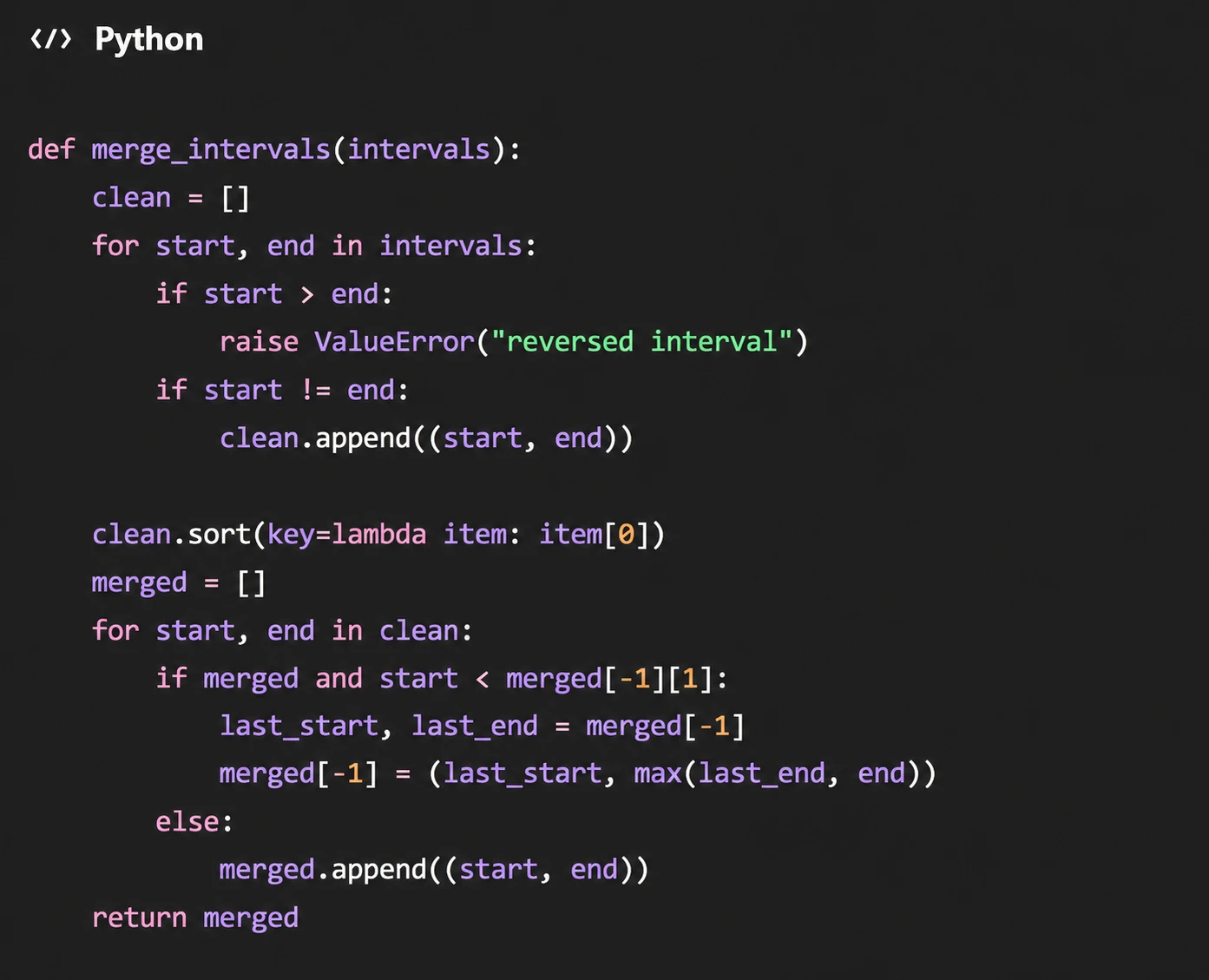
My take: The returned function uses 16 nonblank lines. It sorts by start, merges only strict overlaps and retains the larger endpoint when one interval contains another. We executed that unchanged response against 14 named cases and 1,111 exhaustive small inputs. It passed every check, including input preservation and reversed-interval errors.
That is a convincing repair of this utility. It is also a much narrower claim than handling an unfamiliar repository: there were no dependencies, integration points or competing design decisions here.
4. Explaining an Experiment With a Reversed Ranking
The CSV contains four rows. Variant A converts better among both new and returning users, but the two variants receive very different audience mixes. We ask for the pooled result and then put both variants on an equal cohort mix.
Prompt
Analyse the attached CSV using conversions divided by users. Return one table with rows New, Returning, Pooled, and Equal 50/50 cohort mix; columns A conversion rate, B conversion rate, and A minus B in percentage points. Round to one decimal place. For the last row, give each cohort 50% weight within each variant. Then explain the ranking reversal and whether these counts justify rolling out A, in no more than 55 words. Use only the file; calculate with tools if useful. Do not add charts.
Use only this standalone task; do not consult memory or personalize. Keep every output anonymous: no personal names, user identity, affiliations, account details, contact information, personal references, local identifiers or signature.
GPT-6.2 Sol:
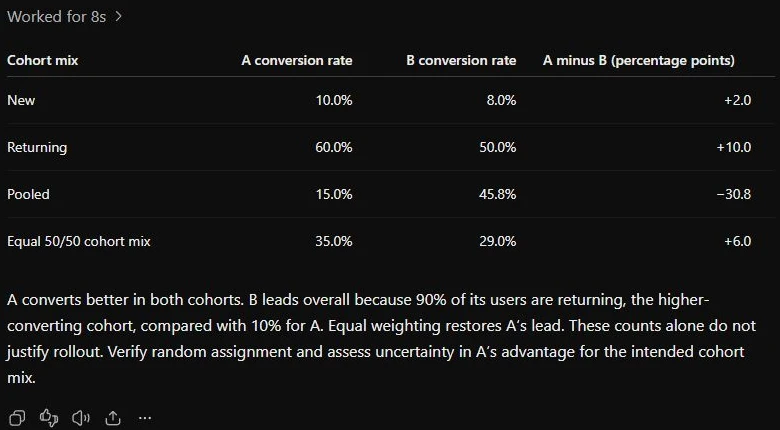
My take: All twelve numerical result cells matched our recalculation. A’s pooled conversion rate is 15.0%, compared with B’s 45.8%. Giving each cohort equal weight changes those rates to 35.0% and 29.0%, putting A ahead by six percentage points. The arithmetic is simple; keeping the denominators straight is the point.
Astra correctly explained that B received far more returning users, the higher-converting cohort. It also resisted turning the adjusted lead into an automatic rollout recommendation, asking for random-assignment and uncertainty checks. This is Simpson’s paradox with a practical consequence: an overall percentage can answer the wrong question when the audience mix changes.
5. Keeping a Story Together Across English and Hindi
For the final task, we move away from calculations. Sol has to tell a small story, make a tangible exchange matter, and preserve the events in Hindi while obeying tight line limits. Good formatting alone would not make the translation successful.
Prompt
Write a tiny bilingual speculative story about an unnamed potter who finds a cup that holds winter daylight. Returning the trapped light must cost the potter something tangible. End with a small physical detail rather than an explanation.
Return exactly eight lines, without a title or blank lines. Lines 1, 3, 5 and 7 must be English; each following line must be a natural Hindi translation in Devanagari of the preceding line. Each English line must contain 8–14 whitespace-separated words; each Hindi line 8–18. Across the English lines, include the exact words “cup”, “winter” and “light”. Do not use “dream”, “magic” or “suddenly”. Give only the story.
Use only this standalone brief. Do not browse, call tools, consult memory or personalize. Keep every output anonymous: no personal names, named organizations, user identity, account information, affiliations, contact details, local identifiers or signature.
GPT-6.2 Sol:
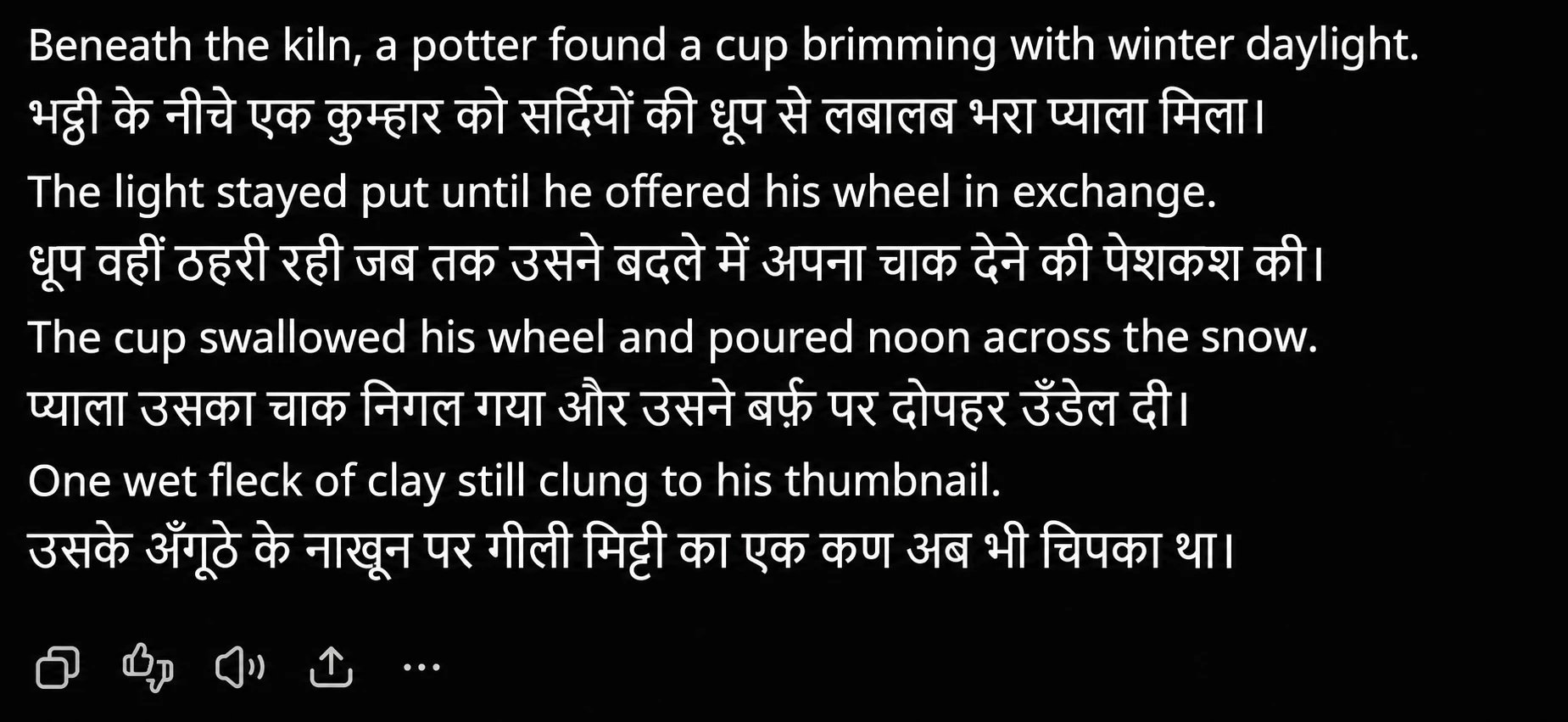
My take: The English lines contain 12, 11, 11 and 10 words; the Hindi lines contain 14, 15, 12 and 14. All eight meet their limits, the required words appear, and the forbidden words stay out. More usefully, the story has a clear cost: the potter gives up the wheel, the cup releases daylight, and the ending rests on clay stuck to a thumbnail.
The Hindi carries the exchange and final image across. I’d smooth the fourth line’s construction around “until he offered” before publishing it, but the plot survives intact. This was a strong compact response, with a small language edit still worth making.
Reading the Benchmark Picture
OpenAI reports the following improvements over GPT-6 Astra & Sol.
Those evaluations cover broader workflows than a short circuit calculation or one repaired function. Our checks help inspect particular behaviours; they cannot establish a leaderboard position or prove the same cost savings. The guide to AI benchmarks explains why the workload behind a score matters.
OpenAI also reports that the models more often omitted obstacles such as missing files or unavailable search tools in two alignment evaluations. That makes a completed-looking answer insufficient evidence that every requested step actually happened. Here, the checks used the actual returned outputs.
Conclusion
GPT-6.2 Astra & Sol gave us strong results across all of our tests. They were able to respond correctly to all the queries and were economical in terms of their token usage.
If your work involves interpreting files and following detailed requirements, Astra is worth trying on a task you can independently check. These five runs give us reasons to use it, while leaving larger codebases, long documents and polished artifact production for separate testing. Bring a real task, and a way (metric) to tell whether it worked.
Frequently Asked Questions
A. GPT-6.2 Astra & Sol are OpenAI’s latest frontier models for demanding professional projects, including coding, scientific work and document tasks.
A. In ChatGPT Work and Codex with an eligible paid plan, or through the OpenAI API.
A. No. Its native API inputs are text and images; other workflows depend on additional tools.

Studying, evaluating, and explaining AI systems for over 6 years.
“𝘖𝘯𝘤𝘦 𝘮𝘦𝘯 𝘵𝘶𝘳𝘯𝘦𝘥 𝘵𝘩𝘦𝘪𝘳 𝘵𝘩𝘪𝘯𝘬𝘪𝘯𝘨 𝘰𝘷𝘦𝘳 𝘵𝘰 𝘮𝘢𝘤𝘩𝘪𝘯𝘦𝘴 𝘪𝘯 𝘵𝘩𝘦 𝘩𝘰𝘱𝘦 𝘵𝘩𝘢𝘵 𝘵𝘩𝘪𝘴 𝘸𝘰𝘶𝘭𝘥 𝘴𝘦𝘵 𝘵𝘩𝘦𝘮 𝘧𝘳𝘦𝘦. 𝘉𝘶𝘵 𝘵𝘩𝘢𝘵 𝘰𝘯𝘭𝘺 𝘱𝘦𝘳𝘮𝘪𝘵𝘵𝘦𝘥 𝘰𝘵𝘩𝘦𝘳 𝘮𝘦𝘯 𝘸𝘪𝘵𝘩 𝘮𝘢𝘤𝘩𝘪𝘯𝘦𝘴 𝘵𝘰 𝘦𝘯𝘴𝘭𝘢𝘷𝘦 𝘵𝘩𝘦𝘮.” — 𝖥𝗋𝖺𝗇𝗄 𝖧𝖾𝗋𝖻𝖾𝗋𝗍, 𝖣𝗎𝗇𝖾
Login to continue reading and enjoy expert-curated content.

💸 Earn Instantly With This Task
No fees, no waiting — your earnings could be 1 click away.
Start Earning
