


Key takeaways
- Zcash development team Zakura (November 26) called for accelerated retirement of the older Sapling privacy pool, which it estimated held about 400,000 ZEC.
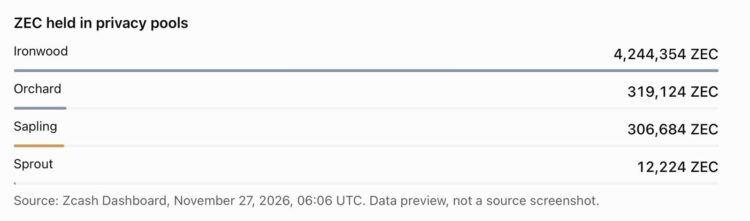
- A November 27 dashboard snapshot showed about 306,684 ZEC still in Sapling, though that does not prove the warning prompted anyone to move funds.
- Zakura’s concern is speculative, unverified mathematical advances, not a successful quantum attack, and Shielded Labs expects to pick a post-quantum direction by the end of January 2027.
- The Quantum Ledger counts about 7.23 million BTC (35.9% of issued supply) with public keys already visible on-chain; Glassnode’s May estimate was 6.04 million BTC.
- No reliable date exists for a quantum computer that can break crypto signatures, but upgrading blockchains, wallets and custody could itself take years.
Can quantum computing break crypto? For years, the question has largely been treated as a problem for the distant future. Zcash developers, however, are already discussing what to do with hundreds of thousands of coins that could become vulnerable if certain cryptographic protections fail.
On November 26, Zcash development team Zakura called for the accelerated retirement of Sapling, an older privacy system that the team estimated still held around 400,000 ZEC. The recommendation followed speculation about mathematical breakthroughs at artificial intelligence laboratories.
A day earlier, Shielded Labs published its first technical update on a separate project designed to protect Zcash against future quantum computers.
Neither development means cryptocurrency has been cracked. Together, however, they raise a more pressing question: can blockchain developers replace the mathematics protecting investors’ money before someone finds a way around it?
What Is Quantum Computing?
Quantum computing is a way of processing information using the properties of quantum mechanics. Unlike conventional computers, which represent information using bits with a value of either zero or one, quantum computers operate using quantum bits, commonly known as qubits.
By manipulating these qubits, researchers can design algorithms capable of solving certain mathematical problems far more efficiently than conventional computers.
The important word here is certain. A quantum computer is not simply a faster version of the laptop sitting on your desk. Its advantages depend on the type of problem it is trying to solve.
Unfortunately for the cryptocurrency industry, some of those problems underpin the security of digital wallets.
As explained in NewsBTC’s guide to quantum computing, blockchains rely on cryptographic signatures to establish ownership and authorize transactions. A sufficiently powerful quantum computer could undermine some of the signature systems currently used to protect digital assets.
How Could Quantum Computers Steal Cryptocurrency?
When you send Bitcoin from your wallet, the network needs to establish that you have the authority to spend those coins. It does this by verifying a digital signature produced using your private key.
Your private key is supposed to remain secret. The corresponding public key can be disclosed because working backward from a public key to its private counterpart is computationally impractical using conventional methods.
Quantum computing could change that.
In 1994, mathematician Peter Shor introduced a quantum algorithm that could efficiently solve certain mathematical problems underlying modern public-key cryptography.
A sufficiently powerful quantum computer running such an algorithm could potentially recover private keys from exposed public keys. An attacker could then create a transaction that the blockchain would recognize as valid, even though the original owner had never authorized it.
That is a particularly uncomfortable problem for cryptocurrencies. Bitcoin does not have a customer service department that can reverse an unauthorized transfer.
The National Institute of Standards and Technology has already developed alternative cryptographic standards intended to withstand these future attacks. The challenge for crypto is incorporating such protection into networks that were originally built around different assumptions.
How Much Bitcoin Is Exposed to Quantum Computing?
Bitcoin’s public transaction history makes it possible to estimate how much of its supply could be exposed under certain quantum attack scenarios.
According to a November 25 snapshot from The Quantum Ledger, approximately 7.23 million BTC, representing 35.9% of issued supply under its methodology, was associated with public keys or spending scripts already visible on the blockchain.
Around 1.94 million BTC was classified as exposed because of its output design. A further 5.29 million BTC was associated with addresses that had previously revealed relevant spending information.
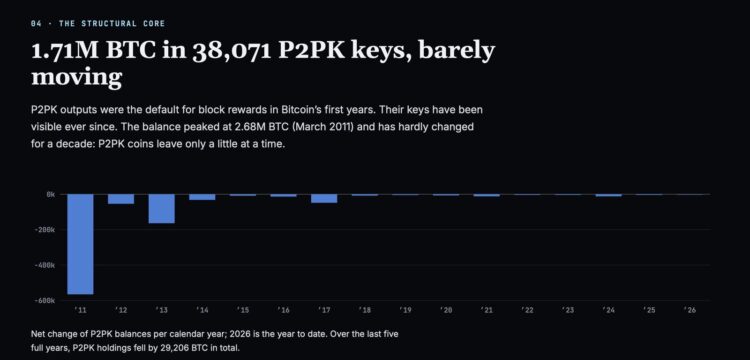
Some of these coins date back to Bitcoin’s earliest years, when transactions commonly revealed public keys directly.
Estimates vary between researchers because they do not all measure exposure in exactly the same way. In May 2026, Glassnode’s research identified 6.04 million BTC under its own classification framework.
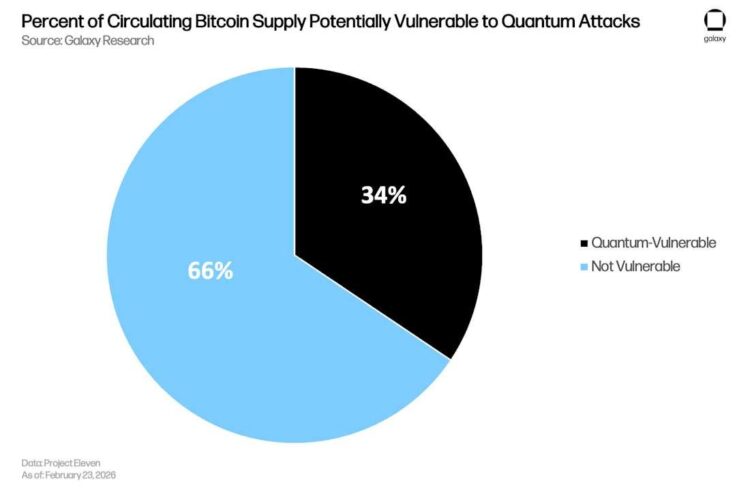
These figures should not be interpreted as the amount of Bitcoin that will eventually be stolen. They measure a potential vulnerability under a specific future scenario, not an active attack.
Owners of many exposed coins could migrate their holdings if suitable protection becomes available. Dormant wallets whose owners have lost their private keys present a considerably harder problem.
Why Zcash Developers Want to Retire an Older Privacy System
Zcash offers a useful example of how complicated a cryptographic migration can become.
Unlike Bitcoin, where transactions are generally visible on a public ledger, Zcash provides privacy features through shielded pools. These allow users to transact without publicly revealing certain transaction details.
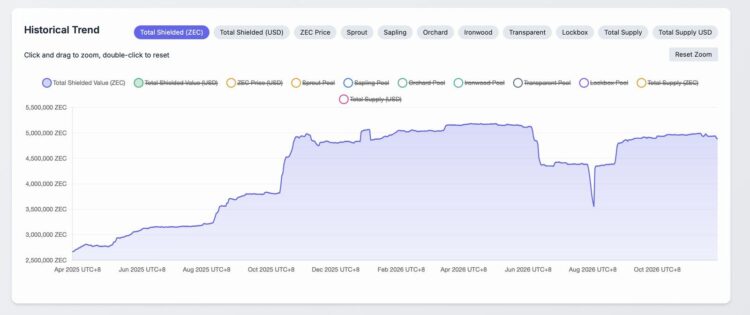
Sapling is one of the network’s older shielded systems. Its proof mechanism relies on mathematical assumptions that Zakura believes warrant additional scrutiny in light of potentially accelerating cryptographic research.
“
The time to prepare for a cryptographic breakthrough is before it happens.
Zakura · Sapling retirement proposal
Zakura proposed preventing new deposits into Sapling while encouraging users to migrate to Ironwood, a newer privacy system. If credible evidence of a threat emerged, further emergency measures could be considered.
The amount involved is already changing. A November 27 snapshot from the Zcash Dashboard, timestamped 06:06 UTC, showed approximately 306,684 ZEC remaining in Sapling, below the rounded estimate cited in Zakura’s proposal. The difference does not, by itself, establish that the warning prompted users to move their funds.
The discussion follows Zcash’s recent NU7 network upgrade, which improved transaction speed and continued the network’s transition away from older infrastructure.
Importantly, the immediate concern raised by Zakura is not evidence of a successful quantum attack. It relates to speculative advances in mathematics that could affect particular cryptographic constructions. Those advances remain unverified.
Can Zcash Become Quantum-Resistant?
On November 25, Shielded Labs published an update on its Epoch project, which aims to develop privacy technology capable of withstanding future quantum computers.
One of the problems its researchers are working on is the size of cryptographic proofs.
Stronger protection can require considerably more data to be processed and transmitted. That can create difficulties for blockchains, where transaction capacity, verification costs and storage requirements already matter.
The team is evaluating two possible approaches and expects to select a direction by the end of January 2027, provided its research progresses as planned.
Ironwood already incorporates features intended to support a future recovery mechanism. However, the developers have made clear that these features do not make Zcash fully quantum-resistant today.
The distinction is important. Having a contingency plan for a future attack is not the same as having protection against one.
Are Bitcoin and Ethereum Preparing for Quantum Computing?
Zcash is not the only network confronting these issues.
Bitcoin developers are discussing changes through proposals including BIP-360, which would introduce a transaction output format designed to reduce certain forms of public-key exposure.
A separate draft, BIP-361, explores a gradual transition away from vulnerable signature schemes once suitable alternatives are available.
Neither proposal should be confused with an activated Bitcoin upgrade.
Ethereum faces additional complications. Beyond individual wallets, its security model relies on cryptographic signatures used by validators and other infrastructure.
Ethereum’s quantum-security challenge extends to staking arrangements and institutional custody.
There is also a governance problem that applies particularly to Bitcoin. If millions of coins remain in old wallets that cannot be migrated, should the network eventually restrict their movement to prevent potential theft?
Doing so could protect the broader ecosystem, but it could also prevent legitimate owners from accessing their own money. Leaving those coins untouched carries a different set of risks.
Cryptography alone cannot settle that argument.
When Will Quantum Computing Become a Real Threat to Crypto?
There is no reliable date for when a quantum computer capable of breaking widely used cryptocurrency signatures will become available.
Building such a machine requires more than increasing the number of qubits. Those qubits must also be reliable enough to carry out lengthy, complex calculations without errors overwhelming the results.
According to Coinbase Institute’s research, the relevant machines do not yet exist, but the process of upgrading blockchains, wallets and custody infrastructure could itself take years.
For that reason, waiting for an actual attack before implementing stronger cryptography would be a risky approach.
Crypto investors should pay attention to what developers implement, whether wallets support the new protections and whether existing funds can be migrated without compromising ownership.
There is no need to buy a token simply because its developers describe it as quantum-resistant, either. Such claims deserve scrutiny of the underlying cryptography and its implementation.
Zcash’s latest proposals offer a glimpse of the decisions other blockchain communities may eventually face. Replacing an algorithm is one thing. Persuading an entire decentralized financial network to move its money before a deadline is something else entirely.

💸 Earn Instantly With This Task
No fees, no waiting — your earnings could be 1 click away.
Start Earning
