


In fact, AI projects are not built by simply choosing a model and feeding it data. Furthermore, a successful AI system goes through multiple stages, starting with identifying the right problem and ending with deployment, monitoring, and continuous improvement.
This structured journey is known as the AI Project Cycle. It helps teams move from an initial idea to a reliable, production-ready AI solution while reducing risks and improving outcomes. This article would outline all the steps involved in the life cycle of an AI project, from a mere concept to a full flesh production ready product.
What is the AI Project Cycle?
The AI Project Cycle is a structured process used to plan, build, evaluate, deploy, and improve an AI system. It helps teams organize complex AI development into clear stages instead of treating model building as an isolated task.
A typical AI project moves through stages such as:
These stages are connected. If evaluation reveals poor performance, the team may need to revisit the data or modeling approach. Similarly, production monitoring may uncover new patterns that require retraining or redesign.
Consequently, this iterative approach helps ensure that an AI solution remains accurate, useful, scalable, and aligned with business objectives throughout its lifecycle.
Stage 1: Problem Definition
First, every AI project should begin with a clearly defined problem. Before selecting a model or collecting data, teams need to understand what they are trying to solve, who is affected, and what business outcome they want to achieve.
For example, instead of defining the goal as “build an AI system for customer support,” a stronger problem statement would be:
Reduce repetitive customer support queries by automatically answering common questions while escalating complex cases to human agents.
A good problem definition should identify:
- the target users
- Defining the expected AI output
- the current baseline
- business and technical constraints
- measurable success criteria
This stage is important because even a highly accurate AI model has little value if it does not solve the right business problem.
Stage 2: Data Collection
Once the problem is clearly defined, the next step is to identify and collect the data required to build the AI system. In addition, the quality of the final solution depends heavily on the quality, relevance, and coverage of this data.
For example, depending on the project, data may come from databases, APIs, application logs, sensors, documents, images, customer interactions, or external sources.
Next, at this stage, teams should focus on:
- collecting data that is relevant to the problem
- ensuring sufficient coverage of real-world scenarios
- checking data ownership and permissions
- identifying sensitive or personal information
- documenting where the data came from
For Generative AI and RAG applications, this may also include knowledge bases, PDFs, websites, internal documentation, and conversation history. Moreover, good data collection creates the foundation for every stage that follows.
Stage 3: Data Preparation and Exploration
However, raw data is rarely ready to be used directly in an AI system. In particular, it may contain missing values, duplicates, inconsistent formats, incorrect labels, or irrelevant information. Therefore, the purpose of this stage is to understand the available data and transform it into a reliable form for model development.
Common activities include:
- handling missing or incorrect values
- removing duplicates
- identifying outliers
- analyzing class distribution
- transforming and normalizing features
- Finally, splitting data into training, validation, and test sets
- checking for data leakage
For Generative AI applications, preparation may involve cleaning documents, splitting them into chunks, adding metadata, and generating embeddings.
Exploratory analysis is equally important because it helps teams identify patterns, biases, and limitations in the data before building the AI solution.
Stage 4: Model Development
Once the data is prepared, the next step is to build the AI solution. This involves selecting an approach that fits the problem, experimenting with different techniques, and comparing their performance.
For traditional machine learning, teams may test models such as logistic regression, random forests, gradient boosting, or neural networks. For Generative AI projects, the solution may involve prompting an LLM, RAG, fine-tuning, tool use, or agentic workflows.
A good practice is to start with a simple baseline and add complexity only when it produces measurable improvement.
During this stage, teams should track:
- model and prompt versions
- training configurations
- hyperparameters
- datasets used
- experiment results
- latency and cost
The goal is not to build the most complex model, but the most effective solution for the problem.
Stage 5: Evaluation
Before an AI system is deployed, it must be tested carefully to determine whether it performs well enough in realistic conditions. Evaluation should measure not only model accuracy, but also reliability, business usefulness, safety, latency, and cost.
For traditional machine learning, common metrics include:
- accuracy
- precision
- recall
- F1 score
- MAE or RMSE
For Generative AI systems, evaluation may include:
- factual correctness
- relevance
- groundedness
- hallucination rate
- retrieval quality
Evaluation should also cover edge cases and failure scenarios. For RAG and agentic systems, individual components such as retrieval, reasoning, tool selection, and final response quality should be tested separately as well as end to end.
A strong evaluation process helps determine whether the system is ready for production or needs further improvement.
Stage 6: Deployment
Once the AI system performs reliably during evaluation, it can be moved into a production environment where real users or applications can access it.
Deployment involves much more than hosting a model. The system must integrate with existing applications, databases, APIs, and security controls while meeting requirements for speed, reliability, and scalability.
Teams should consider:
- API and application integration
- authentication and access control
- latency and availability
- infrastructure and scaling
- logging and observability
AI systems can also be introduced gradually through approaches such as canary releases, A/B testing, or limited user access.
For high-risk applications, human review should remain part of the workflow. A carefully planned deployment helps reduce production failures and makes it easier to monitor how the AI performs under real-world conditions.
Stage 7: Monitoring and Continuous Improvement
Deploying an AI system is not the final step. Its performance must be monitored continuously because real-world data, user behavior, business rules, and operating conditions can change over time.
Teams should track:
- model performance
- data and prediction drift
- latency and error rates
- user feedback
- cost and resource usage
For Generative AI systems, monitoring should also include hallucinations, retrieval quality, prompt effectiveness, tool failures, and safety violations.
If performance declines, teams may need to update the data, modify prompts, retrain the model, improve retrieval, or redesign parts of the workflow.
This continuous feedback loop is what makes the AI Project Cycle truly iterative. Production insights are fed back into earlier stages so the system can keep improving over time.
Why the AI Project Cycle is Iterative
The AI Project Cycle should not be treated as a fixed, one-way process. Each stage can reveal new information that requires teams to revisit earlier decisions.
For example, poor evaluation results may indicate that the training data is incomplete. Production monitoring may reveal new user behavior that was not represented during development. A change in business requirements may require the model or workflow to be redesigned.
A typical feedback loop may look like:
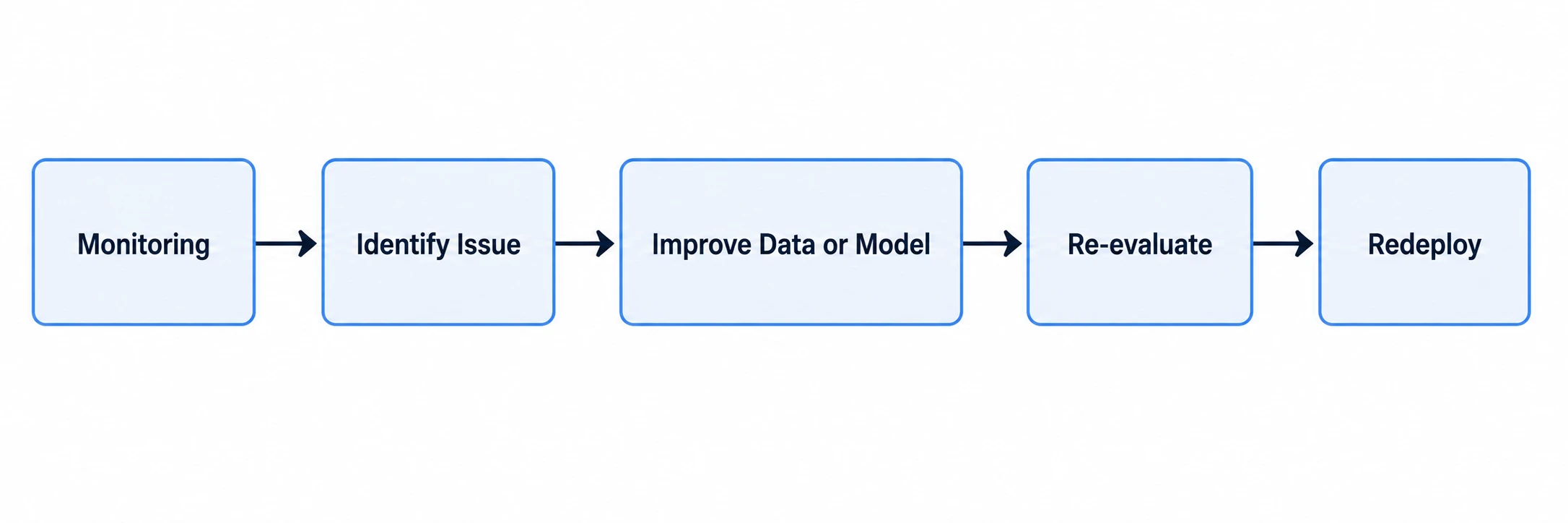
This iterative approach allows AI systems to adapt data, users, business conditions, and technology to change.
Continuous improvement is especially important for Generative AI applications because models, prompts, retrieval sources, and external tools may evolve independently. Treating AI development as a cycle helps teams maintain performance, reliability, and relevance over time.
How the AI Project Cycle Changes for Generative AI
The core AI Project Cycle remains the same for Generative AI, but some activities change significantly.
Traditional machine learning focuses mainly on training data, features, and model performance. Generative AI systems often introduce additional components such as prompts, embeddings, vector databases, retrieval of pipelines, external tools, and AI agents.
For example, a RAG-based application may follow this flow:
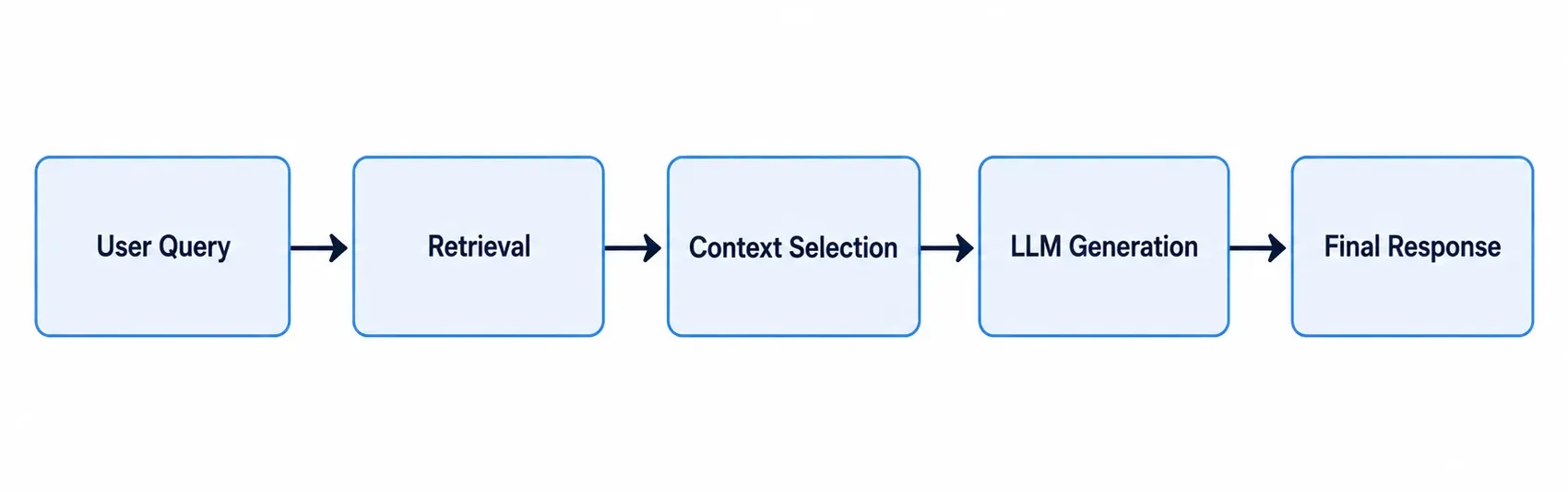
This means teams must evaluate more than just the language model. They should also measure:
- retrieval quality
- prompt effectiveness
- groundedness
- hallucinations
- tool selection
For AI agents, monitoring should additionally cover tool failures, incorrect actions, reasoning loops, and task completion.
As AI systems become more complex, the project cycle becomes increasingly focused on evaluating and improving the complete application rather than a single model.
Common Challenges in the AI Project Cycle
Even with a structured lifecycle, AI projects can fail if key issues are overlooked. Many problems are not caused by the model itself, but by weak problem definition, poor data, unrealistic evaluation, or lack of production planning.
Some common challenges include:
- starting with a technology instead of a business problem
- using incomplete, biased, or low-quality data
- choosing overly complex models too early
- relying on a single evaluation metric
- testing on data that does not reflect real-world conditions
Generative AI systems introduce additional risks such as hallucinations, outdated knowledge, prompt injection, retrieval failures, and unreliable tool usage.
Identifying these challenges early helps teams build AI systems that are more reliable, maintainable, and suitable for production.
Best Practices for a Successful AI Project
A well-defined project cycle improves the chances of building an AI system that works reliably in production. However, teams also need a few practical principles to guide decisions across every stage.
Some important best practices include:
- start with a clearly defined business problem
- establish a simple baseline before adding complexity
- use high-quality and representative data
- define technical and business success metrics early
- track datasets, models, prompts, and experiments
- evaluate both individual components and the complete system
- test edge cases and failure scenarios
- consider security, privacy, and responsible AI from the beginning
- design monitoring and observability before deployment
- use real-world feedback to continuously improve the system
The objective is not to build the most advanced AI architecture possible. It is to create a solution that is accurate, reliable, scalable, cost-effective, and useful to its intended users.
Conclusion
The AI Project Cycle provides a practical framework for taking an AI idea from problem definition to a reliable production system. Each stage plays an important role, from collecting and preparing data to developing, evaluating, deploying, and monitoring the final solution. More importantly, the process does not end after deployment. AI systems must continuously adapt to changes in data, user behavior, business requirements, and technology.
This becomes even more important with Generative AI, RAG, and agentic systems, where multiple components influence the final outcome. A successful AI project is therefore not just about building a good model. It is about creating an end-to-end system that remains useful, reliable, and aligned with real-world goals over time.
Read more: 7 Kimi K3 Features That Make Every Other Model Feel Outdated
Frequently Asked Questions
A. It ensures the team focuses on solving a specific business need rather than just building a model, preventing wasted effort on irrelevant technical solutions.
A. It transforms raw, inconsistent data into a clean, reliable format, allowing teams to identify biases and patterns before training begins.
A. The process is iterative; if evaluation results are unsatisfactory, teams revisit earlier stages like data collection or modeling to refine the system.

Hi, I am Janvi, a passionate data science enthusiast currently working at Analytics Vidhya. My journey into the world of data began with a deep curiosity about how we can extract meaningful insights from complex datasets.
Login to continue reading and enjoy expert-curated content.

💸 Earn Instantly With This Task
No fees, no waiting — your earnings could be 1 click away.
Start Earning
