


I went down another rabbit hole of AI tools a few months ago. But it wasn’t for writing, design, or analytics this time. It was for something outside my expertise: sales.
I’ve never had to hit a sales quota, but I’ve seen the pressure of chasing deals and keeping up with follow-ups. Sales is a constant balancing act of research, outreach, relationship-building, and administrative work that consumes more hours than most people realize. That’s what got me curious about the best AI sales assistant software.
I’d heard claims that these AI sales tools can handle prospecting, draft personalized emails, remind reps to follow up at the perfect time, and predict which deals will likely close. It sounded like the kind of magic sales teams could use, but I wanted to see if the reality lived up to the hype.
Recently, I dug into hundreds of G2 reviews for AI sales assistant software solutions. After evaluating 20+ such tools, I came up with the top eight. These include Agentforce Sales, Gong, HubSpot Sales Hub, Apollo.io, ZoomInfo Sales, Fathom, Instantly, and B2B Rocket.
If you’ve ever lost a deal because a lead went cold while you were buried in admin work, or if you’ve wished for a way to spend more time selling and less time organizing, these AI sales assistants might be exactly what you need.
8 best AI sales assistant software: My picks
- Agentforce Sales: Best for boosting sales productivity and forecasting
Combines AI agents, automation, and CRM data to streamline workflows and improve deal execution. ($125/user/month) - Gong: Best for delivering conversational insights to improve sales performance
Analyzes sales conversations to surface insights, risks, and coaching opportunities. (pricing available on request) - HubSpot Sales Hub: Best for simplifying sales with a user-friendly CRM
Centralizes CRM, automation, and AI tools to manage pipelines and sales activities. ($15/month) - Apollo.io: Best for connecting with prospects using data intelligence and engagement tools
Combines verified contact data, smart filters, and automated sequencing for efficient prospecting. ($49/user/month) - ZoomInfo Sales: Best for a comprehensive B2B contact database to find accurate leads
Provides rich B2B data, intent signals, and filters to target the right prospects.(pricing available on request) - Fathom: Best for AI-driven meeting transcription and highlights
Records meetings and generates instant summaries, transcripts, and action items. ($19/user/month) - Instantly: Best for B2B email outreach with automated campaigns and lead management
Enables high-volume email outreach with automation, warmup, and reply management. ($47/month) - B2B Rocket: Best for AI-driven multichannel outreach and automated lead generation
Uses AI agents to automate outreach, qualify leads, and schedule meetings.($799/month)
*These AI sales assistant software solutions are top-rated in their category, according to G2 Spring 2026 Grid Reports. I’ve also added their pricing to make comparisons easier.
8 best AI sales assistant software I recommend
AI sales assistant software is like having a smart, always-on sales partner that helps manage the busy work so sales teams can focus on closing deals. The AI sales assistant software market is set to surge to $26B by 2035, growing at a 23.7% CAGR as demand for sales automation rises.
While I don’t work in sales, I’ve evaluated various AI-driven tools designed to automate follow-ups, prioritize leads, generate personalized outreach, and analyze deal trends. These tools enhance productivity by handling repetitive tasks, surfacing insights, and ensuring you’re ready to increase sales.
How did we find and evaluate the best AI sales assistant software?
I explored AI sales assistant software at all levels, from basic tools that automate follow-ups and lead prioritization to advanced platforms with AI-driven analytics, predictive insights, conversation intelligence, and seamless CRM integrations. I evaluated their core functionalities and analyzed feedback from sales professionals to gauge real-world effectiveness.
I reviewed hundreds of G2 ratings and explored G2’s Grid Reports to assess accuracy, usability, efficiency, and overall value. After extensive research and combing through user feedback, I’ve compiled a list of the best AI sales assistant software for teams of all sizes.
I also consulted sales professionals with direct experience and verified their insights against trusted G2 reviews. The screenshots in this article include a mix of those sourced from G2 vendor pages and publicly available material.
From what I’ve seen, the best AI sales assistant software pinpoints high-priority leads based on engagement data, suggests personalized follow-ups, and seamlessly integrates with CRMs to organize everything. Some tools analyze past deals to predict which prospects will most likely convert. In short, the best AI sales assistants act like intelligent co-pilots, giving sales teams the insights and automation they need to work more efficiently, close more deals, and stay ahead.
How I evaluated the best AI sales assistant software solutions
Below are the factors I considered while evaluating the best AI sales assistants.
- Core functionality and automation capabilities: When evaluating AI sales assistant software, I first consider its ability to automate and streamline essential sales tasks. The tool should handle lead qualification, follow-ups, meeting scheduling, CRM updates, and sales forecasting. The best AI assistants use natural language processing (NLP) to engage with prospects intelligently, adapting their responses based on previous interactions. If the AI lacks genuine decision-making capabilities and simply automates repetitive tasks without adding strategic value, it’s not worth investing in.
- Integration with existing tech stack: A great AI sales assistant tool integrates seamlessly with your current sales tools. Nobody wants a system that forces them to restructure their workflow or creates data silos. I check if it integrates smoothly with major CRM platforms like Salesforce, HubSpot, or Zoho, and communication tools like Slack, Microsoft Teams, and email clients. Real-time bidirectional data syncing is crucial for accessing updated information without manual data entry.
- Personalization and engagement quality: Personalization is one of the most significant differentiators in sales. Reps need AI beyond generic responses and tailoring interactions based on customer behavior, preferences, and previous conversations. The ideal AI sales assistant software analyzes past engagements and adjusts its messaging to improve conversion rates. If the AI sends standardized, robotic messages, it risks alienating potential customers instead of nurturing them. I also check whether the AI supports multi-channel outreach, including email, chat, and even voice, so you can connect with prospects in their preferred communication style.
- Scalability and performance under load: A sales assistant software should grow with your business. Scalability is crucial because an AI that works well for a small team might struggle under increased demand. I assess how many leads, conversations, and interactions the AI can handle simultaneously without affecting performance. Machine learning capabilities are another consideration because the AI should improve over time rather than remaining static. If the software starts lagging or failing to keep up with an expanding sales pipeline, it’s not a viable long-term solution.
- Analytics and data-driven insights: Beyond automation, teams need AI that provides actionable insights. The software should track and analyze sales performance, lead engagement, and customer behavior, helping refine sales strategy. AI-powered reporting should exceed basic metrics, offering predictive analytics on deal closures and sales trends. If the reporting tools are too basic or lack customization, you might still need to rely on external analytics platforms, which defeats the purpose of having an AI sales assistant.
To be included in the AI sales assistant software category, a product must:
- Support sales teams by automating basic tasks or providing predictive insights
- Utilize embedded artificial intelligence as a main feature
*This data was pulled from G2 in 2026. Some reviews may have been edited for clarity.
1. Agentforce Sales: Best for boosting sales productivity and forecasting
Agentforce Sales (formerly Salesforce Sales Cloud) is a complete growth platform that brings together humans and AI agents at every step of the sales cycle. According to G2 Data, it is used by 46% mid-market teams and 34% enterprises.
Users find it impressive how Agentforce Sales predicts sales trends with AI-driven forecasting. Instead of just generating static reports, it identifies patterns and gives a clearer picture of what might happen next. I can see how this would be useful for sales teams trying to make data-backed decisions instead of relying on instinct. The ability to anticipate changes in the pipeline could help businesses prepare rather than react.
One thing I appreciated about AI-driven sales tools is how they simplify lead management. I’ve observed that Agentforce Sales assigns priority levels to leads based on their engagement and historical data, which seems like a smart way to focus efforts on the right prospects. I imagine this would help sales teams avoid wasting time on leads that are unlikely to convert.
Reviews consistently highlight how Agentforce Sales acts as a single source of truth by bringing together leads, opportunities, customer data, communication tools, and integrations like CPQ, Slack, and third-party apps. This unified ecosystem reduces the need to switch between multiple tools and eliminates data silos.
Users like having AI suggest the best next steps for a deal. G2 reviewers appreciate that Agentforce Sales analyzes ongoing sales activities and offers data-driven recommendations to keep things moving. If a deal is stalling, it can flag potential issues and provide actionable advice.
I’ve noticed how AI in sales software is becoming more personalized, and Agentforce Sales seems to lean into that. Based on previous interactions, it suggests the best way to engage with each prospect. I can see how this would help sales reps avoid sounding robotic or scripted.
There is praise for the platform’s ability to adapt to virtually any sales workflow. Users appreciate how customizable Agentforce Sales is, from pipelines and dashboards to automation rules and data models, allowing teams to tailor the system to their exact business needs.
Pricing can become a challenge, especially as teams scale or require advanced capabilities. Licensing fees, add-ons, and premium features can increase the total cost over time, particularly for organizations with complex needs. Users also recognize that the pricing reflects the platform’s depth, scalability, and enterprise-grade functionality, making it a worthwhile investment for businesses that plan to grow and fully utilize its capabilities.
Agentforce Sales has a feature-rich interface and extensive configuration options, which may take some time for new or non-technical users to get familiar with. Teams may need initial training or admin support to fully navigate the platform. However, once users are up to speed, many find that its structure, automation, and customization capabilities significantly improve efficiency and support more sophisticated sales processes.
Overall, Agentforce Sales stands out as a powerful, scalable platform that brings AI, automation, and customization together to support modern sales teams. For organizations willing to invest in setup and adoption, it delivers long-term value by improving efficiency, visibility, and growth potential.
What I like about Agentforce Sales:
- I find it impressive how Agentforce Sales can predict sales trends instead of just generating static reports.
- The platform automatically ranks leads based on engagement and historical data, and many reviewers say this helps prioritize outreach.
What G2 users like about Agentforce Sales:
“I enjoy how Agentforce Sales allows for efficient tracking of customers through automation. I like that it creates opportunities and contact records automatically when a potential customer is identified, saving us from manual calculations. I appreciate the integration of multiple communication channels like calls, chats, and emails, which helps sales teams collaborate effectively without setting up things separately. I find the feature to use sales email templates with placeholders instead of hard-coding customer information very time-saving. The ability to route work based on sales agent knowledge while maintaining efficiency is great. I also like that the work can be routed to different sales agents based on availability and urgency.”
– Agentforce Sales Review, Saket B.
What I dislike about Agentforce Sales:
- Costs can rise with licensing, add-ons, and advanced features, especially for complex needs. However, many find the pricing justified by its scalability and enterprise-grade capabilities.
- The feature-rich interface and configuration options may require time, training, or admin support for new users. Once adopted, it significantly improves efficiency and supports advanced sales processes.
What G2 users dislike about Agentforce Sales:
“What I dislike about Agentforce Sales is that it can feel complex and overwhelming, especially for new users. The initial setup and customization can take a lot of time and often require a fair amount of expertise. On top of that, the licensing costs can be high for small businesses. With so many features available, the interface can also end up feeling cluttered and less intuitive than I’d like.”
– Agentforce Sales Review, Suhaiv S.
2. Gong: Best for delivering conversational insights to improve sales performance
Gong is a conversational intelligence platform that helps sales teams capture, analyze, and learn from customer interactions. According to G2 Data, it is used by 60% of mid-market teams.
One of the biggest pain points in sales is drafting personalized follow-ups after meetings. With Gong, users don’t have to manually jot down notes or replay entire calls just to extract key details. It automatically summarizes discussions, highlights action items, and sends recaps within minutes. This means users can quickly send impactful follow-ups without second-guessing what was discussed.
Sales forecasting is usually a cumbersome, manual process, but Gong’s forecasting tool makes it much easier. Instead of juggling spreadsheets and back-and-forth emails, users can see real-time insights. It gives them a clear picture of where deals stand and helps them prioritize outreach. You can also quickly see the timeline of engagements and interactions without digging through multiple sources.
Unlike other sales tools that require extensive onboarding, Gong integrates into your workflow almost instantly. I have seen users mentioning that their team didn’t need formal training to use it effectively. Calls are automatically recorded and saved without extra steps, so you can focus on selling instead of dealing with administrative tasks.
When working with multiple stakeholders, details can easily slip through the cracks. With Gong, users can quickly check whether a specific topic was discussed in a previous call. This is particularly useful when aligning with account managers, customer success teams, or other sales reps. You don’t have to rely on secondhand information if a client claims something was promised. You can pull up the exact call and verify what was said.
Gong is widely appreciated for breaking down silos across teams by making customer conversations accessible beyond sales. Marketing, product, and customer success teams can tap into real call data to understand customer needs, objections, and feedback firsthand. Features like easy clip sharing, integrations with tools like Slack and Salesforce, and centralized conversation history help teams stay aligned and make more informed decisions.
Beyond capturing conversations, Gong stands out as a coaching and enablement tool that helps reps continuously improve. Users highlight how they can review their own calls, analyze talk-to-listen ratios, and identify missed opportunities or better ways to handle objections. Managers can also scale coaching by sharing call snippets, reviewing team performance, and providing targeted feedback based on real interactions.
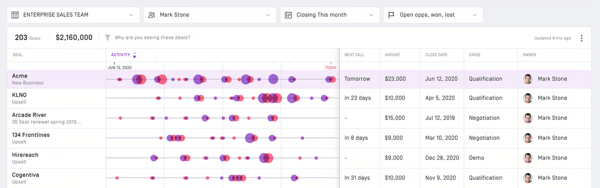
While Gong’s AI-powered insights and summaries are widely valued for saving time, some users note that outputs may occasionally miss context, misattribute speakers, or generate overly generic follow-ups. Transcription accuracy can also vary in complex or fast-paced conversations. That said, many teams view these as manageable trade-offs, often refining outputs as needed while still benefiting significantly from the speed and automation Gong provides.
Gong integrates well with many popular tools, but some reviewers mention gaps when working with less common CRMs or more complex tech stacks. Users have also noted occasional delays or inconsistencies in syncing data across platforms like Salesforce, HubSpot, or meeting tools. However, for teams using widely supported integrations, Gong generally fits smoothly into existing workflows and continues to expand its ecosystem over time.
Overall, Gong stands out as a powerful platform for turning customer conversations into actionable insights that drive better sales outcomes. For teams looking to improve visibility, coaching, and execution, it delivers significant value by making every interaction more measurable and impactful.
What I like about Gong:
- Instead of replaying calls or scrambling to take notes, users get an instant summary with action items. This allows them to send personalized, well-informed follow-ups in minutes.
- G2 reviewers mentioned that they could see real-time insights into their pipeline without juggling spreadsheets or manual reports.
What G2 users like about Gong:
“What I like best about Gong is how it automatically captures and analyzes all sales conversations, giving us deep insights into customer interactions without manual effort. The platform’s analytics and AI‑driven insights help our teams improve messaging, identify risk or opportunity signals, and tailor coaching. Gong integrates smoothly with our CRM and other sales tools, and using it frequently has noticeably boosted team performance and deal outcomes.”
– Gong Review, Hannah L.
What I dislike about Gong:
- While Gong’s AI saves time with summaries and insights, it may occasionally miss context, misattribute speakers, or generate generic follow-ups. These are usually manageable trade-offs given the speed and automation benefits.
- Gong works well with popular tools, but gaps may exist with less common CRMs or complex setups. Some users report sync delays or inconsistencies, though it generally fits smoothly into supported workflows.
What G2 users dislike about Gong:
“While the interface is powerful, the initial setup for mapping complex CRM stages and custom deal warnings can be a bit technical to navigate. I’ve noticed that if multiple people speak at once in a large brainstorming session.”
– Gong Review, Avyan S.
3. HubSpot Sales Hub: Best for simplifying sales with a user-friendly CRM
HubSpot Sales Hub is an AI-powered sales assistant that helps teams manage pipelines, automate outreach, and stay organized in one place. According to G2 Data, it is used by 58% small businesses and 39% mid-market teams.
It offers flexibility in adapting to different sales processes. It doesn’t look like a platform that forces a rigid workflow, which is important for sales strategies that evolve. I would want a system that lets me create pipelines and automation in a way that makes sense for my sales style rather than being stuck with a predefined setup.
I see the appeal of automation for repetitive sales tasks. Things like follow-ups, email sequences, and deal tracking can be time-consuming, so having a system that ensures no lead slips through the cracks sounds valuable. According to G2 Data, 90% users are satisfied with its lead follow-up feature.
When it comes to users, they want a sales platform that provides meaningful insights beyond basic activity tracking, and HubSpot Sales Hub appears to offer that. Access to data on how prospects engage with emails, links, and other content would make it easier to understand their level of interest. Instead of guessing which leads are worth pursuing, you can rely on engagement metrics to make more informed follow-ups.
Sales software must allow users to access detailed reports. HubSpot Sales Hub offers analytics that break down sales performance by individual reps, pipeline stages, and outreach methods. A good system helps identify which strategies work and which need adjustment.
Reviewers frequently highlight how well HubSpot integrates with tools like Gmail, Outlook, LinkedIn, calling platforms, and third-party apps. These integrations ensure that data flows smoothly across systems and help teams maintain a connected workflow without manual syncing.
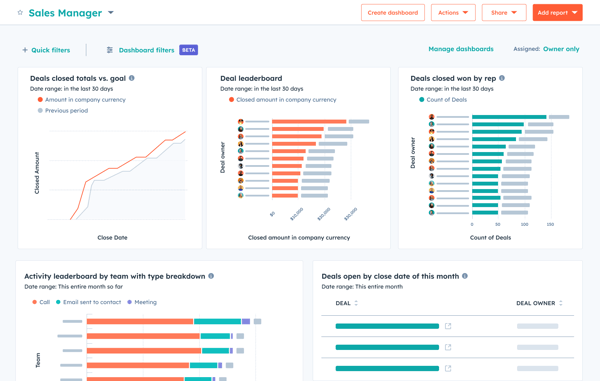
Building highly customized reports or views can require additional setup and configuration. Certain metrics, filters, or layouts may not be immediately available without tweaking, especially for teams with specific reporting needs. Once configured, many teams find the reporting capabilities reliable and effective for tracking performance and guiding decisions.
As teams expand usage to more advanced features, some G2 users note that it may take time to fully configure and optimize workflows, reporting, and processes. This may require initial training or admin support for more complex use cases. However, once set up, the platform is easy to navigate and continues to support efficient, scalable sales operations.
Overall, HubSpot Sales Hub strikes a strong balance between analytics and functionality, making it a reliable choice for teams looking to scale their sales operations.
What I like about HubSpot Sales Hub:
- HubSpot Sales Hub allows flexible sales processes rather than forcing a rigid workflow. It seems like a platform that lets you build pipelines and automation that fit your sales strategy.
- Automation for follow-ups, email sequences, and deal tracking is a big advantage.
What G2 users like about HubSpot Sales Hub:
“I find HubSpot Sales Hub user-friendly and appreciate that it works like any other CRM. The dashboards provide a single window view of my data, which is quite useful. I like the email templates because they are easy to customize and allow for sending bulk emails. The AI-assisted call summary is beneficial as it gives me a simple understanding of call descriptions between leads and my team members, helping in better coordination. The initial setup was smooth, and a proper knowledge transfer was given to the IT team.”
– HubSpot Sales Hub Review, Prashant S.
What I dislike about HubSpot Sales Hub:
- Building highly customized reports or views may require additional setup, as certain metrics, filters, or layouts need tweaking. Once configured, reporting is reliable for tracking performance.
- As teams use more advanced features, workflows, and processes may take time to fully configure and may need initial training or admin support. Once set up, the platform is easy to navigate and scales well.
What G2 users dislike about HubSpot Sales Hub:
“For starters, it’s a little bit complex! Most things are easy to use, but at first, it could be overwhelming! Adding on the cost of Pro or Enterprise tiers, and the limitation in reporting on the Starter plan.”
– HubSpot Sales Hub Review, Rahul P.
Asking sales to do more cold calling? Equip them with the best auto dialers we tested this year.
4. Apollo.io: Best for connecting with prospects using data intelligence and engagement tools
Apollo.io is an AI-powered sales intelligence and engagement platform designed to help teams find high-quality leads, automate outreach, and build a pipeline faster. According to G2 Data, it is used by 66% small businesses and 31% mid-market teams.
Users consistently highlight how easy Apollo.io is to navigate, even for first-time users. The platform’s intuitive design allows sales teams to quickly get started with minimal training, making it accessible for both beginners and experienced reps. This ease of use helps teams adopt the tool faster and stay focused on prospecting and outreach rather than figuring out complex workflows.
I find the idea of AI-powered lead prioritization valuable, especially when working with many prospects. Apollo.io seems to take the guesswork out of deciding who to reach out to by ranking leads based on engagement data. Instead of spending time chasing cold leads, this AI sales assistant helps focus efforts on those most likely to convert.
Email timing and messaging play a huge role in outreach success, and users appreciate how Apollo.io uses AI to optimize this. It analyzes engagement data to predict the best times to reach out and which email styles are most effective. That could mean fewer wasted emails and higher response rates, which every salesperson would appreciate.
Keeping up with leads across multiple platforms can be overwhelming, and the reviews praise how Apollo.io handles that with AI-driven automation. It can manage email sequences, call scheduling, and LinkedIn outreach, which would keep sales teams on track without manual follow-ups.
Users frequently highlight the reliability of Apollo.io’s contact data, including verified emails and phone numbers. Features like data enrichment and waterfall verification help ensure higher accuracy by sourcing and validating information from multiple channels. This reduces time spent on manual validation and increases confidence in outreach
G2 reviewers also like that Apollo.io uses AI to suggest personalized messaging based on a prospect’s background, industry, or past interactions. That sounds useful for keeping emails and messages relevant without spending too much time researching each contact. AI-generated recommendations could help make outreach more effective, especially for teams handling many leads.
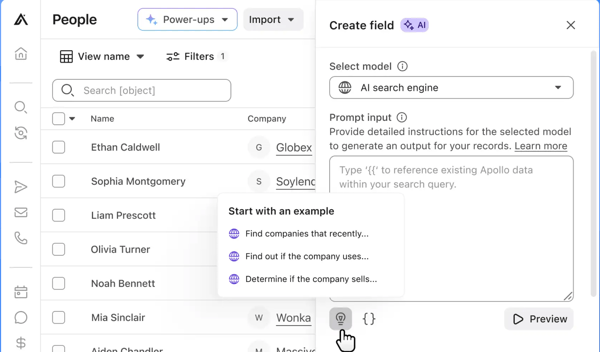
Apollo.io’s AI features are widely appreciated for speeding up outreach and simplifying workflows. Some G2 reviewers note that outputs like email drafts or persona understanding may benefit from further refinement in certain use cases, especially for highly tailored messaging. That said, many teams still find the AI valuable for getting a strong starting point and improving productivity, while customizing outputs as needed.
Certain advanced workflows, such as bulk actions, highly specific filters, or deeper automation triggers, may require additional steps or workarounds. However, for most standard sales use cases, the platform provides a comprehensive toolkit, and it continues to expand its feature set over time.
Overall, Apollo.io stands out as a powerful, all-in-one sales intelligence platform that helps teams find, engage, and convert prospects more efficiently.
What I like about Apollo.io:
- Apollo.io’s AI takes the guesswork out of lead prioritization. Instead of wasting time on cold leads, it helps focus on those most likely to convert.
- It can suggest personalized messaging based on a prospect’s background, industry, or past interactions.
What G2 users like about Apollo.io:
“Apollo.io has been a great tool for prospecting and outreach. The platform is intuitive and easy to navigate, even for those who are newer to sales outreach tools. The contact database is robust and made it straightforward to identify and connect with the right people at target organizations.”
– Apollo.io Review, Misael S.
What I dislike about Apollo.io:
- Apollo’s AI helps speed up outreach and workflows, though some outputs like email drafts or persona understanding may need refinement for highly tailored use cases. Still, it provides a strong starting point and boosts productivity.
- Some advanced use cases (e.g., bulk actions, specific filters, deeper automation) may require extra steps or workarounds. However, the platform remains comprehensive for most sales needs and continues to evolve.
What G2 users dislike about Apollo.io:
“One thing I sometimes find challenging about Apollo.io is that the data accuracy can vary for certain contacts, so it occasionally requires additional verification before outreach. Also, the platform has many features, which is great, but it can feel a little overwhelming at first for new users to navigate and fully utilize everything. A slightly more streamlined interface or clearer onboarding guidance could make the experience even better.”
– Apollo.io Review, Akshata K.
Growing your sales team in 2026? Check out the most important sales KPIs you should track.
5. ZoomInfo Sales: Best for a comprehensive B2B contact database to find accurate leads
ZoomInfo Sales helps teams identify, prioritize, and connect with the right prospects faster by combining a vast B2B contact database with intent signals, insights, and automation. According to G2 Data, it is used by 30% small businesses, 42% mid-market teams, and 29% enterprises.
ZoomInfo Sales makes cold outreach more efficient by providing verified contact information. Rather than wasting time searching for email addresses or phone numbers, users can quickly access a list of prospects more likely to engage. This allows you to scale outreach efforts while maintaining personalization. Additionally, having direct dial numbers means you don’t always have to go through gatekeepers, increasing the likelihood of connecting with decision-makers.
Not all leads are equal, and ZoomInfo helps prioritize high-value prospects, according to G2 reviewers. With firmographic and intent data, I can focus on leads that show signs of being in an active buying cycle. Instead of contacting every contact on a list, you can narrow efforts to those more likely to convert. This means you are increasing volume and improving the quality of your outreach.
Users frequently highlight the depth of company-level insights available in ZoomInfo Sales, including organizational hierarchies, company news, and firmographic data. This helps sales teams understand how companies are structured, identify key stakeholders, and tailor their approach more effectively. Having this level of visibility reduces guesswork and supports more strategic account planning.
I also noticed praise for ZoomInfo’s powerful filtering capabilities, which allow users to narrow down prospects based on criteria like industry, revenue, location, job title, and more. These granular filters make it easier to build highly targeted lists and focus outreach on the most relevant prospects, improving both efficiency and conversion rates.
The AI sales assistant tool is also valued for its automation features and real-time alerts, such as notifications when target accounts show buying signals or visit a website. These proactive updates help teams engage prospects at the right moment, reduce manual tracking, and stay ahead of competitors by acting on timely insights.
Another standout benefit is how easily ZoomInfo integrates with CRM systems like Salesforce and HubSpot. Users appreciate being able to push leads directly into their CRM, enrich data automatically, and keep everything synchronized without manual effort. This streamlines workflows and ensures sales teams can act on insights quickly without switching between tools.
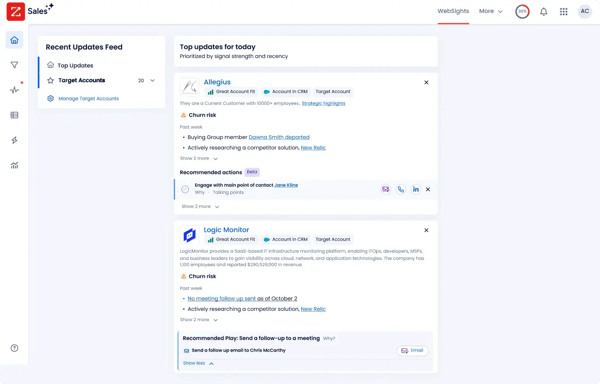
While ZoomInfo offers broad global coverage, some users mention that data availability can vary across certain regions, such as APAC or Europe, and for smaller or emerging companies. In these cases, teams may complement ZoomInfo with additional sources for deeper insights. That said, for mid-market and enterprise segments, the platform continues to provide rich, actionable data that supports effective prospecting.
The platform is widely valued for its extensive and reliable contact data, though some G2 users note that certain records, such as emails, phone numbers, or job roles, may occasionally require verification, especially in fast-changing industries. This can vary for niche roles or smaller organizations. However, many teams still find the data highly dependable overall and use it as a strong starting point for targeted outreach.
ZoomInfo Sales stands out as a robust and insight-driven platform that helps teams identify and engage the right prospects with greater precision. With its strong data foundation, intent signals, and automation capabilities, it remains a valuable tool for scaling modern B2B sales efforts.
What I like about ZoomInfo Sales:
- Instead of spending hours searching for the right email addresses or phone numbers, users can quickly pull up a list of verified contacts that are more likely to respond.
- Not every lead is worth pursuing, and ZoomInfo helps reps focus on the ones that truly matter. With firmographic and intent data, they can prioritize prospects already showing signs of being in a buying cycle rather than reaching out blindly.
What G2 users like about ZoomInfo Sales:
“It makes prospecting much more efficient. Instead of spending hours trying to find the right contacts or verify information, I can quickly identify the right decision-makers and get reliable contact details in one place. I also find the intent data and company insights really helpful because they give context about which companies might actually be in the market for what we offer. Overall, it just helps me focus more on having meaningful conversations with the right people rather than spending most of my time on research.”
– ZoomInfo Sales Review, Sadhwi P.
What I dislike about ZoomInfo Sales:
- While ZoomInfo offers broad global data, coverage may vary for regions like APAC/Europe and smaller or emerging companies. Teams may supplement with other sources, though it remains strong for mid-market and enterprise prospecting.
- ZoomInfo provides reliable contact data, but some records (emails, phone numbers, roles) may need occasional verification, especially in fast-changing or niche segments. Overall, it remains a dependable starting point for outreach.
What G2 users dislike about ZoomInfo Sales:
“Sometimes you’ll get a contact with data that’s off or incorrect, but that’s part of the game. Another thing that would really help is having a timeline on the info—something that shows when the last data pull happened. You end up with a lot of outdated info, which is also part of the game, and it means you still need to source and verify your contacts.”
– ZoomInfo Sales Review, Ryan C.
6. Fathom: Best for AI-driven meeting transcription and highlights
Fathom is an AI meeting assistant that records, transcribes, and summarizes calls so teams can stay focused on the conversation instead of taking notes. According to G2 Data, it is used by 81% small businesses.
The AI in Fathom captures details effectively, even in fast-paced conversations. It ensures that nothing important is missed during sales calls. Users can rely on it to extract meaningful insights without reviewing every call. This level of accuracy makes it a valuable tool for staying on top of sales conversations.
The AI significantly reduces the time reps spend manually capturing and reviewing notes. It allows users to focus more on the sales process than on administrative tasks. This efficiency ensures you can move quickly from one prospect to another without losing track of key details. The time that would have been spent on documentation is now redirected toward engaging with potential clients.
Users highlighted that with Fathom, they don’t have to worry about manually initiating the note-taking process on every call. The AI captures and summarizes conversations automatically. This means you can step into meetings without extra preparation related to note-taking.
G2 reviewers often mention that Fathom runs quietly in the background without disrupting the flow of conversation. I’ve seen several users say it helps keep interactions natural, without making clients feel like they’re being monitored or analyzed in real time. That non-intrusive design seems to make it easier to build rapport without awkward interruptions from the software.
After the call, many users appreciate being able to rely on AI-generated notes instead of combing through full recordings. I noticed a lot of feedback about how this improves the accuracy of follow-ups—since you can reference the actual points discussed, not just what you remember or managed to jot down during the meeting.
Fathom is also valued as more than a note-taking tool. Reviewers mention features like talk-time tracking, monologue alerts, highlights, and team sharing as especially helpful for coaching and internal alignment. Sales managers and individual reps can use these insights to improve call quality, while teams can share recordings, action items, and takeaways more easily across sales, customer success, and leadership.
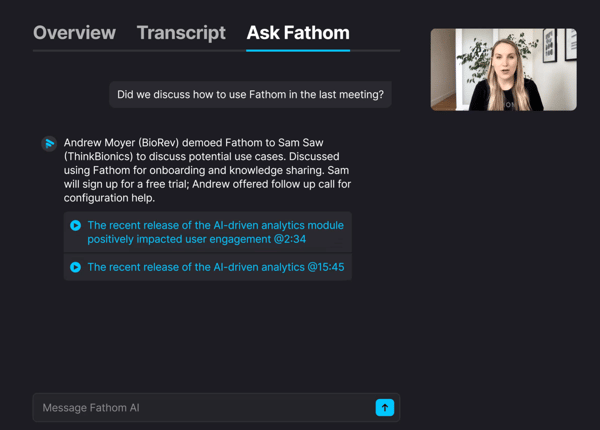
Fathom integrates seamlessly with major meeting platforms, CRMs, and project management tools, making it easy to fit into common sales workflows. However, some G2 users note that support for additional tools, such as phone systems, messaging platforms like WhatsApp, or niche CRMs, could be expanded to better match diverse tech stacks. That said, for teams using widely supported platforms, Fathom delivers a smooth and reliable experience, and its ecosystem continues to grow over time.
In more complex or technical conversations, some users mention that transcripts, speaker attribution, or summaries may benefit from slight refinement or customization. However, most teams still find the outputs highly useful as a strong foundation, often reviewing or tailoring them as needed while benefiting from significant time savings and improved productivity.
Overall, Fathom stands out as a highly efficient AI meeting assistant that simplifies note-taking and keeps teams aligned after every call. With its ease of use, fast insights, and growing capabilities, it continues to be a valuable tool for improving productivity and collaboration.
What I like about Fathom:
- The AI in Fathom captures details accurately, even in fast-paced conversations. Users don’t have to worry about missing key points during sales calls.
- The AI handles note-taking automatically, which helps them stay focused on selling rather than getting bogged down by admin work. It’s frequently mentioned as a major time-saver during calls.
What G2 users like about Fathom:
“I really love how the app automatically prepares me for my next meeting. The initial setup is very easy, and you honestly don’t have to do anything else as long as the app is installed. The support I received when I needed it was amazing; they gave me exactly what I needed. I use it daily, and it never fails. Even though the number of features depends on the plan, the purpose of the app is great, and it integrates perfectly with the tools we use, like Zoom or Google Meet.”
– Fathom Review, Derwin V.
What I dislike about Fathom:
- Fathom integrates well with major meeting tools, CRMs, and workflows, though support for phone systems, messaging platforms, and niche tools could expand. It still works smoothly for most common setups and continues to grow.
- In complex conversations, transcripts, speaker attribution, or summaries may benefit from slight refinement. Even so, they provide a strong starting point, helping teams save time and improve productivity.
What G2 users dislike about Fathom:
“Sometimes the Fathom icon to add it to the room does not appear; I have to manually add it, and sometimes it still won’t appear. Sometimes it takes a while to appear in the waiting room. Maybe I am doing something wrong. Sometimes the notes aren’t the most accurate. Like it doubled the price I was giving to my client… maybe that was a sign to raise my prices, haha. It can be a little overwhelming knowing all the features and how to utilize them properly.”
– Fathom Review, Courtney B.
7. Instantly: Best for B2B email outreach with automated campaigns and lead management
Instantly helps teams with cold email and outbound automation and is designed to help teams scale outreach without compromising deliverability. According to G2 Data, it is used by 96% small businesses.
I’ve seen a lot of G2 reviewers appreciate how Instantly automates follow-ups. You don’t have to manually track when to send the next message as the platform takes care of it, helping users maintain consistent outreach without the need to remember every interaction.
Users consistently highlight Instantly’s strong deliverability infrastructure, including inbox rotation, domain warm-up, and reputation management. These features work in the background to ensure emails land in primary inboxes rather than spam, even when running campaigns at scale.
The reporting features also come up frequently in reviews. Users mention that Instantly provides clear insights into email performance, including open rates, reply rates, and other key metrics. I noticed several reviewers say this makes it easier to refine their outreach strategy based on real data instead of guesswork.
Instantly’s AI automatically reads incoming replies and categorizes them (e.g., interested, not interested). This helps sales teams quickly prioritize high-intent leads and respond faster. By reducing manual sorting and follow-up effort, it improves efficiency and ensures no important conversation is missed.
Another standout feature is how Instantly leverages AI to personalize emails at scale. According to users, this helps make cold outreach feel more tailored without spending hours on customization. It’s a common theme that this level of personalization improves engagement and helps messages come across as more authentic. 91% users have expressed their satisfaction with the AI text generation feature on G2.
Users frequently mention the Unibox feature, which consolidates all campaign replies into a single, organized view. This makes it easier to manage conversations across multiple campaigns, track engagement, and maintain consistent follow-ups without switching between accounts or tools.
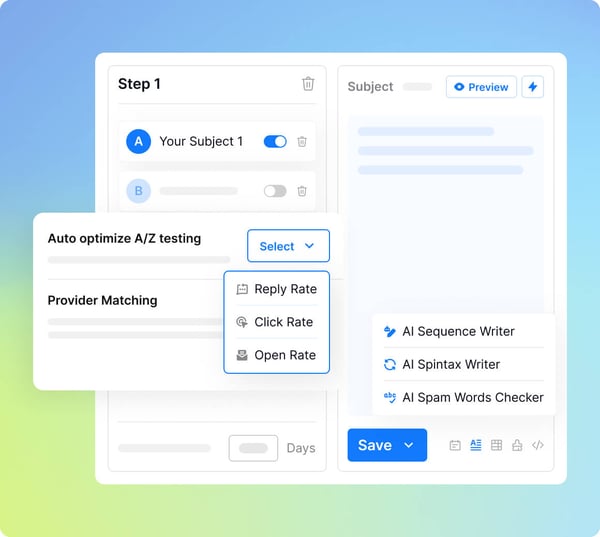
Instantly offers strong value with its all-in-one outbound capabilities, but some G2 users note that costs can increase as usage grows, especially when combining multiple modules like sending, lead generation, and CRM features. Pricing tiers may also require closer evaluation to fully understand what’s included at each level. That said, many teams find the investment worthwhile given the platform’s ability to scale outreach efficiently and generate consistent pipeline.
Deeper visibility into email performance, like more detailed deliverability dashboards or sender reputation insights, would further enhance campaign optimization. However, the platform continues to deliver strong results, with many teams successfully maintaining healthy inbox placement and improving outreach performance.
Overall, Instantly stands out as a powerful and efficient outbound platform that simplifies cold email at scale. With its strong automation, deliverability features, and growing AI capabilities, it continues to help teams generate pipeline faster and more consistently.
What I like about Instantly:
- Instantly handles follow-ups automatically, which saves time and removes the need to track every interaction manually.
- The tool provides clear performance metrics like open and reply rates. This makes it easier to make informed decisions instead of guessing what’s working in your campaigns
What G2 users like about Instantly:
“What I like most about Instantly is its smart campaign orchestration and planning. It helps structure outreach in a way that feels organized and efficient, so I do not have to constantly think through every detail manually. It saves mental energy, keeps the workflow clear, and makes campaign execution much easier.”
– Instantly Review, Konstantīns S.
What I dislike about Instantly:
- Costs can increase with usage, especially when combining modules like sending, lead generation, and CRM. Pricing tiers may need closer evaluation, though many find it worthwhile for scaling outreach and pipeline.
- More detailed dashboards and sender reputation insights could enhance visibility into email performance. Still, teams report strong inbox placement and consistent outreach results.
What G2 users dislike about Instantly:
“Nothing much, really, maybe just the reporting part could be perfected. The analytics are good for the basics (opens, clicks, replies), but I’d love to see more granular reporting and advanced behavioral triggers for automations.”
– Instantly Review, Alla L.
8. B2B Rocket: Best for AI-driven multichannel outreach and automated lead generation
B2B Rocket is an AI-driven sales automation platform. By combining AI agents, multichannel automation, and contact data in one system, it helps businesses scale prospecting while keeping outreach personalized and organized. According to G2 Data, it is used by 88% small businesses.
The tool receives praise for its AI-powered outreach that feels genuinely human. Instead of sounding robotic or overly scripted, the platform’s AI can carry on personalized conversations, respond in a professional tone, and adapt to a company’s brand voice. This helps teams scale outreach without losing the human touch that is so important in B2B relationship-building.
Users consistently highlight B2B Rocket’s ability to automate repetitive sales tasks like prospecting, follow-ups, lead qualification, and meeting scheduling. Rather than spending hours manually moving leads through the funnel, teams can rely on the platform to keep outreach active in the background.
A major advantage mentioned in G2 reviews is how simple B2B Rocket is to get started with. Users describe the platform as intuitive, beginner-friendly, and easy to navigate, even for teams without deep technical expertise. From launching campaigns to training AI agents and reviewing analytics, the overall experience feels approachable, which helps teams adopt the platform quickly.
B2B Rocket brings multiple channels together in one place, including email, LinkedIn, calls, SMS, and even WhatsApp in some cases. Having outreach, conversations, scheduling, and lead tracking centralized reduces the need to juggle multiple tools.
The platform’s contact database, enrichment tools, and filtering options are key strengths. G2 reviewers mention that B2B Rocket helps them find decision-makers faster, validate contact information, fill in missing CRM data, and target prospects more precisely using firmographic and intent-based signals.
B2B Rocket gives teams the visibility and flexibility they need to grow. Users value the clear dashboards, campaign analytics, A/B testing insights, and reporting that help them optimize performance. At the same time, reviewers note that the platform scales well for larger teams, supports multiple agents and users, and is backed by responsive customer support that makes onboarding and ongoing use much smoother.
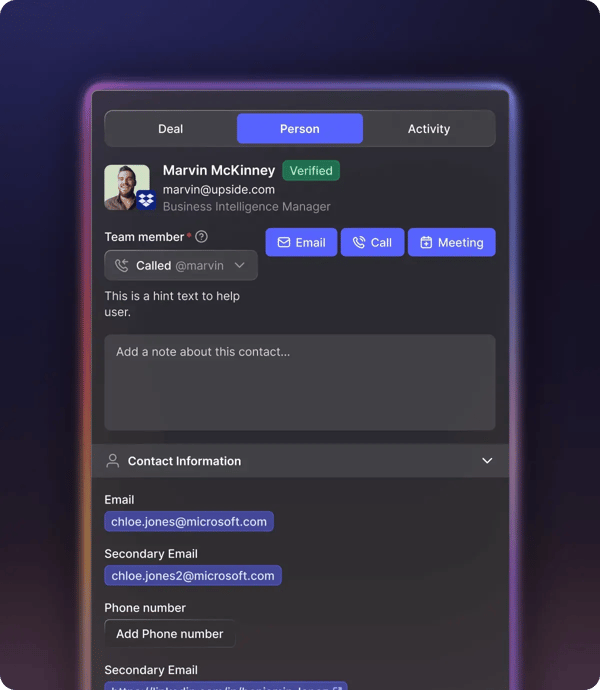
B2B Rocket delivers a broad mix of AI agents, multichannel outreach, and automation in one platform, but some users note that costs can feel higher for small businesses or startups, especially when adding advanced features or additional agents. Many teams still view the investment as worthwhile because of the time savings, automation, and revenue impact the platform can deliver.
Some users noted occasional lag, minor glitches, or short delays in syncing and validation, particularly during more intensive workflows. In most cases, these appear to be manageable rather than disruptive, and teams continue to use the platform successfully for day-to-day outreach.
Based on my evaluation, B2B Rocket stands out as a powerful AI-driven platform that helps teams scale outreach while maintaining a personalized approach.
What I like about B2B Rocket:
- AI agents handle prospecting, follow-ups, and conversations in a way that feels natural and human.
- B2B Rocket brings everything into one place, making it easier to manage campaigns, track performance, and stay organized.
What G2 users like about B2B Rocket:
“It is very approachable, with a clean and intuitive dashboard that makes managing AI agents easy. Training the agents to reflect our brand’s voice was simple, and deploying them across various channels was hassle-free. The customer support team is outstanding—patient, knowledgeable, and quick to respond, which made the entire process much smoother. The platform supports multiple AI agents simultaneously, allowing us to cover different aspects of customer engagement efficiently.”
– B2B Rocket Review, Eurie jay P.
What I dislike about B2B Rocket:
- Costs can feel higher for small businesses, especially with advanced features or additional agents. However, many find it worthwhile due to strong automation, time savings, and revenue impact.
- Some users report occasional lag, minor glitches, or syncing delays in intensive workflows. These are generally manageable, and the platform remains reliable for daily outreach.
What G2 users dislike about B2B Rocket:
“The pricing is quite high for solo VAs or small teams, and there is a learning curve at the beginning. Some features are not very intuitive and take time to fully understand.”
– B2B Rocket Review, Pratiwi S.
Best AI sales assistant software: Frequently asked questions (FAQs)
Got more questions? G2 has the answers!
1. What are some affordable AI sales assistants for medium businesses?
Apollo.io, Instantly, and HubSpot Sales Hub are good options because they combine multiple sales functions in one platform, reducing the need for extra tools and keeping costs manageable.
2. What AI software is most effective for improving sales?
Agentforce Sales, Gong, and B2B Rocket are highly effective since they use AI for forecasting, conversation insights, and automated outreach, all key areas directly impacting revenue.
3. What are the best AI sales assistant software for small business?
Apollo.io, HubSpot Sales Hub, and Fathom work well for small teams because they are easy to use, quick to implement, and don’t require heavy technical setup.
4. What is the best AI tool for enhancing sales process?
HubSpot Sales Hub, Agentforce Sales, and B2B Rocket stand out as they support the full sales cycle, from lead tracking to automation and decision-making.
5. What are the best-rated AI sales assistant tools?
Agentforce Sales, Gong, HubSpot Sales Hub, Apollo.io, ZoomInfo Sales, Fathom, Instantly, and B2B Rocket are all top-rated on G2, covering different sales use cases.
6. Which is the best sales AI software according to reviews?
According to G2 review-based rankings, tools like Agentforce Sales, HubSpot Sales Hub, Gong, Apollo.io, and ZoomInfo are consistently recognized for usability, data quality, and performance.
7. What are the most recommended AI service for sales teams?
Gong, HubSpot Sales Hub, and B2B Rocket are widely recommended because they improve team productivity, collaboration, and pipeline visibility.
8. What are the top-rated AI app for sales?
There’s no single “top” app. Gong excels in insights, HubSpot in CRM simplicity, Apollo in prospecting, and Instantly in outreach, making each strong for different needs.
9. What’s the top AI sales app for increasing leads?
Apollo.io, ZoomInfo Sales, Instantly, and B2B Rocket are strong choices because they focus on lead generation, targeting, and outreach automation.
10. Which AI sales assistant software do other businesses use?
Businesses commonly use a mix of tools like HubSpot Sales Hub for CRM, Gong for insights, Apollo.io or ZoomInfo for data, and Instantly or B2B Rocket for outreach, depending on their sales strategy.
11. Which AI sales tool is best for email personalization?
For AI-driven email personalization, Instantly and Apollo.io offer automated, tailored email sequences based on prospect behavior. HubSpot Sales Hub provides AI-powered email tracking and customization, while ZoomInfo Sales enriches contact data to improve targeting.
Think all AI sales tools are helpful? Think again!
I get the hype after diving deep into AI sales assistant software solutions. The best ones make selling easier. They take the pressure off by handling tedious admin work, surfacing the best leads, and nudging you at the right moment so you don’t miss an opportunity. Instead of drowning in follow-ups, spreadsheets, and CRM updates, you can focus on what moves the needle: closing deals and building relationships.
But not every AI tool lives up to its promise. Some are more of a headache than a help, adding unnecessary notifications or delivering insights that don’t make a difference. That’s why it’s important to pick a tool that fits your workflow, not one that forces you to change how you sell. Look for an AI sales assistant that provides real value, whether that’s by saving you time, improving forecasting, or helping you engage leads more effectively. If it feels like another thing to manage, it’s probably not right.
At the end of the day, AI should work with you, not against you. The right AI sales assistant keeps you ahead of your pipeline, sharpens your strategy, and lets you focus on what you do best: selling. Choose wisely, and you’ll spend less time buried in busy work and more time winning deals.
Want to close more deals this year? Learn how G2 helps you create compelling, persuasive proposals that close business.

💸 Earn Instantly With This Task
No fees, no waiting — your earnings could be 1 click away.
Start Earning
