


If you’re a small- to mid-sized business selling into big-box retailers or major partners, you already know the pressure: electronic data interchange (EDI) isn’t optional; it’s a requirement. But choosing the right and best EDI software? That’s where things get complicated.
Questions pile up fast: How quickly can I get up and running? Will it integrate with my ERP or accounting software? What will I actually pay once transaction fees are factored in? And can it handle all my trading partners without constant IT support?
As someone who spends a lot of time researching and comparing B2B software, I wanted to make this decision easier. I reviewed 20+ software solutions on G2, comparing their features, reviews, and user ratings to identify the ones that actually deliver on fast partner onboarding, reliable ERP integrations, and support that doesn’t leave you stranded mid-implementation.
My top picks are SPS Commerce Fulfillment EDI, Celigo, TrueCommerce EDI, AWS Transfer Family, and eZCom Software EDI. Whether you’re adopting EDI to meet a customer requirement, replacing a legacy provider, or looking to streamline B2B transactions, this guide will help you evaluate the top options and identify the best fit for your business.
5 best EDI software for 2026: My top picks
- SPS Commerce Fulfillment EDI: Best for multi-retailer EDI fulfillment
Connects suppliers to thousands of prebuilt retailer trading partners with built-in compliance management, ASN automation, and ERP integrations. (Custom pricing) - Celigo: Best for ERP integration and workflow automation
Offers prebuilt Integration Apps for NetSuite, Shopify, and Salesforce alongside a visual flow builder to automate order-to-cash and procure-to-pay processes. (Custom pricing) - TrueCommerce EDI: Best for mid-sized enterprises and wholesale businesses
Combines EDI document exchange with product information management and B2B eCommerce capabilities, backed by prebuilt trading partner connections for retailers. (Custom pricing) - AWS Transfer Family: Best for cloud-native file transfers within the AWS ecosystem
Provides fully managed, serverless SFTP, FTPS, FTP, and AS2 transfers that integrate directly with Amazon S3 and EFS. (Custom pricing) - eZCom Software EDI: Best for small to mid-sized businesses needing hands-on support
Handles X12 and EDIFACT compliance, batch processing, ASN and invoice automation, and label creation. (Custom pricing)
*These best EDI software are top-rated in their category, according to the latest G2 Summer 2026 Grid Report.
5 best EDI software I recommend in 2026
The electronic data interchange (EDI) market is projected to grow from $34.02 billion in 2024 to $74.36 billion by 2031. The market is anticipated to register a CAGR of 11.9% during 2025–2031.
Before comparing EDI software, I found it helpful to understand that not all platforms solve the same business challenges in the same way.
What separates one EDI solution from another is how it handles implementation, integrations, partner onboarding, and ongoing management. Some platforms focus on helping small and midsize businesses meet retailer compliance requirements quickly, while others offer advanced automation, managed services, or deeper ERP integrations for larger organizations.
As I analyzed product information and verified G2 reviews, I noticed buyers consistently evaluated EDI software based on a few key factors: ease of setup, support for existing trading partners, integration capabilities, automation features, pricing transparency, and the quality of customer support. These factors often had a greater impact on long-term satisfaction than the ability to exchange documents alone.
How did I find and evaluate the best EDI software?
I started by reviewing G2’s 2026 Grid Report for EDI software, in which verified users share feedback on implementation, integrations, support quality, pricing, automation, and day-to-day usability.
Since I couldn’t test each platform firsthand, I focused on evaluating the experiences of users who work with these tools regularly. I analyzed G2 review data to identify recurring themes across the category, including ease of setup, trading partner support, ERP and accounting integrations, document automation, customer service, and pricing transparency.
I also used AI to help analyze review patterns at scale. This helped me surface common strengths, recurring limitations, and buyer-relevant tradeoffs faster across more than 1,000 G2 reviews. I then reviewed those themes myself to ensure the final recommendations reflected real user feedback, product capabilities, and practical buying considerations.
All product screenshots featured in this article come from official vendor G2 pages and publicly available materials.
What makes the best EDI software worth it: My selection criteria
While comparing different EDI platforms, I kept returning to a core set of criteria that consistently distinguished the best tools from the rest.
- Reliable integrations with ERPs and accounting systems: Even good EDI tools can fall short if they don’t connect reliably to platforms like QuickBooks Enterprise, NetSuite, SAP, or legacy Oracle ERPs. I looked for providers that offer prebuilt connectors, REST APIs, or robust middleware support to automate the syncing of purchase orders, invoices, shipping notices, and payment remittance files.
- User-friendly interface and setup: Many small and mid-sized teams don’t have a dedicated EDI coordinator or IT department. I paid close attention to platforms with clean, modern dashboards, step-by-step partner set-up workflows, and intuitive mapping tools that don’t require specialized EDI consultants to get started.
- Support for major EDI standards and protocols: Different customers and trading partners often mandate specific formats and transport methods. I looked for software that supports ANSI X12 (common in North America), EDIFACT (global), and older standards like TRADACOMS. Protocol support for AS2, SFTP, FTP, and VAN connectivity was also important to ensure you have the flexibility to meet each partner’s requirements.
- Responsive, knowledgeable customer support: A recurring theme in G2 reviews is the cost of waiting days for help when a critical document fails. I favored vendors that offer clear SLAs, 24/7 technical support options, and dedicated onboarding assistance so you’re not left in the dark when something goes wrong.
- Scalability for growing transaction volumes: Some EDI tools work fine for a few hundred transactions a month, but struggle when you scale up to thousands of documents or expand to multiple warehouses. I looked for platforms built on modern cloud infrastructure with load balancing and performance monitoring to handle growth without delays or instability.
- Cloud-based or hybrid deployment options: I considered whether each platform offered fully cloud-hosted services or hybrid models that integrate with on-premises systems. Cloud-based EDI is usually faster to deploy, simpler to maintain, and offers automatic updates and security patches, which is especially helpful for smaller teams.
- Built-in compliance and audit features: Many businesses need to meet regulatory standards such as SOC 2, HIPAA, and GDPR. I prioritized solutions with encrypted data transmission (TLS/SSL), secure data storage, detailed audit logs, and role-based access controls to help demonstrate compliance during audits.
- Support for labeling and advanced shipping notices (ASNs): Retail and distribution partners often require ASNs and standardized barcode labels, such as GS1-128 (UCC-128). I included this as a must-have because failing to meet labeling requirements can result in chargebacks or shipment delays.
- Trading partner onboarding and mapping flexibility: Onboarding new trading partners can take weeks if the EDI platform doesn’t offer prebuilt templates or a flexible mapping tool. I looked for solutions that simplify mapping different document formats and speed up partner onboarding without requiring specialized consultants for every change.
The list below contains genuine user reviews from the EDI Software category on G2. To be included in this category, a solution must:
- Provide a secure data exchange between a defined network of computers
- Offer document mapping and project planning tools to help automate and optimize data transfers
- Offer robust security measures such as encryption, digital signatures, and secure authentication to protect data in transit.
- Support automated workflows and business rules to streamline data exchange processes
- Facilitate various communication protocols for transmitting data, such as AS2, FTP, SFTP, VAN, and email
*This data was pulled from G2 in 2026. Some reviews may have been edited for clarity.
1. SPS Commerce Fulfillment EDI: Best for multi-retailer EDI fulfillment
As I analyzed G2 reviews and product information, SPS Commerce Fulfillment EDI consistently stood out as one of the most established solutions in the category. It was also the highest-ranked product in the latest G2 Grid® Report for EDI software, earning strong scores for both satisfaction and market presence. Many teams described it as the “default” choice when you need something proven and battle-tested, especially in retail, consumer goods, and wholesale.
One of the standout things I learned is that SPS has an enormous network of prebuilt connections with thousands of retailers, grocers, and distributors. So if you’re a supplier who needs to meet a specific retailer’s EDI requirements, say, Walmart, Amazon, or Costco, this platform already has the mappings and specs in place. That can save a ton of onboarding headaches.
SPS also has pre-built integrations with major ERP tools, accounting, and other software like NetSuite, Microsoft Dynamics 365, QuickBooks, Shopify, SAP, and more. Several users mentioned how helpful it is to have standardized templates and workflows that keep purchase orders, invoices, and advance shipping notices flowing without manual intervention.
Another strength that stood out during my review analysis is compliance management. Retailers often impose strict requirements for formatting, labeling, and document submission, and SPS Commerce helps businesses stay compliant by proactively identifying issues before they lead to chargebacks or rejected transactions. For companies managing multiple retail relationships, this can reduce administrative overhead and compliance-related risks.
G2 reviews note that SPS automates the sending and receiving of purchase orders, eliminating manual entry and reducing the human error that can lead to fulfillment penalties. The error-alert system notifies teams when a document issue arises, allowing corrections before fines are triggered.
The platform’s fulfillment monitor, with notification setup, filtering, and real-time reporting, gives teams clear visibility into EDI transaction status across all trading partners. G2 reviewers note that it significantly reduces the time spent troubleshooting document errors.
On the feature side, the highest-rated aspects were data exchange, EDI standards support, and communication protocols, all scoring around 91% or above. That lines up with what you’d expect from a mature EDI vendor. It handles core functionality reliably and gives you the flexibility to meet different customer requirements.
That said, some users reported that onboarding new trading partners or implementing complex integrations can take longer than expected, particularly when custom mappings or legacy ERP environments are involved. However, many reviewers noted that the additional setup effort ultimately helped create more stable long-term workflows.
Pricing was another concern mentioned by some reviewers, reporting that SPS Commerce may be more expensive than some alternatives. This can be challenging for smaller businesses with lower transaction volumes. However, many users also indicated that the platform’s extensive trading partner network, compliance support, and managed services helped justify the investment over time.
Overall, if you’re in consumer goods, retail, or wholesale and you’re looking for an EDI platform that’s stable, comprehensive, and trusted by many big trading partners, SPS Commerce Fulfillment EDI is hard to ignore, with a 4.3/5 rating on G2. I’d recommend SPS Commerce Fulfillment EDI for companies that expect to scale their EDI operations significantly or already have established relationships with major retailers.
What I like about SPS Commerce Fulfillment EDI:
- I really like how many prebuilt retail connections SPS offers, as well as its compliance. Users on G2 have observed that it saves a ton of time when working with large customers with strict requirements.
- Compliance monitoring catches document issues before they lead to chargebacks. Rather than discovering a penalty after the fact, SPS flags problems proactively so teams can correct errors while there’s still time.
What G2 users like about SPS Commerce Fulfillment EDI:
“Its vast retail network and user-friendly interface. Since they are already connected with major retailers, onboarding new partners is incredibly fast. Plus, the platform is so intuitive that anyone on our team can easily manage POs and invoices without advanced EDI knowledge.”
– SPS Commerce Fulfillment EDI review, Christie K.
What I dislike about SPS Commerce Fulfillment EDI:
- Skimming through G2 feedback, I noticed that implementation can take longer than you might expect, particularly if you have an older ERP or need extensive custom mapping.
- According to a bit of user feedback I saw, SPS can be a bit expensive. So smaller businesses might want to take a closer look at the costs to make sure they fit their budget. But it definitely delivers on value once everything is up and running.
What G2 users dislike about SPS Commerce Fulfillment EDI:
“There is a premium cost to having an all-in-one solution. Support was recently consolidated into a single inbox/e-mail and has become much slower as a result. There aren’t a lot of ad hoc solutions for problems with EDI, so when something is wrong, it can be difficult, or even impossible, to correct in the integration, and often ends up having to be resolved in a heavily manual way in the fulfillment portal.”
– SPS Commerce Fulfillment EDI review, Mark V.
Businesses exchange massive volumes of transactional data every day. Explore the latest big data statistics to understand how growing data volumes are shaping automation, integration, and digital transformation initiatives.
2. Celigo: Best for ERP integration and workflow automation
Celigo is a little different from the more traditional EDI players like SPS or TrueCommerce. It started as an integration platform (iPaaS), and you can feel that DNA throughout the product. What jumped out to me right away is how much attention Celigo has put into making integrations feel accessible, even if you don’t have a big technical team.
Celigo’s extensive library of prebuilt Integration Apps really impressed me. These managed integrations connect popular platforms such as NetSuite, Shopify, Salesforce, Amazon, and other business systems without requiring extensive custom development. Many reviewers highlighted how these preconfigured integrations helped accelerate deployment and reduce implementation complexity.
Beyond EDI document exchange, the platform helps automate business processes such as order-to-cash, procure-to-pay, inventory synchronization, and customer data management. For growing businesses, this can eliminate manual work across multiple departments while improving data consistency. The platform earns standout ratings for communication protocols (97%), data mapping (96%), and third-party integration (95%), highlighting its ability to connect systems and automate data exchange reliably across the business ecosystem.
If you need more flexibility, you can use their flow builder, a visual drag-and-drop tool for creating custom integrations. I found that many reviewers appreciated the balance between accessibility and flexibility. Business users can configure many workflows without code, while technical teams can still build more advanced integrations when needed.
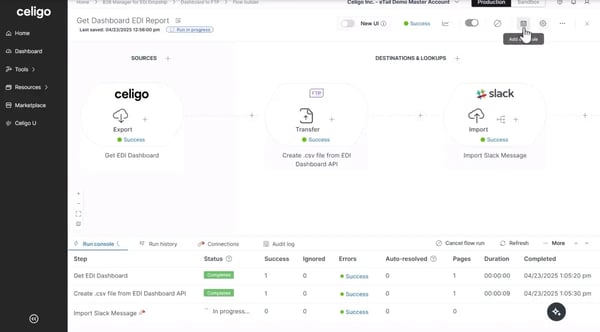
Another area where Celigo shines is its marketplace. This feature offers reusable workflows and preconfigured connectors that simplify common integration scenarios. Rather than building flows from scratch, teams can start with a template and customize from there, reducing both implementation time and the risk of configuration errors.
I also noticed some positive remarks around Celigo’s real-time and batch integrations. This feature, as reviewers explain, gives teams the flexibility to choose how data moves between systems based on operational requirements, whether they need immediate updates or scheduled synchronization. For high-volume eCommerce and EDI workflows running simultaneously, that flexibility is a genuine operational advantage.
Customer support emerged as another major strength. Multiple reviewers praised the responsiveness and expertise of Celigo’s support team, particularly during implementation and troubleshooting. For businesses managing complex integrations, access to knowledgeable support can significantly reduce downtime and speed up issue resolution.
While Celigo provides detailed monitoring and logging tools, some users reported that certain error messages can lack context, making troubleshooting more time-consuming in complex workflows. However, many reviewers also noted that the support team is often quick to help resolve these issues.
Pricing also came up as a consideration. It can get a little expensive once you start adding advanced features and extra connections. Still, most users felt those drawbacks were a fair trade for the faster implementation and the flexibility the platform brings to growing teams.
On G2, Celigo earned an average rating of 4.6 out of 5. Consumer goods, retail, and apparel companies often appear in reviews, and many teams said Celigo helped them finally move away from manual EDI processes without needing a large IT department. On the whole, I’d recommend Celigo if you’re a fast-growing business that wants a cloud-first EDI and integration solution without all the complexity of old-school systems.
What I like about Celigo:
- I really like how Celigo combines EDI with modern integration capabilities. It feels more like an all-in-one hub than just a document exchange tool. That all-in-one experience is something G2 reviewers frequently highlight, especially when comparing Celigo to more traditional EDI platforms.
- The prebuilt connectors and templates to link systems like NetSuite, Shopify, and Salesforce seem like a huge time-saver. Those out-of-the-box integrations are a major draw for users who want to speed up implementation.
What G2 users like about Celigo:
“I am not an IT person, but the integration to NetSuite is intuitive and easy to use. We’ve been using Celigo as our NetSuite connector for 3 years, and its performance has been smooth and intelligent. When I get stuck, the tech support is exceptional and very timely. Pricing for our small implementation is reasonable.”
– Celigo review, Pete K.
What I dislike about Celigo:
- I found that some error messages can be difficult to interpret in complex integration scenarios. While the platform provides monitoring and logging capabilities, troubleshooting occasionally requires additional investigation.
- Several reviewers also mentioned that costs can rise as businesses expand their integration footprint or adopt advanced functionality. The tradeoff is that many organizations reported significant time savings and operational efficiencies that helped offset those additional expenses.
What G2 users dislike about Celigo:
“Struggles with workflows spanning multiple systems + conditional logic + transformations”
– Celigo review, Kamlesh C.
TrueCommerce vs. SPS Commerce Fulfillment EDI: Which is the best?
If you’re trying to choose between SPS Commerce and TrueCommerce, you’re definitely not alone. These are two of the biggest names in EDI.
On G2, both get solid marks from users across the board. TrueCommerce scores slightly higher for meeting requirements and ease of administration, while SPS stands out slightly more for information tracking and overall scalability.
It’s also worth noting who’s using each platform. SPS Commerce shows up most often in reviews from consumer goods, retail, and wholesale companies. TrueCommerce has a similar footprint but also gets plenty of feedback from manufacturing and distribution teams.
To dig deeper, see side-by-side ratings, and read firsthand experiences from real users, explore G2’s detailed comparison page for TrueCommerce EDI vs. SPS Commerce Fulfillment EDI.
3. TrueCommerce EDI: Best for mid-sized enterprises and wholesale businesses
If you’re looking for an established EDI platform that’s often seen as a strong alternative to SPS Commerce, TrueCommerce is worth a serious look. It has built a reputation for being reliable and genuinely user-friendly, especially for wholesale, consumer goods, and retail businesses that need EDI to work smoothly without heavy IT involvement.
Like some other big names, TrueCommerce offers integration with your ERP, accounting, and warehouse systems. So, whether you run NetSuite, SAP, QuickBooks, or nearly any other platform, you can sync EDI data straight into your core workflows. That alone makes it much easier to avoid manual data entry and reduce errors.
G2 Data also highlights strong customer satisfaction. TrueCommerce earns a 93% score for meeting requirements, one of the highest ratings among the products I evaluated. The platform also scores above the category average for ease of use, suggesting that many businesses can adopt it without the steep learning curve often associated with traditional EDI systems.
Another recurring theme I found in reviews is workflow automation. Users frequently mentioned how automated order imports, ASN creation, document scheduling, and exception monitoring helped reduce manual effort and improve operational efficiency.
I also noticed positive feedback around the platform’s visibility and process controls. Everything flows through one dashboard, including orders, shipments, and invoices, so teams aren’t jumping between emails, portals, and spreadsheets to piece together transaction status. G2 reviewers frequently cite this consolidated view as one of the platform’s biggest day-to-day advantages, particularly for teams managing high order volumes across multiple retail partners.
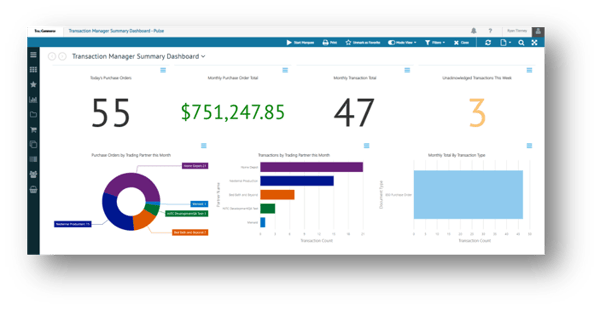
Again, like SPS, TrueCommerce has a huge library of 180,000+ pre-configured trading partner maps for retailers, distributors, and marketplaces such as Amazon, Walmart, and Target. For companies that don’t want to spend weeks building custom integrations for each partner, this can be a major time-saver.
But what I found interesting was that, unlike providers that focus solely on EDI document exchange, TrueCommerce positions itself as a one-stop commerce hub. It bundles EDI with tools for product information management, B2B eCommerce storefronts, inventory visibility, and fulfillment. So if you want to centralize everything from order capture to shipping, this platform is designed to keep your data consistent across every channel.
That said, based on the reviews I came across, getting everything up and running with TrueCommerce can take longer than some teams anticipate, particularly if you have many custom configurations or need to connect with multiple trading partners. Honestly, that’s pretty common across most EDI platforms, so it wasn’t surprising to see it mentioned here too. On the upside, quite a few users said that once everything is set up, the platform runs smoothly and helps them reduce manual work.
Support came up a few times as an area with mixed experiences. Some people said the team was helpful and responsive, while others felt it could take longer than they’d like to get clear answers or move a project forward. But overall, most users seem pretty happy with the experience, as reflected in its average G2 rating of 4.4.
I’d recommend TrueCommerce EDI to mid-sized and enterprise companies that want a comprehensive platform to manage both EDI and broader commerce operations.
What I like about TrueCommerce EDI:
- TrueCommerce doesn’t just stop at EDI, and that’s something I really appreciate. It also offers tools for product information management and B2B eCommerce, making it easier to manage more of your operations from one platform. This was a common thread I saw on G2 reviews.
- Its automation features stood out to me, especially options like scheduling document transfers and setting up alerts. G2 users frequently highlight how these tools help reduce manual tasks and streamline day-to-day workflows.
What G2 users like about TrueCommerce EDI:
“What I like best about TC EDI is their ease of integration & onboarding with other companies’ EDI platforms, streamlining our order process and order-issue resolving/notification, and lastly, their support dashboard easily allows me to articulate my issues and have TC’s Team come in and resolve my issues.”
– TrueCommerce EDI review, EJ C.
What I dislike about TrueCommerce EDI:
- Implementation timelines tend to run longer than expected, particularly when custom configurations or multiple trading partner connections are involved. Building an extra runway into the project plan upfront avoids go-live surprises.
- Several reviewers also mentioned that resolving complex support requests can occasionally require additional follow-up. However, most users still rated the overall platform experience positively, indicating that the long-term value outweighed these frustrations.
What G2 users dislike about TrueCommerce EDI:
“The user interface could be more intuitive to speed up the navigation and reduce the learning curve for new users. Additionally, faster processing times during acknowledging it in the inbox, especially when handling large volumes of transactions, and improved customization options for reporting.”
– TrueCommerce EDI review, Rommel E.
When to expect ROI from EDI software: What G2 Data says
On average, teams using EDI software see their investment pay off in just 13 months.
If you’re curious about how long implementation takes, what real users say about pricing, and which features actually deliver the most value, you can dig into the full G2 Grid Data for a closer look.
4. AWS Transfer Family: Best for cloud-native file transfers within the AWS ecosystem
AWS Transfer Family is the only platform on this list that isn’t a traditional EDI-first solution. It’s a fully managed, serverless file transfer service built natively into the AWS ecosystem, and for organizations already running infrastructure on AWS, that distinction is what makes it worth considering.
The core advantage of AWS Transfer Family is that it eliminates the need for a dedicated file transfer server. The platform supports SFTP, FTPS, FTP, and AS2 as a fully hosted service, handling availability, patching, and scaling automatically. G2 reviewers specifically call out the removal of server maintenance overhead, including no longer having to patch critical vulnerabilities in legacy SFTP server software, as a meaningful operational relief.
One of the biggest strengths I found is its native integration with AWS services. AWS Transfer Family works seamlessly with Amazon S3 and Amazon EFS, allowing organizations to exchange files without building or maintaining their own transfer servers. For businesses already running workloads in AWS, this can simplify architecture and reduce operational overhead.
Another advantage is support for multiple industry-standard protocols. The platform supports SFTP, FTPS, FTP, and AS2, making it easier to exchange files with customers, suppliers, and trading partners that use different communication methods. This flexibility can be particularly valuable for organizations managing diverse B2B integration requirements.
I also found that AWS Transfer Family removes much of the infrastructure management traditionally associated with managed file transfer solutions. Because AWS handles server provisioning, patching, scaling, and availability management, teams can focus on their file transfer workflows rather than maintaining the underlying infrastructure.
Security is another area where the platform performs well. AWS Transfer Family includes encryption, identity management integrations, logging capabilities, and access controls that align with broader AWS security services. For organizations operating in regulated industries or handling sensitive business data, these capabilities can help support compliance and governance requirements.
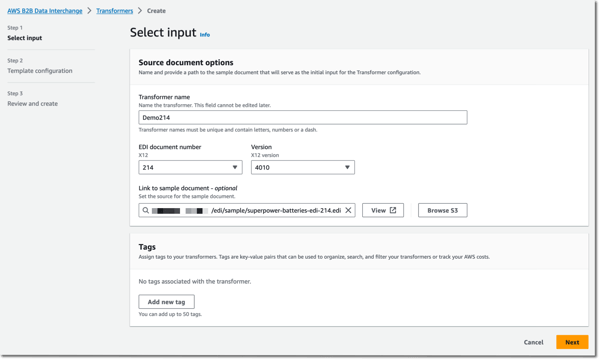
Scalability was another recurring benefit. Because the service is built on AWS infrastructure, businesses can accommodate growing file transfer volumes without investing in additional hardware or rearchitecting their environments. G2 Data shows an 84% likelihood to recommend and a 91% ease-of-use score, reflecting the low operational overhead once the service is running.
I also noticed that many users value the automation opportunities available through the broader AWS ecosystem. Businesses can connect Transfer Family with services such as AWS Lambda, EventBridge, Step Functions, and Amazon S3 to automate file processing, notifications, integrations, and downstream workflows.
G2 Data reflects strong customer sentiment around the platform’s core functionality. AWS Transfer Family currently maintains a 4.3-star rating and earns particularly high marks for security, reliability, and ease of deployment within AWS environments.
That said, AWS Transfer Family may not be the most beginner-friendly option for teams that are new to AWS. Configuring IAM permissions, storage access policies, and secure endpoints can require cloud expertise and careful planning. However, businesses already invested in AWS often find that this additional setup effort pays off through stronger security controls, scalability, and tighter integration with other AWS services.
Some reviewers also noted that AWS Transfer Family uses a usage-based pricing model, which offers flexibility but can make expenses harder to predict as transfer volumes, workflows, and connected services grow. However, many users felt the reduced infrastructure management and scalability benefits helped offset these costs.
Overall, AWS Transfer Family is a good option for organizations that already operate within AWS and need secure, scalable file transfer capabilities to support EDI and B2B integration workflows. It may not offer the retailer-focused trading partner management found in traditional EDI platforms, but it excels as a cloud-native foundation for secure data exchange.
What I like about AWS Transfer Family:
- I like how tightly AWS Transfer Family integrates with services such as Amazon S3, EFS, Lambda, and EventBridge. For organizations already invested in AWS, this creates opportunities to automate file transfer and data processing workflows without additional infrastructure.
- As I reviewed user feedback, I found consistent praise for the platform’s scalability, security, and managed-service approach. Teams can support growing file transfer requirements without maintaining dedicated servers or complex infrastructure.
What G2 users like about AWS Transfer Family:
“What I like most about AWS Transfer Family is that it lets organizations securely transfer files using familiar protocols such as SFTP, FTPS, and FTP, while still leveraging AWS storage services behind the scenes. It removes the burden of managing file transfer servers and offers smooth integration with S3 and EFS.”
– AWS Transfer Family review, Atharva P.
What I dislike about AWS Transfer Family:
- Teams without prior AWS experience may face a steeper learning curve during implementation. However, organizations already operating in AWS often view this additional setup effort as a worthwhile tradeoff for the platform’s security controls, scalability, and deep ecosystem integrations.
- The usage-based pricing model provides flexibility, but costs can become harder to predict as transfer volumes, connected services, and automation workflows grow. Many businesses prefer this approach because it allows them to scale gradually rather than commit to large upfront infrastructure investments.
What G2 users dislike about AWS Transfer Family:
“The only limitation is that some advanced features, like cross-region transfers or automation for large volumes, can be a bit tricky for new users. In some cases, troubleshooting failed transfers might require knowledge of multiple AWS services, which might be a bit challenging if you’re not already familiar with them. Be cautious with your costs, as high-volume transfers might increase them unexpectedly. Even though this service is very reliable, smaller teams without any AWS knowledge might take a while to set up access controls correctly.”
– AWS Transfer Family review, Nijat I.
5. eZCom Software EDI: Best for small to mid-sized businesses needing hands-on support
eZCom Software EDI has built an impressively loyal following, especially among companies in wholesale, consumer goods, and even apparel and cosmetics, and for a good reason, from what I could see.
At its core, eZCom’s Lingo platform provides the functionality most businesses expect from a modern EDI solution. It supports major EDI standards such as ANSI X12 and EDIFACT, offers prebuilt retailer mappings, and enables businesses to exchange purchase orders, invoices, advance shipping notices (ASNs), and other documents electronically while maintaining compliance with trading partner requirements.
eZCom integrates with ERPs, including NetSuite, QuickBooks, and SAP, as well as warehouse management systems, 3PL providers, marketplaces, and carriers such as FedEx and UPS. G2 reviewers describe the integration setup as smooth and guided, with the eZCom team walking users through the process step by step rather than leaving them to figure it out on their own.
Invoicing is one of eZCom’s most consistently praised capabilities. The platform automates invoice creation and transmission once an order ships, removing manual work from the finance team and reducing the risk of billing errors. G2 reviewers specifically call out how the invoicing process takes pressure off their teams and keeps cash flow moving without constant manual oversight.
Another capability reviewers frequently mentioned is automation. Features such as ASN generation, invoice processing, document validation, and label creation help businesses reduce administrative overhead while minimizing compliance-related errors that could lead to retailer chargebacks.
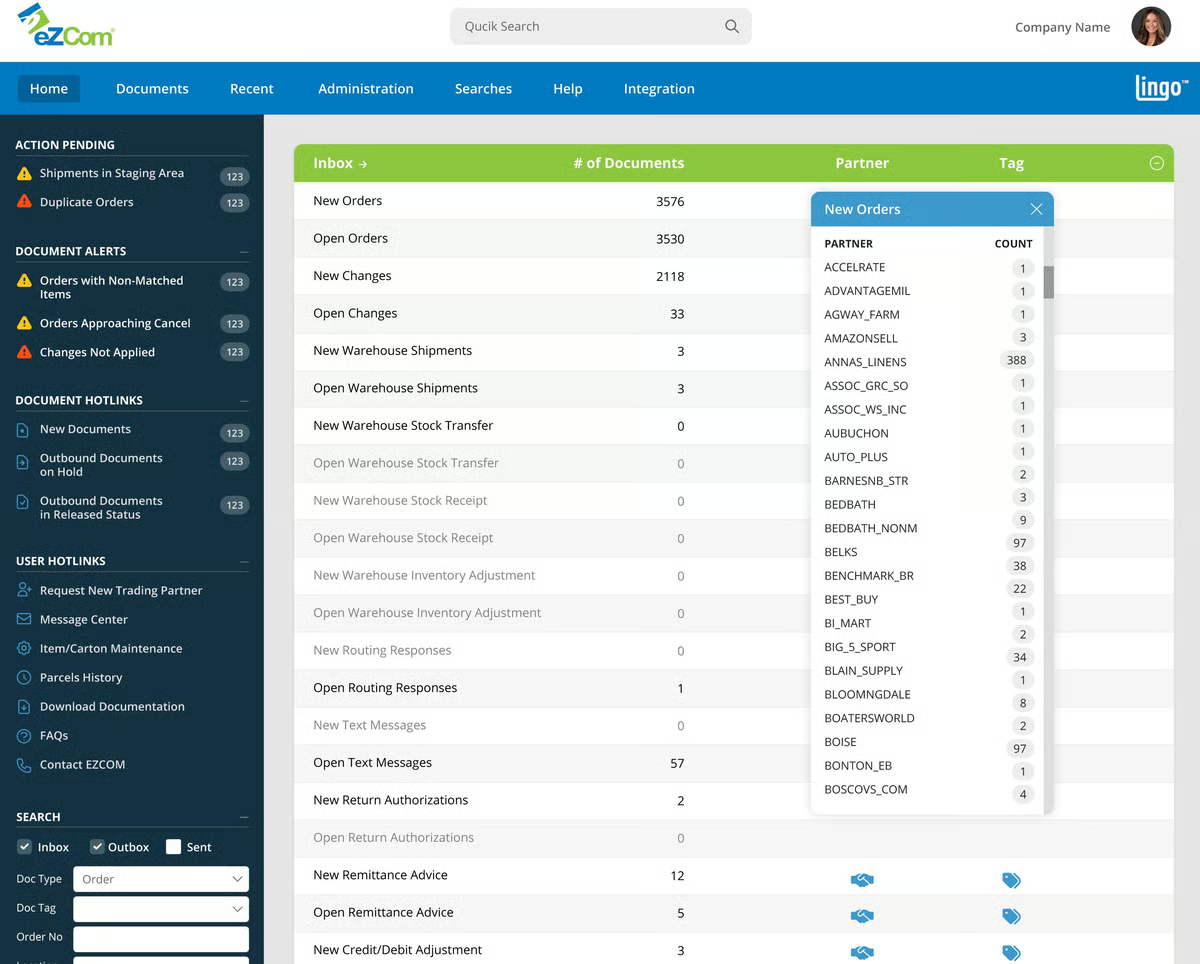
eZCom’s reporting tools and order dashboard give teams clear visibility into incoming purchase orders, outbound documents, and shipment status in one place. G2 reviewers note it’s easy to pull up historical orders, track what’s due, and stay organized across multiple retail accounts, particularly useful for teams managing daily order volumes without dedicated operations staff.
Customer support emerged as the platform’s strongest differentiator. As I reviewed G2 feedback, I repeatedly saw users highlight the support team’s responsiveness, accessibility, and expertise. Many reviewers described receiving quick answers, proactive guidance, and hands-on assistance when resolving EDI-related issues. G2 Data reinforces this strength, with 99% of users rating the quality of support positively, one of the highest scores in the category.
Ease of use is another area where eZCom performs exceptionally well. The platform earns a 90% satisfaction score for ease of use and 93% for ease of setup. Many reviewers noted that they were able to become productive quickly, even without extensive prior EDI experience. For organizations with lean IT resources, that accessibility can be a significant advantage.
With a 4.7-star rating on G2 and 95% of reviewers awarding four stars or higher, eZCom maintains some of the strongest customer satisfaction scores among the EDI platforms I evaluated. That said, a few users felt the user interface could be a bit cleaner or more modern, and there were occasional mentions that learning all the nuances of EDI workflows still takes time, especially if you’re coming from spreadsheets. However, many reviewers also pointed out that the platform’s functionality and ease of navigation matter more than its visual design in day-to-day operations.
While eZCom is generally viewed as easier to deploy than many enterprise-focused EDI platforms, some users reported that onboarding can still take time when multiple trading partners, integrations, or custom workflows are involved. The upside is that many reviewers credited the support team with helping them navigate those challenges successfully.
I’d say eZCom is a great option if you want something that feels approachable but is still robust enough to handle higher document volumes and retail compliance requirements. It’s especially well-suited to smaller and mid-sized companies that don’t have big IT teams but still need a reliable way to connect with major trading partners.
What I like about eZCom Software EDI:
- I really like how consistently reviewers praise the support team. As I analyzed G2 feedback, I found that users frequently mentioned receiving quick, knowledgeable assistance during onboarding and ongoing EDI operations, which can be invaluable for teams without dedicated EDI specialists.
- I also appreciate how approachable the platform appears to be for smaller organizations. Between the prebuilt retailer mappings, automation features, and ease-of-use ratings, eZCom seems designed to help businesses become productive without an overly complex implementation process.
What G2 users like about eZCom Software EDI:
“I like eZCom Software EDI for its ease of use and responsive customer support. It’s straightforward to navigate, making it easy to manage EDI transactions. I appreciate that retailer onboarding and setup are generally smooth and that the application simplifies complex EDI requirements. The customer service team has been very knowledgeable, responsive, and helpful whenever questions or issues arise, which helps us resolve problems quickly and maintain uninterrupted communication with our customers. eZCom also automates document processing, reduces manual entry, improves accuracy, and provides better visibility into orders, shipments, and invoices. It’s a very reliable solution that saves time, improves operational efficiency, and helps us meet our customers’ EDI compliance requirements.”
– eZCom Software EDI review, Monica B.
What I dislike about eZCom Software EDI:
- The interface looks dated compared to more modern EDI platforms, and repetitive tasks like printing labels for multiple orders require more clicks than they should. It’s a cosmetic limitation rather than a functional one, but it’s worth knowing before you start.
- While eZCom is often viewed as easier to implement than larger enterprise EDI platforms, some businesses reported longer onboarding timelines when connecting multiple trading partners or configuring custom workflows. However, many reviewers credited the support team with helping streamline the process and resolve issues quickly.
What G2 users dislike about eZCom Software EDI:
“It can be a little hard to get a grasp of it if you haven’t had previous experience with a similar system and aren’t familiar with the interrogation lingo, but once you get an understanding of it, it is extremely user-friendly.”
– eZCom Software EDI review, Leah F.
Comparison of the best EDI software for 2026
| Software | G2 Rating | Free plan and trial | Starting price of paid plans |
| SPS Commerce Fulfillment EDI | 4.3/5 | No free trial; free demo only | Custom pricing |
| Celigo | 4.6/5 | 30-day free trial + free plan available (with limitations) after trial | Custom pricing |
| TrueCommerce EDI | 4.4/5 | No free trial; free demo only | Custom pricing |
| AWS Transfer Family | 4.3/5 | No free trial; AWS free tier may apply for limited use | Custom pricing |
| eZCom Software EDI | 4.7/5 | No free trial; free demo only | Custom pricing |
Note: G2 ratings are based on user reviews and are subject to change.
Frequently asked questions about the best EDI software
Got more questions? G2 has the answers!
Q. What is the most trusted electronic data interchange (EDI) software by operations teams based on user reviews?
SPS Commerce Fulfillment EDI earns the highest trust among operations teams managing retail and wholesale supply chains. Its prebuilt trading partner network, compliance monitoring, and managed services team mean operations staff spend less time troubleshooting and more time fulfilling orders.
Q. What is the highest-rated electronic data interchange (EDI) software for reducing implementation time and ensuring user adoption?
Celigo leads in implementation speed, particularly for teams connecting NetSuite, Shopify, or Salesforce. Its prebuilt Integration Apps eliminate the need to build flows from scratch. eZCom Software EDI also stands out for its fast onboarding and ease of adoption, making it a strong choice for businesses with limited EDI expertise.
Q. Which electronic data interchange (EDI) platforms see sustained team adoption after initial rollout?
eZCom Software and SPS Commerce consistently receive positive feedback for long-term usability. These software solutions are frequently highlighted for their responsive support, reliable workflows, and intuitive interfaces. Likewise, Celigo’s flow builder and marketplace templates allow teams to expand their integration footprint over time without rebuilding from scratch, driving continued engagement well past the initial rollout.
Q. What is the most reliable electronic data interchange (EDI) software according to user reviews from successful deployments?
TrueCommerce EDI is among the most reliable platforms, according to verified G2 reviews. It consistently earns praise for stability, retailer compliance, and dependable day-to-day EDI operations. SPS Commerce Fulfillment EDI also earns strong reliability marks across high-volume retail deployments, with its 24/7 compliance monitoring catching document issues before they escalate into chargebacks or fulfillment failures.
Q. What is the best electronic data interchange (EDI) software for teams evaluating based on real user implementation feedback?
eZCom Software EDI and Celigo stand out in implementation feedback. eZCom earns praise for its ease-of-setup score, with reviewers specifically praising the guided onboarding experience. Celigo’s Integration Apps are appreciated for cutting implementation timelines on common ERP-eCommerce combinations.
Q. Which electronic data interchange (EDI) platforms do customers rate highest for setup speed and ongoing support?
eZCom Software receives some of the strongest feedback for implementation speed and customer support. SPS Commerce is another highly rated option, particularly for organizations that want guided onboarding and managed EDI services.
Q. Which electronic data interchange solutions eliminate manual order processing across multiple trading partners and suppliers?
SPS Commerce Fulfillment EDI’s prebuilt connections to thousands of retail trading partners, combined with automated PO receipt, invoice generation, and ASN transmission, remove manual order processing from the equation across every connected partner simultaneously. TrueCommerce EDI and eZcom Software EDI deliver similar results for small to mid-sized businesses, consolidating orders, shipments, and invoices from all trading partners in a single dashboard.
Q. Which electronic data interchange platforms integrate fastest with NetSuite and 3PL systems without vendor IT bottlenecks?
Celigo is a good choice for NetSuite integrations. Its prebuilt Integration Apps for NetSuite-Shopify, NetSuite-Salesforce, and NetSuite-Amazon are preconfigured and ready to deploy without custom development, removing the vendor IT bottleneck that slows traditional EDI implementations. eZCom Software EDI also integrates smoothly with NetSuite and major 3PL systems.
Q. Which electronic data interchange platforms have visual mapping builders that make integration setup intuitive for non-technical teams?
Celigo offers one of the most intuitive visual integration experiences, allowing teams to build and manage EDI workflows with minimal technical effort. eZCom Software is another user-friendly option for organizations new to EDI.
Q. What are the best electronic data interchange (EDI) software for teams prioritizing quick implementation?
Celigo and eZCom Software EDI are the top picks for teams where implementation speed is the primary criterion. Celigo’s Integration Apps get common ERP-eCommerce configurations live faster than most traditional EDI platforms, while eZCom’s hands-on support team walks users through setup step by step. For teams with straightforward retail compliance needs and no dedicated IT staff, eZCom is often the faster path to go-live.
Signed, sealed, delivered
If there’s one takeaway I want to share with you, it is that your EDI platform can quietly become the invisible backbone of your business or the bottleneck you’re always fighting. The difference usually isn’t just the feature checklist. It’s whether the provider treats you like another account number or as a partner who needs help translating all that complexity into something you can actually manage.
I was surprised by how many teams credited their success to responsive support, clear documentation, and integrations that didn’t break every time their ERP updated.
So if you’re weighing your options, I’d look closely at how each vendor handles the boring stuff, like mapping tweaks, onboarding new partners, and troubleshooting at 4 p.m. on a Friday, because that’s where the real test of “best” actually shows up.
Curious about other ways to connect your systems and automate workflows beyond EDI? You can explore more options in G2’s data integration tools category to see how these platforms stack up alongside other integration solutions.

💸 Earn Instantly With This Task
No fees, no waiting — your earnings could be 1 click away.
Start Earning
