


If you’ve ever used an SEO plugin like Yoast or Rank Math, you’ve seen that “focus keyword” field staring back at you. You type something in, the plugin runs some checks, and you get a green light (or a frustrating orange one).
But here’s the thing: if you’re new to SEO, you might not actually understand what a focus keyword is, or why it matters beyond making that indicator turn green.
A focus keyword isn’t just a box to fill in. It’s the foundation of your on-page SEO strategy. Choose the wrong one, and you’re optimizing for a term nobody searches for—or one you’ll never rank for. Choose the right one, and you’re targeting real traffic from people who actually want what you’re offering.
This guide covers everything you need to know about focus keywords: what they are, how to pick the right one, where to use it, and how to track whether it’s working.
A focus keyword (also called a focus keyphrase) is the main search term you want a specific page to rank for in search engines.
Think of it as the primary term that defines what your page is about. It’s the answer to the question: “If someone searches for one thing and lands on this page, what should that thing be?”
You might also hear it called a target keyword, primary keyword, or main keyword. They all mean the same thing—the central term you’re optimizing around.
Practical example
If you’re writing a guide about brewing coffee at home, your focus keyword might be “how to make pour over coffee.” Not just “coffee” (too broad) or “brewing” (too vague), but a specific phrase that matches what your page actually covers.
Here’s an important distinction: your focus keyword isn’t the only keyword you’ll rank for.
According to our classic study of 3 million search queries, the average #1 ranking page also ranks in the top 10 for nearly 1,000 other relevant keywords. Your focus keyword is your North Star—the primary target—but you’ll pick up rankings for variations, related terms, and long-tail phrases naturally.
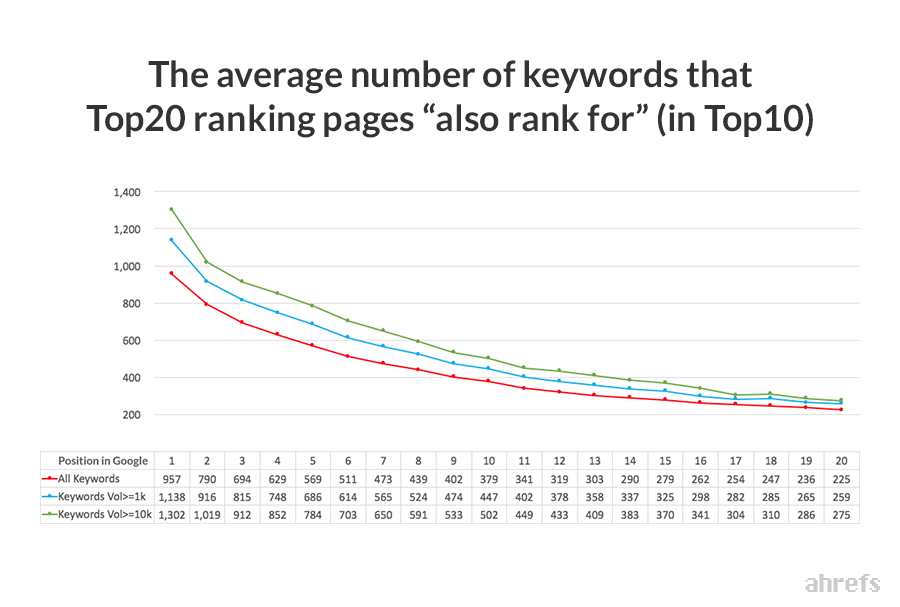
The focus keyword guides your optimization efforts. Everything else follows from there.
SEO has a lot of overlapping terminology, and it’s easy to get confused. Here’s a quick breakdown:
| Term | What it means |
|---|---|
| Focus keyword | The main term you’re optimizing a page for |
| Target keyword | Same as focus keyword (different name) |
| Primary keyword | Same as focus keyword (different name) |
| Secondary keywords | Related terms to include naturally in your content |
| Long-tail keywords | More specific, lower-volume keyword variations |
| LSI keywords | Semantically related terms (this concept is pretty outdated) |
Don’t overthink the terminology. Focus keyword, target keyword, and primary keyword all refer to the same thing: the main search term you want your page to rank for.
The key is picking one primary focus and being intentional about it.
Focus keywords matter for three reasons:
1. They give your content clarity.
Choosing a focus keyword forces you to define what your page is actually about. Without one, content tends to drift—you try to cover too much, and the page ends up ranking for nothing.
A clear focus keyword keeps you on track. Every section, every heading, every example ties back to that central topic.
2. They guide your optimization.
Once you have a focus keyword, you know where to place it: your title, your headings, your URL, your first paragraph. It gives your on-page SEO a clear direction instead of random keyword sprinkling.
3. They give you a measurement baseline.
How do you know if your SEO is working? By tracking whether you rank for your focus keyword. It gives you a specific, measurable target to monitor over time.
Sidenote.
Importantly, Google doesn’t see your focus keyword. There’s no “focus keyword” meta tag. Google’s algorithms don’t know which term you’ve designated as your primary target. Instead, Google understands topics, entities, and context. The focus keyword is for your clarity—to guide your content creation and optimization.
This is where most people get stuck. You have a topic in mind, but which exact keyword should you target?
Here’s a four-step process to get it right.
Step 1: Find keyword ideas
Start by generating a list of potential focus keywords. You’ll narrow down later—first, you need options.
Ways to find keyword ideas:
- Brainstorm based on your topic. What would someone type into Google to find your content? Write down 5-10 variations.
- Use keyword research tools. Enter a seed keyword into Ahrefs’ Keywords Explorer to generate hundreds of variations. The “Matching terms” report shows keywords containing your seed term. The “Questions” filter surfaces question-based keywords (great for informational content).
- Check what competitors rank for. Look at the top-ranking pages for your topic. What keywords drive their traffic?
- Use Google’s suggestions. Type your topic into Google and note the autocomplete suggestions. Check “People also ask” for question variations.
- Ask AI. AI tools like ChatGPT can help suggest synonyms, variations, and related topics—or you can use the AI suggestions feature in Keywords Explorer to automatically generate tons of ideas.
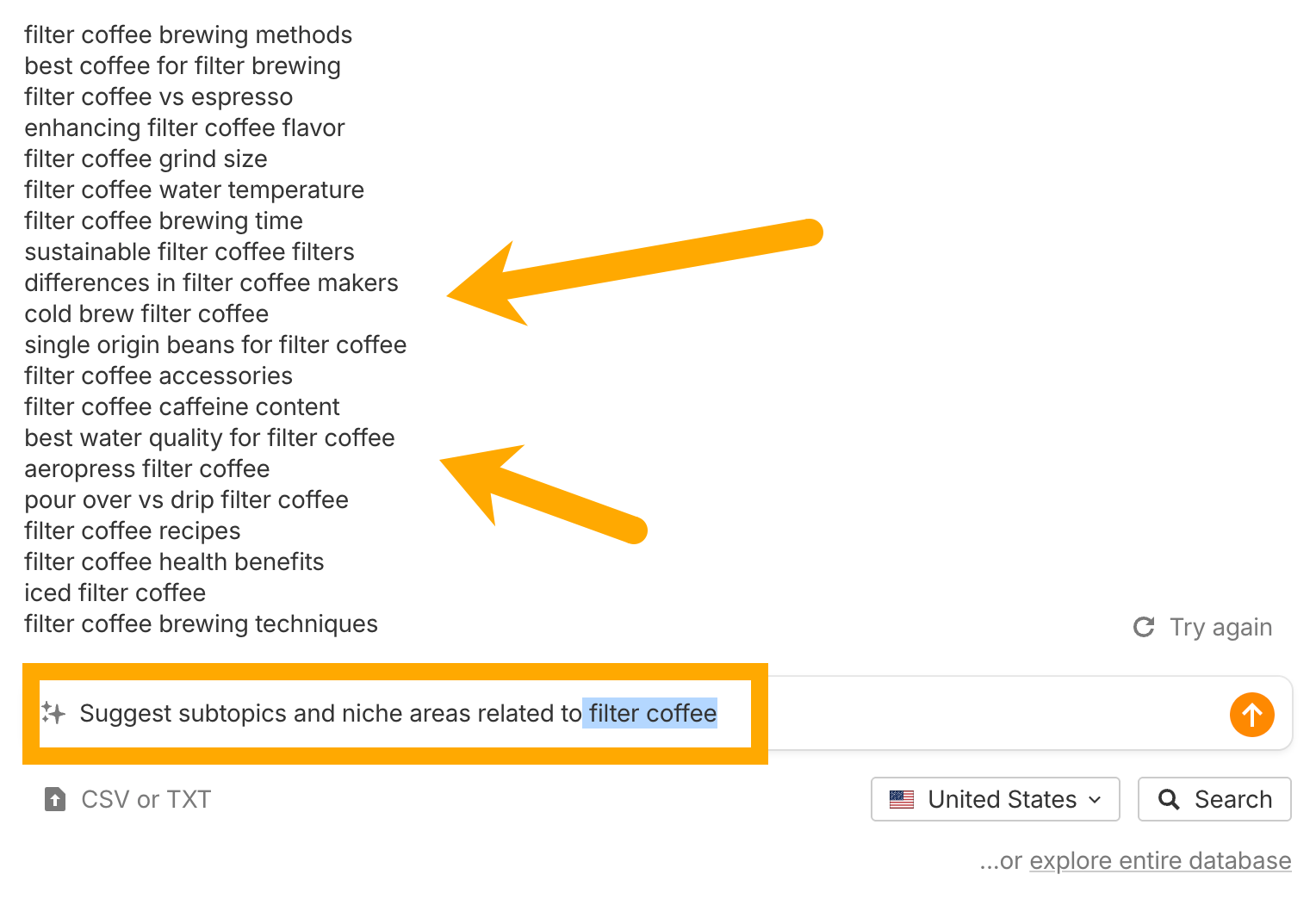
At this stage, don’t judge—just collect. You want a solid list of potential focus keywords to evaluate.
Step 2: Check the numbers
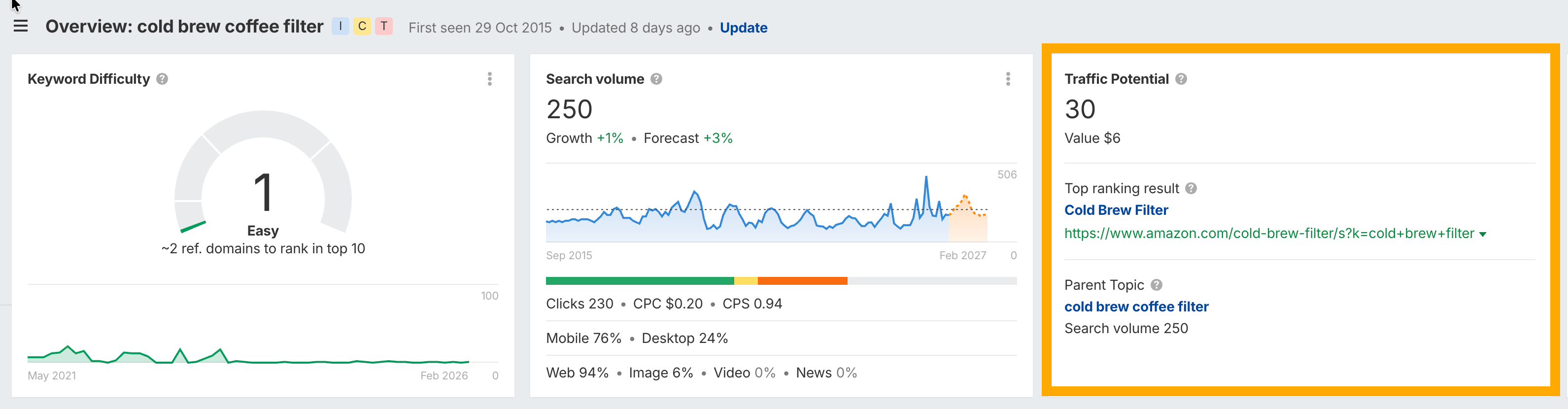
Now it’s time to evaluate your options. For each potential focus keyword, look at four key metrics:
Search volume: How many people search for this term each month?
Volume tells you whether there’s demand. But don’t chase high-volume keywords blindly. A lower-volume keyword that’s highly relevant to your audience can be more valuable than a high-volume one that attracts the wrong visitors. 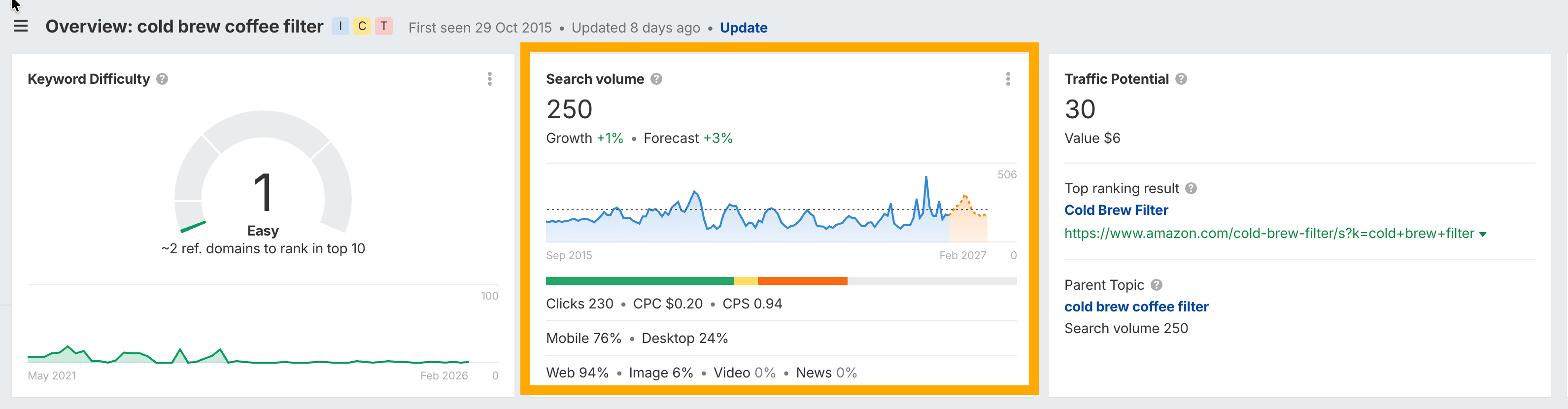
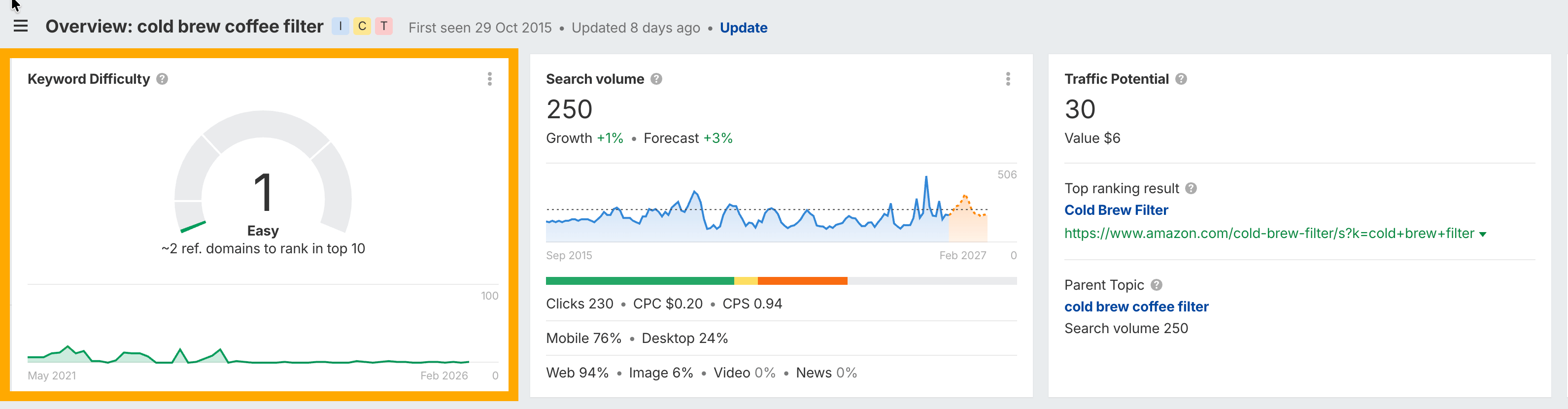
Keyword difficulty (KD): How hard is it to rank in the top 10?
Ahrefs’ Keyword Difficulty score ranges from 0-100. As a general rule:
- New sites: target KD under 20.
- Established sites with some authority: can aim higher.
- Very competitive terms (KD 50+): need strong backlinks and content.
Traffic potential (TP): What could the #1 page realistically get?
This metric is often more useful than raw volume. Traffic potential estimates the total organic traffic the top-ranking page receives from all the keywords it ranks for—not just the one you’re analyzing.
Why does this matter? Because if you rank #1 for your focus keyword, you’ll likely rank for dozens of related terms too. Traffic potential captures that upside.
Search intent: Does the intent match your content type?
This is crucial. Search intent is the reason behind a search query:
- Informational: People want to learn something (blog posts, guides, tutorials)
- Commercial: People are researching before a purchase (comparisons, reviews)
- Transactional: People want to buy or take action (product pages, sign-ups)
- Navigational: People are looking for a specific site or page
Your focus keyword’s intent must match your content. “Best running shoes” has commercial intent—people want comparisons and recommendations. If you write an informational blog post about running form, that keyword won’t work as your focus.
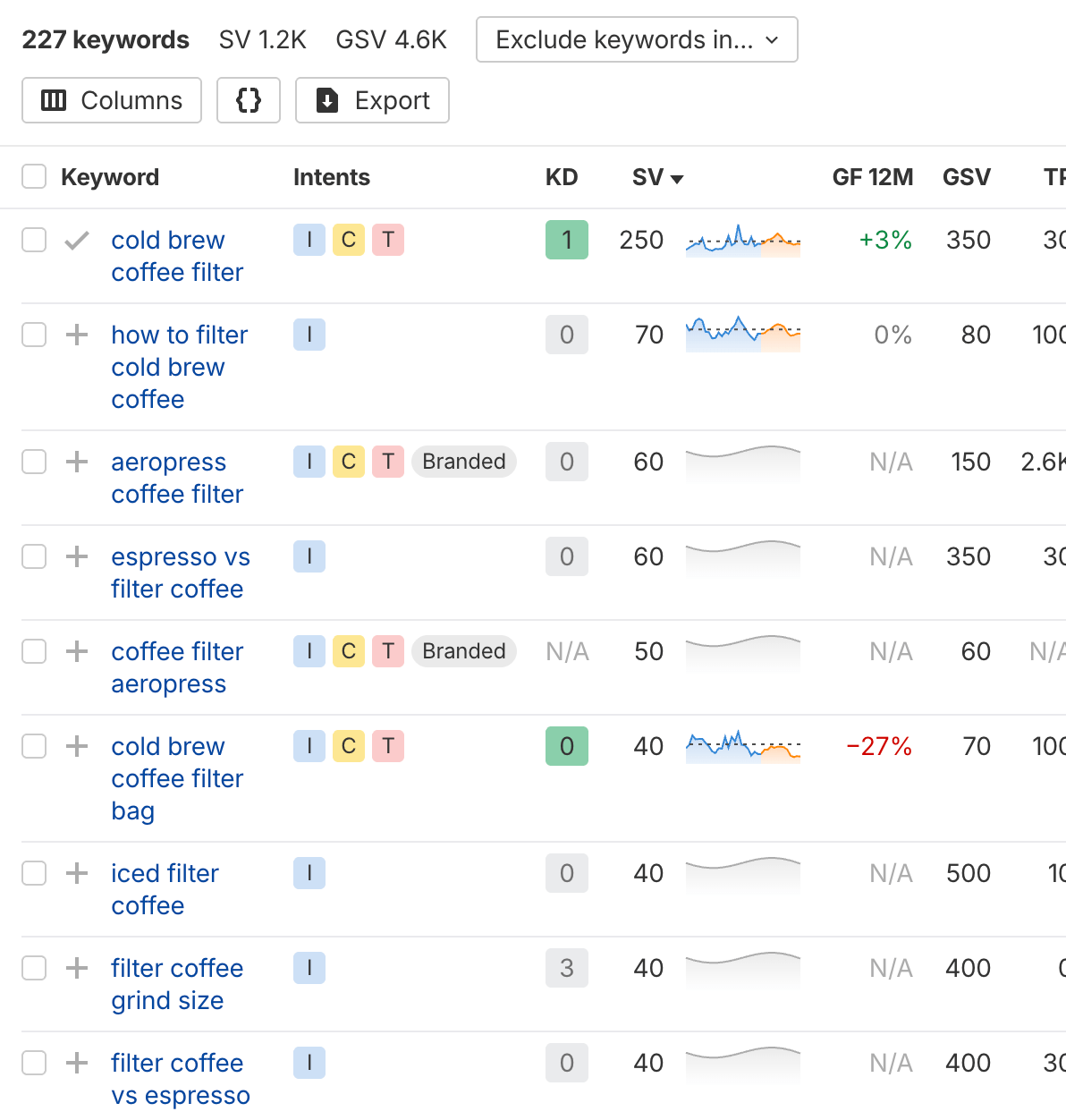
Get data for every keyword that matters
In Keywords Explorer, you can see all these metrics at a glance: volume, KD, traffic potential, and intent badges showing whether the keyword is informational, commercial, or transactional.
Step 3: Validate against the SERP
Before committing to a focus keyword, Google it. The search results tell you exactly what Google thinks searchers want.
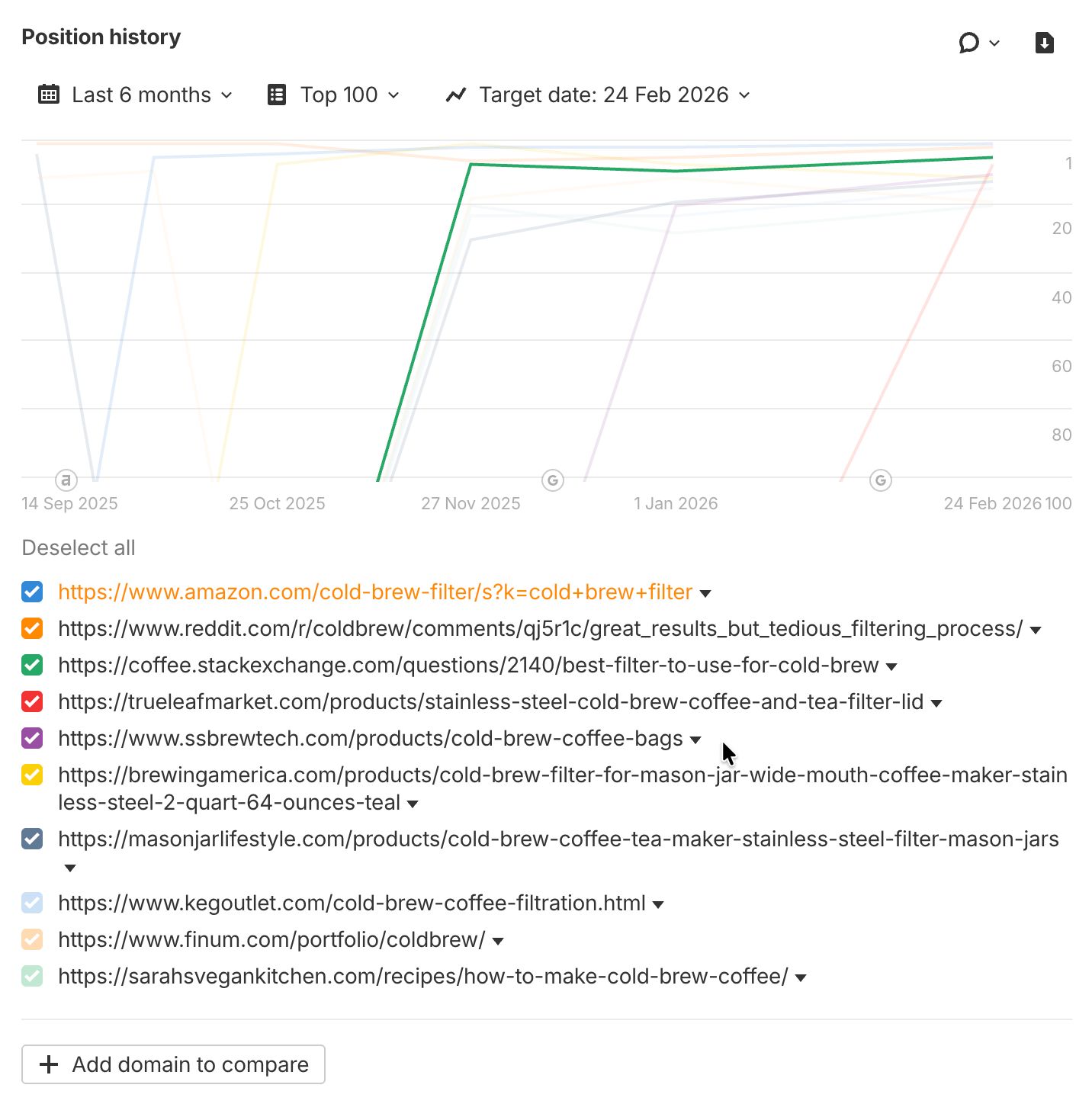
Check who’s ranking.
Look at the domains in the top 10. Are they major publications with sky-high authority, or is there a mix of smaller sites? If every result has a Domain Rating of 80+, you’ll need significant authority to compete. If you see sites with DR 30-50 ranking, there’s opportunity.
Ahrefs’ SERP Overview shows you the Domain Rating, traffic, and backlinks for every top result—making this analysis quick.
Check what type of content ranks.
Is the SERP dominated by listicles? How-to guides? Product pages? Video results?
If every result is a “10 Best…” listicle, that’s the format Google expects. Don’t write a deep-dive essay if the SERP clearly wants a list.
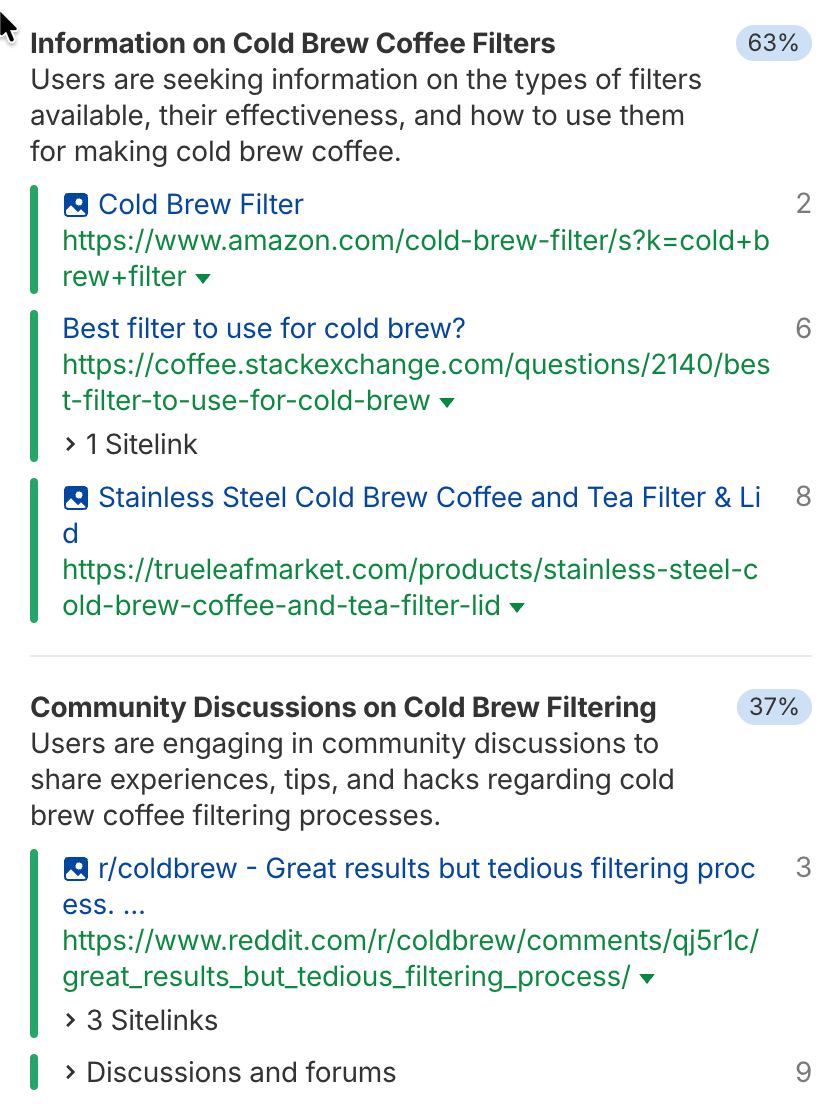
Check if the intent matches your assumption.
Sometimes you think a keyword is informational, but the SERP shows shopping results. Let the SERP override your assumption—it reflects real user behavior.
Check this using the “Identify intents” button in Keywords Explorer. You’ll get an automatic summary of the primary intent of the actual pages in the search results:
Look for a gap.
Even if competitors are strong, there might be an angle they’re missing. Maybe all the guides are outdated. Maybe no one covers a specific subtopic. A unique angle can help you compete even in crowded SERPs.
Step 4: Confirm it’s right for your site
The final check is relevance to your site specifically.
Is it relevant to your business or audience?
A keyword can have great metrics but attract the wrong people. If you sell enterprise software, ranking for beginner tutorials might drive traffic but not customers. Make sure your focus keyword aligns with who you want to reach.
Do you already rank for it?
Check if another page on your site already targets this keyword. In Site Explorer, go to the Organic Keywords report and search for your potential focus keyword:
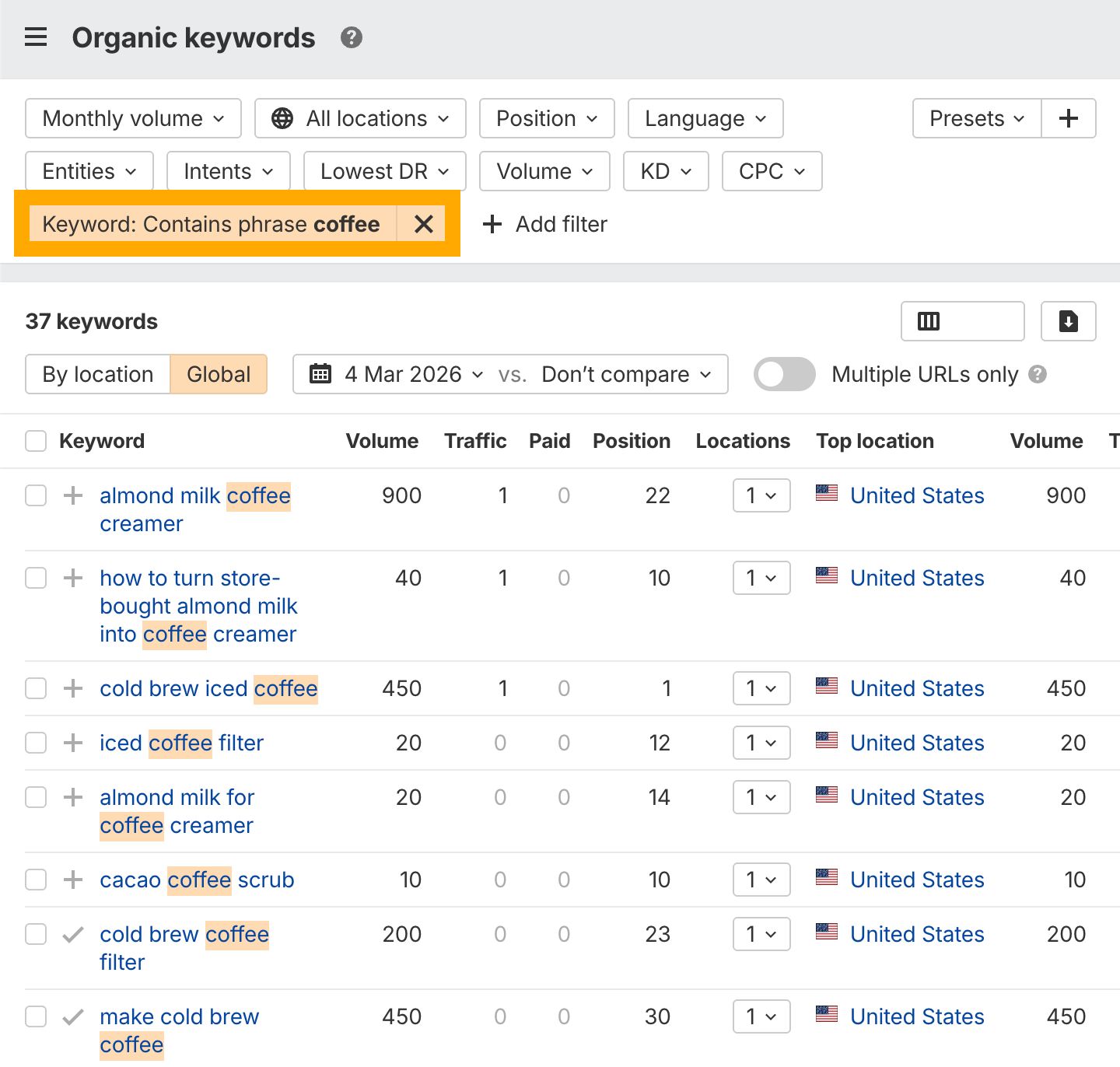
If you’re already ranking with a different page, you have two options:
- Update and improve the existing page, known as content refreshing.
- Differentiate the new content to target a different intent
Don’t create competing pages for the same keyword—that’s called keyword cannibalization, and it hurts both pages.
Can you actually create great content on this topic?
Be honest. Do you have the expertise, authority, research, or access to create something genuinely valuable? The best focus keyword in the world won’t help if your content is thin.
Short answer: one.
Each page should have one primary focus keyword. That doesn’t mean you ignore other keywords—you’ll naturally include variations and related terms throughout your content. But your optimization efforts should center on one main target.
Why? Because your title tag can only say so much. Your H1 can only communicate one main idea. Trying to optimize for multiple focus keywords dilutes your efforts and confuses your content structure.
What about similar keywords?
Very close variations can often be treated as one. For example, “focus keyword” and “focus keywords” (singular vs. plural) don’t need separate pages. They share the same parent topic and the same search intent.
In Ahrefs, you can check the Parent Topic for any keyword. Keywords with the same parent topic often cluster together—meaning one page can potentially rank for all of them:
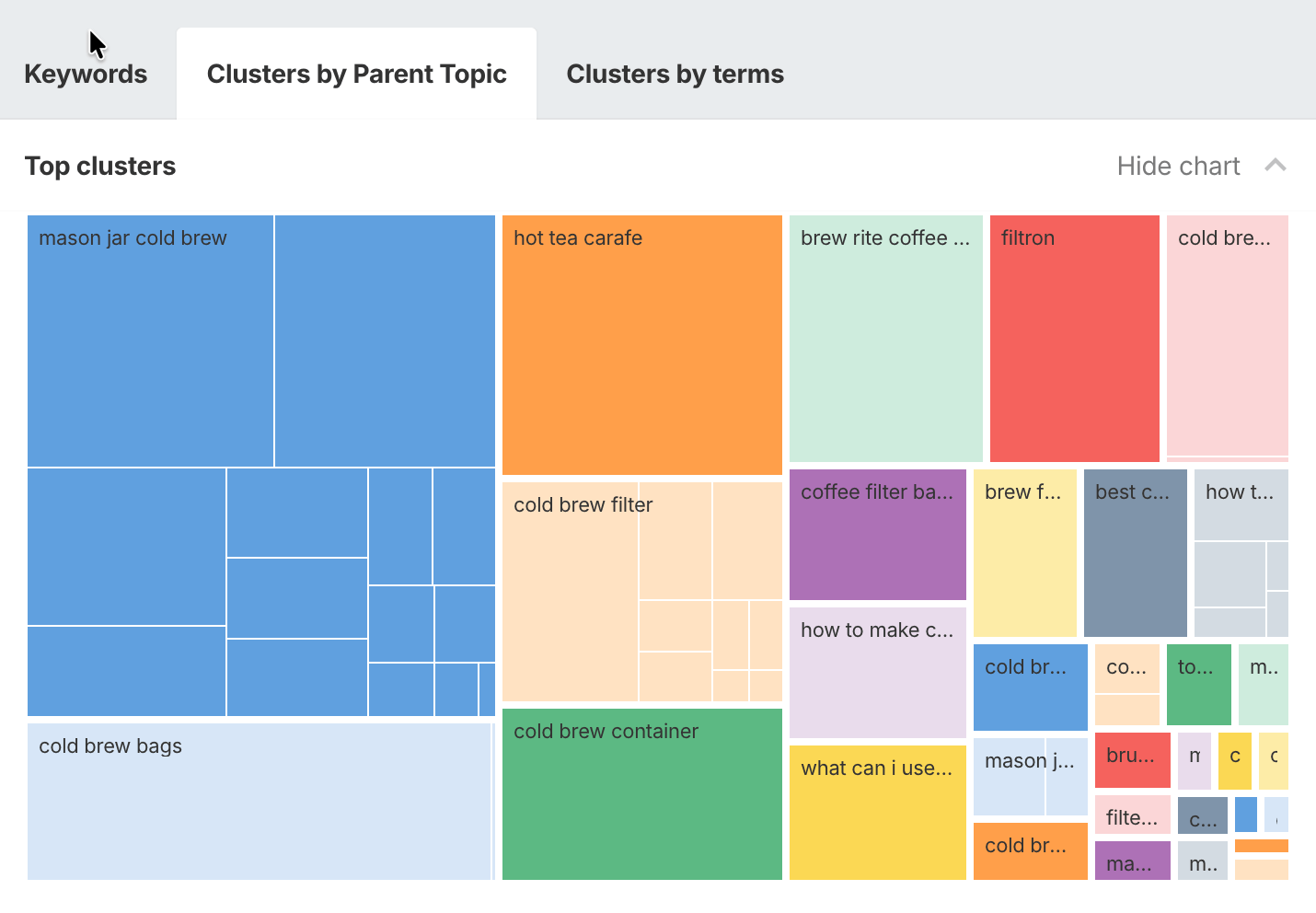
But “focus keywords” and “long-tail keywords”? Those are different topics. They need separate pages.
Once you’ve chosen your focus keyword, here’s where to include it:
Title tag — Include your focus keyword, ideally near the beginning. The title is one of the strongest on-page signals.
H1 heading — Your main headline should contain the focus keyword or a close variation.
URL slug — Keep it short and include the focus keyword. /focus-keywords/ is better than /blog/post-12345/.
Meta description — A natural inclusion can help click-through rate when the keyword appears bolded in search results.
First 100 words — Establish your topic early. Mentioning the focus keyword in your introduction signals relevance immediately.
H2/H3 headings — Where naturally relevant. Don’t force it into every heading, but include it where it makes sense.
Image alt text — Especially for your main image. Describe the image while incorporating the focus keyword if appropriate.
Throughout your content — Naturally. The keyword should appear multiple times, but only where it reads well.
Importantly, you need to avoid over-optimization. That means:
- Don’t stuff the keyword everywhere (readability matters more)
- Don’t sacrifice natural writing for exact-match placement
- Don’t use the exact keyword in every single heading
- Don’t obsess over “keyword density” (that’s an outdated metric)
Modern search engines and AI search engine understand synonyms, variations, and context (thanks to something called semantic search). Write for humans first. If your content genuinely covers the topic well, the focus keyword will appear naturally—and that’s exactly what Google and ChatGPT both want.
Avoid these pitfalls:
1. Choosing keywords that are too broad.
“Marketing” has millions of results and unclear intent. “Content marketing strategy for B2B startups” is specific, searchable, and rankable. The more specific your focus keyword, the better your chances.
2. Ignoring search intent.
If the SERP shows product pages and you write a blog post, you won’t rank—no matter how good your content is. Match your content type to what’s already ranking.
3. Targeting the same keyword on multiple pages.
This creates internal competition. Your pages fight each other for rankings, and often neither wins. Before creating new content, check if you already have a page targeting that keyword. Site Audit can help identify keyword cannibalization issues automatically.
4. Obsessing over exact match.
Your focus keyword is “best running shoes 2024.” Does that exact phrase need to appear word-for-word? No. Google understands “top running shoes this year” means the same thing. Focus on natural language.
5. Targeting keywords you can’t compete for.
A brand new site won’t rank for “insurance” anytime soon. Be realistic about your domain’s authority and target keywords within reach. Build up to competitive terms over time.
6. Setting it and forgetting it.
Search intent changes. Competition changes. New content appears. A focus keyword that was perfect two years ago might need reassessment today. Revisit your key pages periodically.
Ranking for your keyword is an ongoing, iterative process. Once you found the right keyword to target and crafted the best content imaginable, the next step is tracking your performance over time.
These are the most important performance metrics to track:
- Ranking position — Where does your page rank for the focus keyword? Check manually in the search results, or use Ahrefs Site Explorer to see all of your page’s rankings in one place.
- Organic traffic — How much search traffic does the page receive? Use Google Search Console to get data direct from Google, or estimate it using Ahrefs traffic figures.
- Total keywords — How many keywords does the page rank for beyond the focus keyword?
- Click-through rate — What percentage of impressions turn into clicks?
Monitor rankings every day
In Rank Tracker, you can add your focus keywords to monitor daily position changes. You’ll see visibility trends over time and can compare your rankings against competitors for the same keywords.
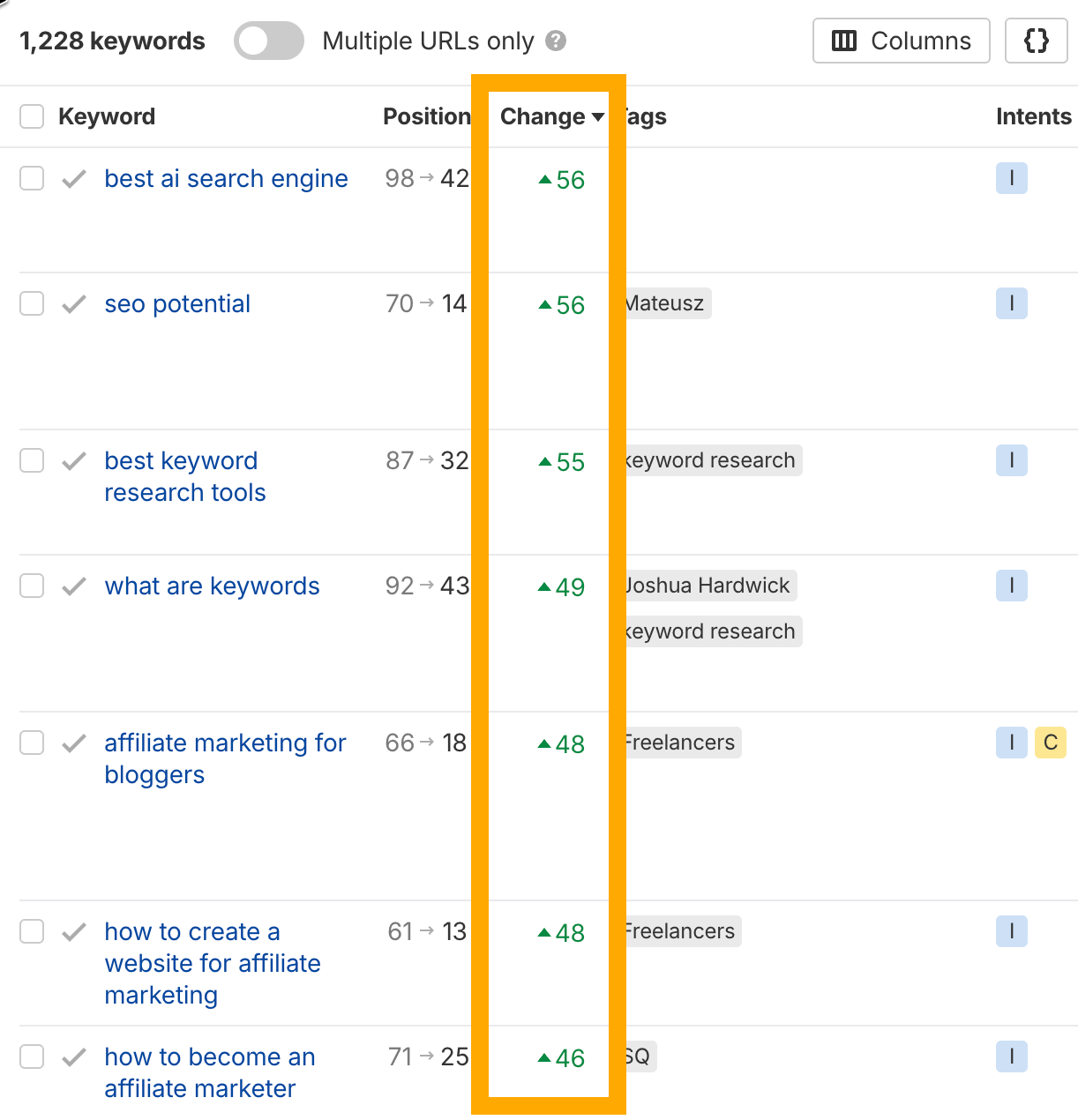
New content deserves weekly attention for the first three months, while established pages can be reviewed monthly. A full content audit each quarter is also worthwhile.
As for when to act, if a page is stuck below page two after six months, the keyword may be too competitive or the content may need strengthening. If you’re ranking but not seeing traffic, check whether intent matches or if CTR needs work. And if rankings are dropping, look to see if your content needs updating (or if your competitors have published something even more epic than your article).
SEO is a long-term pursuit, so don’t panic over day-to-day fluctuations. Look at trends over weeks and months.
Search is changing. AI Overviews, conversational search, and chat-based assistants like ChatGPT and Claude are reshaping how people find information. Does the focus keyword concept still apply?
Yes—but with some changes.
AI Overviews change visibility.
When Google displays an AI-generated answer at the top of the SERP, position 1 isn’t what it used to be. Your content might be the source for the AI Overview without getting the click. Comprehensive, authoritative content is more important than ever—it’s what AI systems cite—but you might need to lower your expectations for website traffic.
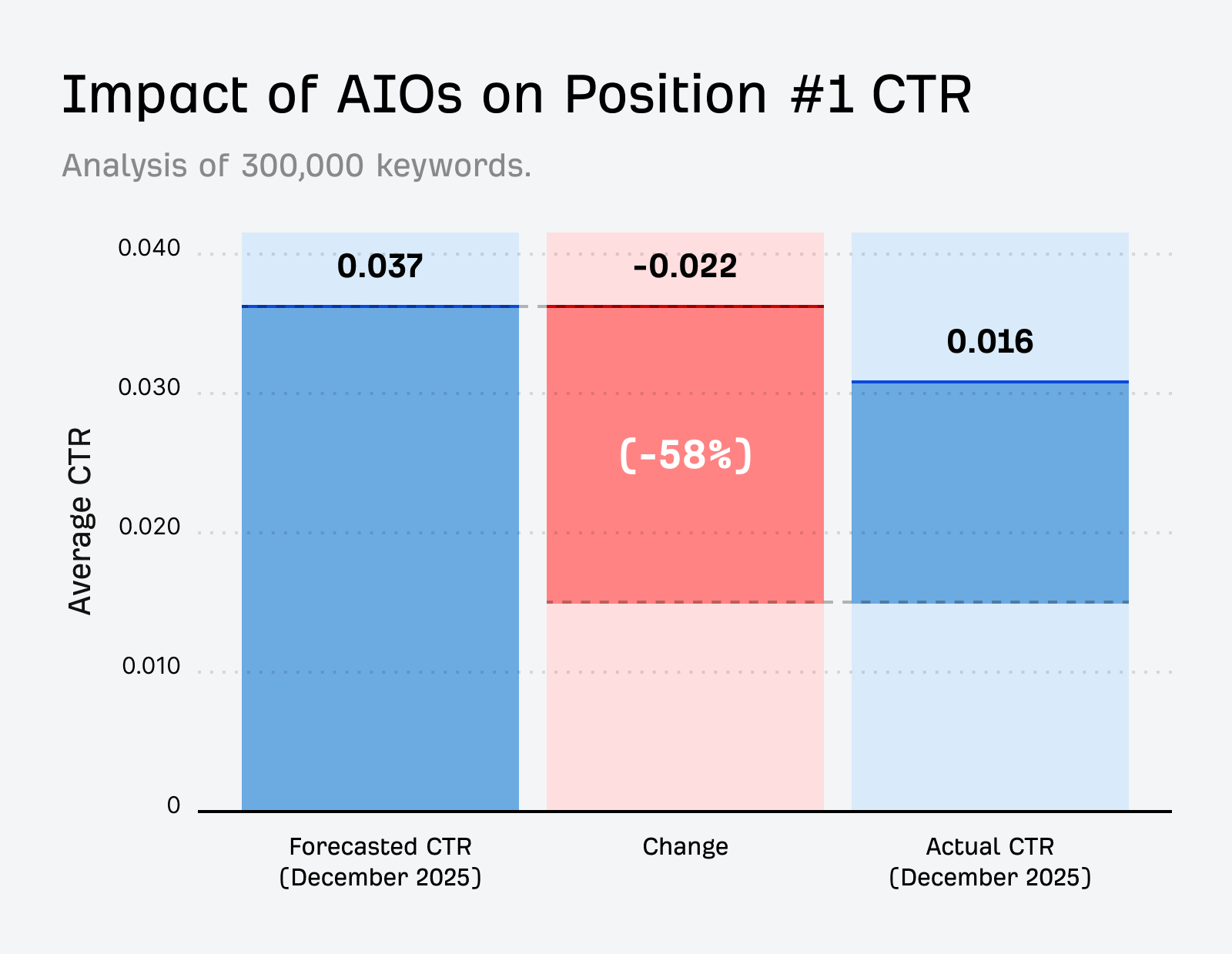
Our research found that AI Overviews reduce the click-through rate for top-ranking content by an average of 58%.
Topic coverage matters more.
A focus keyword is still useful as a targeting strategy, but Google increasingly rewards pages that thoroughly cover a topic. Don’t just optimize for one phrase—make sure your content answers every related question someone might have.
Search is becoming conversational.
Voice search and chat-based AI use natural language queries. Focus keywords should reflect how people actually ask questions, not just short keyword strings.
The bottom line
Focus keywords remain a practical mental model for content optimization. But think topic-first, keyword-second. Your focus keyword is the entry point; comprehensive coverage is what keeps you ranking.
Final thoughts
A focus keyword is the main search term you want a page to rank for. It’s your optimization North Star—the term that guides your title, headings, content structure, and measurement.
Here’s the process in a nutshell:
- Find keyword ideas using tools, competitor research, and brainstorming
- Check the numbers: volume, difficulty, traffic potential, intent
- Validate against the SERP to confirm you can compete
- Use ONE focus keyword per page and place it strategically
- Track performance and iterate based on results
The best focus keyword isn’t just the one with the highest volume. It’s the one that brings the right audience to content that genuinely helps them.
Start there, and the SEO follows.
Got questions? Ping me on LinkedIn.

💸 Earn Instantly With This Task
No fees, no waiting — your earnings could be 1 click away.
Start Earning
