


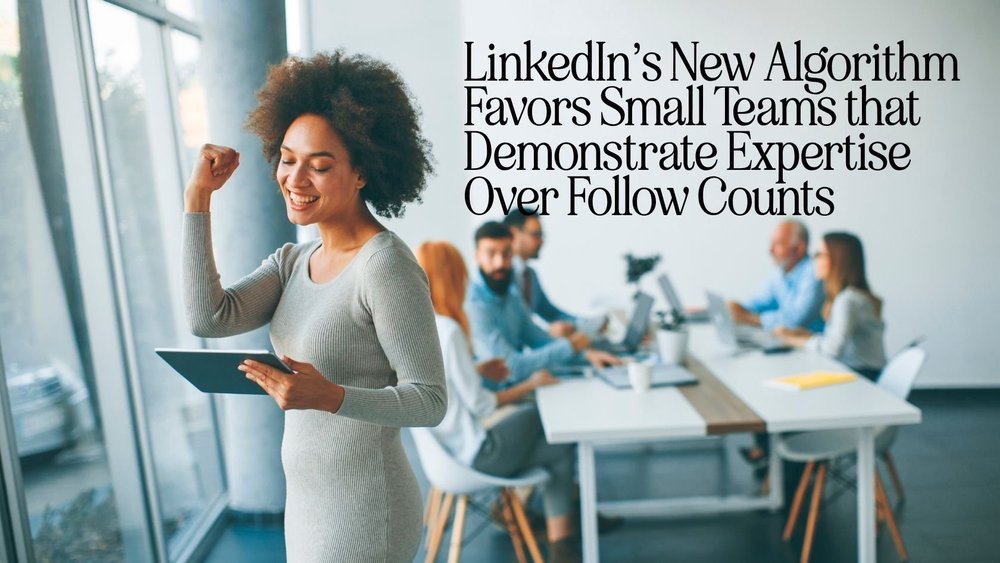
LinkedIn is starting to function less like social media and more like a trade publication where the people who show up consistently become known as the experts.
If you’re not big on LinkedIn, I get it.
For years, it’s been the corporate-heavy platform where most of us listed our experience in the driest copy possible, uploaded a stiff headshot, and checked in maybe twice a year as an afterthought.
As a small brand or founder-led company, your focus has likely been elsewhere—getting your product in front of eyeballs on platforms like Instagram. On LinkedIn, you might post a trade show date or upload a catalog occasionally, but not much else.
That approach made sense.
But LinkedIn is evolving, and it’s worth understanding what that means for your brand.
Why LinkedIn Matters for Small Brands, Even Outside the Corporate World
Your LinkedIn profile is no longer a static résumé.
“Your LinkedIn profile isn’t a résumé anymore. It’s the instruction manual for how people—and AI—understand your expertise.”
In 2026, it’s increasingly functioning as a trust and discovery engine, one that can influence how your brand shows up not just on LinkedIn, but across AI-powered search tools.
There’s been a noticeable shift in how content is distributed on the platform. Many marketers and creators are pointing to LinkedIn’s evolving AI systems (often referred to as 360Brew) as a key driver behind this change.
Regardless of what you call it, the takeaway is clear:
A loosely defined profile doesn’t just look unpolished, it makes it harder for LinkedIn (and AI systems more broadly) to understand who you are and who should see your content.
1. Your Profile Is Now a Context Signal
LinkedIn is moving beyond ranking individual posts.
It’s increasingly evaluating the context around the person posting—including your headline, About section, skills, and content history.
If your profile and your content tell the same story, your expertise is easier to categorize.
If they don’t, distribution can suffer.
Example:
-
Profile: Sustainable Fashion Founder
-
Content: Crypto trends, productivity hacks, random reposts
That disconnect makes it harder for the platform to confidently match your content with the right audience.
The Bottom Line:
Clarity and alignment improve your visibility.
2. LinkedIn Rewards Focus, Not Volume
Small teams don’t have the luxury of brute-force marketing—and increasingly, they don’t need it.
What appears to be working now is semantic consistency over high-volume posting.
When your profile clearly reflects 3–4 core areas of expertise, it becomes easier for LinkedIn to understand:
-
what you talk about
-
who should see it
-
where you fit in the broader conversation
The Bottom Line:
A clear profile allows you to post less, and reach more of the right people.
3. Your Profile Is Being Read by AI, Not Just People
When buyers, editors, or partners research your brand today, they’re often using AI-powered tools.
And those tools frequently pull from LinkedIn.
If your profile is vague, scattered, or overly generic, it becomes difficult for AI systems to categorize your expertise—which can limit how often you show up in recommendations.
The Bottom Line:
Your LinkedIn profile is increasingly part of your brand’s search visibility infrastructure.
4. Credibility Is Networked
For founders, personal credibility and company visibility are tightly connected.
What’s becoming more apparent is that LinkedIn rewards clusters of expertise:
-
engaging with others in your niche
-
contributing to relevant conversations
-
reinforcing your role within a specific category
This doesn’t require a massive following.
It requires clear positioning and consistent participation.
The Bottom Line:
Your profile doesn’t operate in isolation—it’s part of a broader credibility ecosystem.
5. LinkedIn Is Becoming a Discovery Layer for AI
When someone asks an AI tool: “Who are the top experts in sensitive skincare formulation?”
…the systems generating those answers rely on structured, high-signal sources. LinkedIn profiles are one of them.
Profiles with strong topical clarity and consistent language are simply easier to interpret—and more likely to surface.
The Bottom Line:
Your LinkedIn profile helps shape how AI systems understand, and potentially recommend, your brand.
On LinkedIn, your thoughtful posts are now traveling farther and reaching people who really can move the needle on your business goals → be they more PR coverage, store sales, or investors. Think:
-
Buyers
-
Journalists
-
Investors
-
Partners
-
Celebrity Stylists
-
Celebrity Makeup Artists
In other words: the exact people who can actually move a business forward.
So What Actually Changed?
LinkedIn has been investing heavily in AI-driven ranking and recommendation systems, including large-scale models designed to better match content with the right audiences.
While there isn’t a single public “switch flipped” moment, many creators and marketers began noticing meaningful changes in distribution patterns in early 2026.
Broadly speaking, the shift looks like this:
-
Less emphasis on broad engagement signals
-
More emphasis on relevance and expertise
-
Stronger alignment between profile + content + audience
-
Reduced visibility for low-value or generic posts
Or put simply: LinkedIn isn’t just evaluating your content anymore—it’s evaluating your credibility.
The New Rules of Engagement on LinkedIn
LinkedIn has transitioned to a unified AI pipeline powered by the 150-billion parameter 360Brew model.
-
The new algorithm prioritizes semantic content depth and user engagement over keyword optimization.
-
The new system penalizes automated, low-value content while rewarding long-form, native, and high-engagement posts.
As of 2026 LinkedIn’s AI doesn’t just read your posts → it reads you.
When I first read about the information parameters that Brew360 has put into place it made total sense. Then I looked at the crochet work of content that I’ve been posting over the past few years on my own profile, and a lightbulb went on.
Like most occasional users of LinkedIn, I had tried to more or less to jam every little thing that I do onto my page without really quantifying it. I have excellent experience in the media and PR world, but Brew360 is a show-me-don’t-tell-me type of animal.
So if you’re a founder with a profile that says one thing such as bee pollen expert while your content says another like, founded a skincare line, then this semantic mismatch triggers a 360Brew flag, causing the algorithm to suppress reach ie: shadowban you.
How to Fix Your LinkedIn Profile in 4 Steps
You can probably do this in 20 minutes:
-
Your Opening Appeal: Your headline should explicitly state your specific expertise. Vague or cutesy headlines such as AI Thought Leader fail compared to specific ones like AI Visibility Strategist because they don’t provide a clear categorization signal.
-
The Keyword Sync: List the top 3 topics you want to be known for. Now, find your LinkedIn Headline. Do at least 2 of those topics appear there? Your top three featured skills must directly map to your headline and the expertise domain you want the algorithm to associate with your profile.
-
The About Narrative: Your About section should not simply be a list of past jobs and dates. It should be the Source Code for your content. It must explicitly state who you help and how. Treat the first paragraph of your About section as an AI training document. It must name your core topics and the specific problems you solve to validate the hypothesis set by your headline.
-
The Skill Taxonomy: Ensure your listed Skills section contains the specific technical terms you use in your posts. This helps the algorithm categorize your Credibility Cluster.
-
The 90-Day Content Mirror: Look at your last 10 posts (if you’ve posted any). If an AI (like 360Brew) read those posts and your profile together, would they tell the same story? Your posts must demonstrate consistent topic authority. If your profile says you are a Sales Consultant but your last five posts are about Fitness or Politics, 360Brew sees a mismatch and throttles your distribution.
If the above sounds daunting, my suggestion is to tap into Google’s Gemini (AI Mode) and ask it to audit your profile using the Brew360 algorithm – it can do a masterful job of helping you swap keywords and edit job descriptions so that your profile has a unified message. There are keywords-inside-of-keywords within your LinkedIn profile that Gemini will help you locate and make sense of. It can also help you map out a content strategy that will make short work of this project.
The New Rules of Engagement on LinkedIn
360Brew has changed which metrics matter → and if you like to chat, you’re in luck.
-
Depth is more important than Speed: Mini comments like Great post! or heart emojis are now dead weight. High-value engagement includes thoughtful replies and, most importantly, Saves. Try to comment with 2 or 3 sentence full thoughts. Interestingly this weighs as much for your profile score, as it does for the profile of the author of the post you’re commenting on.
-
The 3-2-1 Rule for Your Posts: Try a simple posting structure: 3 sentences to stop the scroll, 2 deep insights, and 1 clear takeaway.
-
The 5-3-2 Mix: 5 posts of curated industry news, 3 original insights, and 2 humanizing behind-the-scenes founder moments focused on your core business/mission to build trust.
-
Consistency in a narrow lane is the rule of the road on LinkedIn.
-
Treat your profile as your Personal Ad, not your history book.
-
The 80/10/10 Engagement Rule for 2026: To fix the shadowban and scale, spend about 20 minutes of daily engagement like this:
-
80% on profiles of business prospects: Comment on their wins. Ask editorial questions. Stay top-of-mind for their next project.
-
10% experts in your field (authority peers): Leave smart comments on their frameworks. This borrows their authority and signals to the bot that you belong in the High-Level Professional cluster.
-
10% Legacy Peers (your heritage): Engaging with alumni from past jobs reinforces your professional narrative, which is your unique Credibility Moat.
Pro-Tip: The Comment Bridge: When you comment on a Peer’s post, use your own keywords.
-
Before-and-After LinkedIn Headline Examples
Check out how these profiles shift from being a static list of roles to a semantic anchor that AI tools (like Perplexity or ChatGPT) can easily categorize and recommend.
Example 1: The Broad Founder (High Risk of Mismatch)
This is the most common mistake. A broad headline makes it impossible for 360Brew to build a Credibility Cluster around you.
-
❌ BEFORE (Human-Only & Vague):
Founder at GreenTech Solutions | Entrepreneur | Passionate about Sustainability and Innovation | 2x Exited Founder
The Problem: Terms like Entrepreneur and Innovation are too generic. 360Brew sees these as low-signal keywords. If you then post about specific solar panel tech, the AI doesn’t see a strong enough link between your title and your content.
✅ AFTER (AI & Human Optimized):
Founder @ GreenTech Solutions | Scaling Commercial Solar Infrastructure for Mid-Sized Manufacturers | Renewable Energy Strategy & ESG Compliance Expert
Why it works: It uses high-density semantic terms (Solar Infrastructure, ESG Compliance). When an AI tool like Perplexity is asked, Who is an expert in solar scaling for factories?, the After profile has a clear mathematical match (vector embedding) to that query.
Example 2: The Multi-Hyphenate Small Team Leader
Small teams often wear many hats, but for 360Brew, you must pick a Primary Lane to avoid the overreach penalty.
-
❌ BEFORE (The Everything Profile):
Marketing Consultant | Real Estate Enthusiast | Content Creator | Crypto Investor | Helping Brands Grow
The Problem: This is a noisy profile. 360Brew’s credibility audit will flag this as having low topical authority because the signals are scattered. Your reach will be diluted across all these topics, and you’ll likely rank for none of them in AI search.
✅ AFTER (The Topical Authority Profile):
B2B Marketing Strategist for Real Estate Tech | Specialist in Lead Gen Systems & Content Funnels for PropTech Founders
Why it works: It narrows the lane. 360Brew can now group you into a specific Credibility Cluster of Real Estate Tech. This increases the Trust Score of your posts, even if you have a smaller following, because you are seen as a Deep Expert rather than a Generalist.
Follow the Rule of Two when rewriting your headline:
-
The Human Signal: One part must clearly state the transformation you provide such as scaling revenue.
-
The AI Signal: One part must use the technical taxonomy of your industry such as SaaS GTM Strategy.
What to Delete From Your Profile Immediately
Search your profile for these terms and replace them with specific metrics or technical taxonomy:
-
Vague Adjectives:
-
Passionate, Motivated, Strategic, Innovative, Creative.
-
The 360Brew Issue: AI models consider these non informative. They provide zero semantic weight to your actual expertise.
-
-
Filler Power-Words:
-
Expert, Specialist, Thought Leader, Guru.
-
The 360Brew Issue: These are self-proclaimed. The algorithm looks for proofScaled SaaS from $0 to $1M ARR rather than labels. Remember: Show Don’t Tell!
-
-
Generic I Help Statements:
-
I help brands grow, Helping founders win.
-
The 360Brew Issue: These are too broad for vector embedding. If the AI can’t tell how you help or who specifically, it won’t categorize you into a Credibility Cluster.
-
-
Legacy Office Skills:
-
Microsoft Office, Public Speaking, Management.
-
The 360Brew Issue: For a founder or team leader, these are assumed table stakes. Including them wastes valuable keyword real estate that should be used for niche-specific terms like B2B Demand Gen or Seed Stage Operations.
-
🔄 What to use instead: The Specifics Swap
Encourage your readers to use the numbers/outcomes method:
-
Instead of Innovative Founder, use Patent-holding Founder in AgTech.
-
Instead of Strategic Leader, use Reduced Churn by 22% via Product-Led Growth.
-
Instead of Experienced Marketer, use 10+ Years in Performance Marketing for Fintech.
Remember Clarity over Cleverness! If a stranger can’t tell exactly what you do in 5 seconds, you’ve failed the credibility audit.
✨ Oh, and, this is the perfect time to ask you → please follow me on LinkedIn!
👉 Related Reading: The 6 Things Your Brand Bio Must Include If You Want Press to Take You Seriously
FAQ
What is LinkedIn’s 360Brew?
LinkedIn research describes 360Brew as a large AI model for ranking and recommendation across multiple parts of the platform.
Did LinkedIn officially say the whole feed changed on one specific day?
Not in any simple public statement I found. Most exact-date claims circulating in March 2026 appear to come from creators and commentators interpreting broader changes.
Why does this matter for founders?
Because LinkedIn content is increasingly being discussed as relevance- and expertise-driven, which favors clear positioning over random posting.

💸 Earn Instantly With This Task
No fees, no waiting — your earnings could be 1 click away.
Start Earning