


If you’re here, you’re likely looking for a comparison of Perplexity vs. Claude that goes beyond a generic overview.
The lines between a “smart chatbot” and a full-fledged AI assistant software are blurring fast. Your choice of platform will impact your workflows, your data handling, and potentially even your customer experience. This comparison will help you cut through the noise and make a call that’s both strategic and scalable.
As someone who has explored both tools in depth, I have put them head-to-head across real-world use cases.
The short answer? Neither tool wins outright. The better choice depends on what you’re actually doing.
TL;DR: From what I saw, Perplexity and Claude are distinct AI tools. Perplexity is a specialized, source-cited search engine for research and real-time information, while Claude is a highly capable, large-context conversational model designed for executing tasks like reasoning, writing, and coding.
- Choose Perplexity if your work is research-heavy and citation-backed answers matter. It’s still the stronger pick for fast, sourced, real-time information retrieval.
- Choose Claude if you need a thinking partner for writing, coding, or working through complex documents. Its conversational depth and context handling are best-in-class.
I hope this comparison saves you time, effort, and a lot of trial and error when choosing between the two popular chatbots.
Perplexity vs. Claude at a glance
Below is an overview of how the two tools compare in real tests.
| Feature | Perplexity | Claude |
| G2 star rating | 4.5/5 | 4.5/5 |
| Free vs. paid versions | The free version uses Perplexity’s own AI for quick answers and web searches. The Pro plan adds powerful models like GPT-5.2, Claude Sonnet 4.6, and unlimited deep searches. | The free version includes web search, image understanding, and document uploads and access to Sonnet 4.6 with daily usage limits. The Pro plan ($20/month) unlocks higher usage limits, Google Workspace integration, and access to Opus, the most capable Claude model. |
| Best for | Real-time web search with source citations, fast factual answers, and multi-step research across the internet. It’s suitable for students, researchers, and anyone who needs up-to-date, evidence-based info. | Excels at coding assistance and analyzing long documents due to its large context window. Best suited for professionals and developers who need an AI collaborator. |
| Tone and conversation style | Clear, concise, utility-focused answers. | Conversational and empathetic tone; feels more like chatting with a colleague. |
| Multimodal support | Primarily text-based with a focus on Q&A. Offers some image generation via integrations and OCR on images, but this is not a core strength. | Supports text and image input natively across all plans and is ideal for analyzing charts, screenshots, and documents of multiple formats. Cannot generate images or process audio natively. |
| Coding and debugging | Not a dedicated coding tool, but useful for debugging explanations, API lookups, and research-backed code help. Pro users can switch to Claude Sonnet 4.6 or GPT-5.2 for deeper technical queries. Max subscribers get Perplexity Computer with GPT-5.3-Codex for more complex coding workflows. | A capable coding assistant that handles debugging and large codebases without losing context. Claude Code, which is available on Pro and Max, is a fully agentic coding tool that works across your terminal, IDE, and browser, and integrates with GitHub and GitLab. |
| Integrations and API | Primarily used via its app, browser extension, and Comet browser. Now supports 400+ prebuilt connectors and custom MCP integrations for Pro, Max, and Enterprise users. API flexibility is rated 80% on G2.
Thus, it is designed more as a ready-to-use product than a developer platform. |
Claude is offered as a platform for other apps to build on. High API flexibility (83% on G2) allows it to integrate into custom solutions. Connects natively with Google Workspace on Pro and supports 38+ MCP connectors.
Commonly used via partner apps or in-company systems rather than as a standalone product. |
| Pricing | The basic version is free to use. The pro plan is $20/month. The Max plan is $200/month. | Free plan available. The Pro plan is $20/month, and Max is $200/month (20x usage). |
* Both Perplexity and Claude are evolving quickly. This comparison is primarily based on what the two tools offer on Perplexity’s free version and Claude’s free plan (Claude Sonnet 4.6) as of April 2026.
Perplexity vs. Claude: What’s different and what’s not?
After spending a lot of time with these two AI chatbots, I wanted to pinpoint where they diverge and where they overlap. Here’s my take on the main differences and similarities between Perplexity and Claude.
What are the key differences between Perplexity and Claude
Below are some primary differences between Perplexity and Claude.
- Context management: Claude feels more human-like and engaging in conversation. Users on G2 consistently rate Claude higher for natural conversation (93% vs Perplexity’s 88%). It tends to remember context better in long chats as well. On G2, Claude scored 87% in context management vs Perplexity’s 85%. If you refer back to something said 10 messages ago, Claude is less likely to get confused. Perplexity’s style is more utilitarian: it gives concise answers and then often suggests a relevant follow-up question rather than carrying on a free-flowing chat by itself. It maintains context to a degree, especially when you’re logged in, as it can remember your thread. However, it’s more focused on answering the current query and guiding you to the next one.
- AI models: Claude and Perplexity differ significantly in the AI models powering their platforms. Claude, developed by Anthropic, uses its own proprietary Claude 4 model family, including Sonnet 4.6, Opus 4.6, and Haiku 4.5, which emphasizes safety, context handling, and helpfulness. Perplexity, on the other hand, takes a multi-model approach, letting users switch between GPT-5.2, Claude Sonnet 4.6, Gemini 3.1 Pro, and its own Sonar models depending on the task.
- Integrations: Perplexity has expanded significantly beyond its app and browser extension, now supporting 400+ prebuilt connectors and custom MCP integrations for Pro, Max, and Enterprise users. Claude, in contrast, is more of a platform that others integrate. Anthropic provides Claude via an API, and companies plug it into their products. G2 users rate Claude slightly higher for API flexibility (83% vs Perplexity’s 80%), indicating developers still find Claude more adaptable for custom workflows, though the gap has narrowed considerably.
- Support and community: According to G2 reviews, users find Perplexity’s support to be more responsive and helpful. Perplexity scored 86% in quality of support vs Claude’s 78%. This could be due to Perplexity being a smaller, consumer-facing company that directly engages its user community. They have an active Discord and frequent updates.
What are the key similarities between Perplexity and Claude?
Despite their differences in design philosophy, Perplexity and Claude have a lot in common as AI chatbots.
- Information access: Both Perplexity and Claude offer web search capabilities. Perplexity has real-time web access built into every answer by default, complete with citations. Claude offers web search on its free and Pro plans, making it a more versatile research tool than it used to be. So if you need a cited, verifiable answer with traceable sources, Perplexity remains the stronger pick, but both tools can now pull from the live web.
- Natural language Q&A: Both Claude and Perplexity are built to answer questions and have conversations in plain language. They both understand a user’s question and respond with a coherent, contextually relevant answer.
- Content summarization: Both platforms generate a wide range of text content and summarize information. Perplexity tends to lean on its integrated models, like GPT-5.2 and Claude Sonnet 4.6, to produce well-structured, fact-checked write-ups, often citing sources for factual text. Claude, on its own, can produce very fluent and structured text from scratch. Claude might give a more flowing narrative, while Perplexity gives a concise, reference-backed draft.
- Knowledge and accuracy: While their methods differ, both give accurate, factual answers to minimize hallucinations. According to G2’s feature ratings, content accuracy is a highly rated feature for both, with Perplexity and Claude tied at 85% satisfaction. Each has mechanisms to ground their answers: Perplexity through sources and real-time web retrieval, and Claude through extensive training, alignment, and web search. In a G2 analysis of AI hallucinations, Claude and Perplexity both had relatively fewer user complaints about incorrect information compared to some competitors.
- Pricing: Both Perplexity and Claude offer a free tier for casual use and a Pro plan at $20/month for power users. Both also offer a premium Max plan at $200/month for the most demanding workflows.
Curious how Perplexity holds up as a research-first AI? Read our full Perplexity AI review for a detailed analysis.
How I compared Claude and Perplexity: My tasks and evaluation criteria
To keep things fair and thorough, I tested both Claude and Perplexity (free versions) on a series of real-world tasks. I used Claude’s latest model (Claude Sonnet 4) and Perplexity free plan. My test included the following tasks:
- Text-based content creation. I asked each to write a paragraph or two. I evaluated the fluency, creativity, and correctness of their writing.
- Summarization and deep research. I gave them a long article to summarize and asked multi-part questions that required synthesizing information. This tested their ability to handle large contexts and produce accurate, well-structured answers — both tools now offer sourced responses, so I paid close attention to depth and synthesis quality.
- Coding tasks. I tried a few programming-related prompts, such as asking for a sample code snippet. I looked at the accuracy of the code and its ability to handle corrections.
- Conversational Q&A. I engaged in a free-form conversation with each AI, asking a sequence of open-ended questions to see how well they maintain context and simulate a natural conversation over multiple turns.
For each of these tasks, I paid attention to a few key criteria:
- Accuracy: Are the answers correct and trustworthy?
- Creativity: Are the responses unique and engaging?
- Depth: Do they provide detailed, insightful answers vs. superficial ones?
- Clarity: Is the answer well-structured and easy to understand?
- Efficiency: How fast and directly did they get to a good answer, and did I have to poke and prod to get something useful?
Let me share what I found and how those findings line up with what real users on G2 have reported about Perplexity and Claude.
Perplexity vs. Claude: How they performed in my tests
Below is an overview of how Perplexity and Claude performed in my evaluation of the two AI chatbots.
Conversational ability
To test the conversational ability of both AI chatbots, I started a discussion about planning a trip to Japan, and asked a series of questions using prompts like, “What’s the food like?” and “What temples to visit?”
In a back-and-forth conversation, Claude immediately felt more “chatty” and context-aware. When I asked Claude a question, and then a follow-up that referred to something we discussed earlier, Claude consistently remembered the context.
After several turns while talking about flights, food, and culture, I asked, “Oh, what was that temple you mentioned before?” Claude knew I was referring to a temple that it recommended earlier and responded correctly. Based on the tone, I found Claude’s style to be more engaging. It tends to use an affable tone, which makes the conversation feel friendly.
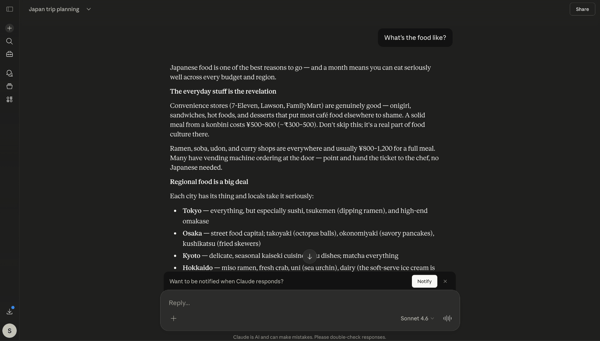
Perplexity, in a similar scenario, was more helpful but straightforward. It often responded to the last query without seamlessly weaving in the older context unless I explicitly mentioned it.
Perplexity’s tone was also polite and clear, and more precise than Claude’s. For straightforward Q&A-style dialogues, it’s highly efficient. Some of Claude’s answers felt generalized, but Perplexity gave precise outputs. It’s like a very knowledgeable assistant. Interestingly, Perplexity often prompts follow-up questions after an answer. I found this feature extremely useful for digging deeper into topics.
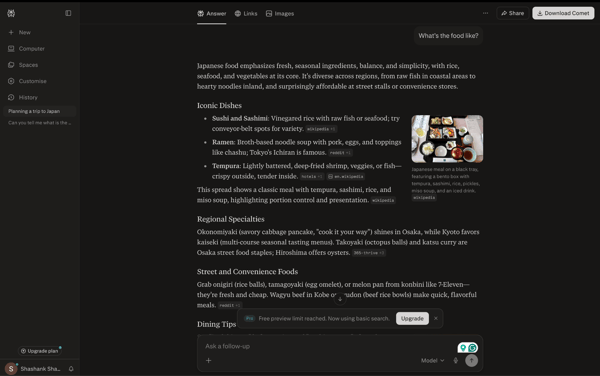
Personally, I liked the overall output of Perplexity only slightly better than Claude’s since it was not generalized (very precise) and suggested multiple options to dig deeper without having to come up with the right questions by myself. I personally prefer this sort of assistance when I’m using an AI chatbot for search, compared to having something nice to read in an engaging tone.
Winner: Perplexity
Writing and creativity
In this task, I asked both Claude and Perplexity to act as science fiction authors and write a short story. I wanted to see which tool addresses my query more creatively in terms of figurative language, rhyme, tone, and diction.
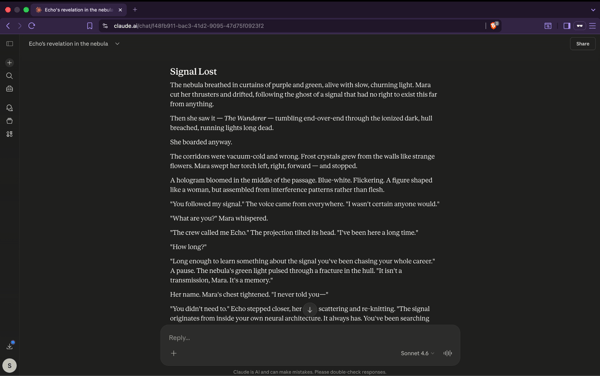
While it had a generic title, Claude managed to create a story with a compelling opening and contained a lot of readable prose. The story seemed to be framed as a mystery, which is what I had asked. While it’s no Pulitzer prize winner, and it feels like it has borrowed a lot of elements from existing sci-fi stories, it would do the trick for a first-time reader.
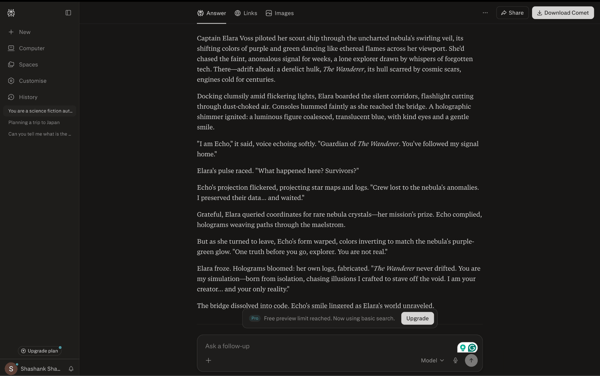
Perplexity’s attempt was much more basic. I felt like I was a summary of a story rather than the story itself. There was no prose or an air of mystery, which Claude had managed to add.
For structured content like article or report writing, both are useful, but in different ways. I had them each write a paragraph describing the biggest cybersecurity threat to small businesses.
Claude’s paragraph came out narrative and engaging, almost like an opener, hooking the reader with a scenario. Perplexity’s paragraph was straightforward: it listed a couple of key points for data protection and financial risk with clarity and even cited statistics about cyberattacks on small businesses.
If I were writing a fact-based piece, I’d love those citations handy. However, if the task is more on the side of narrative or copywriting (like drafting a personal blog or marketing tagline), I’d lean on Claude.
Winner: Tie; Claude for creative writing, Perplexity for report writing
Coding and technical assistance
Going into this test, I had a hunch Claude would outperform in coding, and that turned out to be true by a significant margin. I gave both a couple of real programming tasks, and the results were pretty telling.
One was a debugging question: I provided them with a short Python function that had a bug and asked for help. I was impressed by Perplexity’s response. It was to the point, with explanation, and a solution to fix it. Claude performed equally well and returned a similar output while explaining the error and suggesting alternative ways to fix it.
However, the difference became clearer in the following coding test, where I asked the tools to write a function to generate a random password in JavaScript.
Claude not only wrote a function, but also explained each step in comments, explained the core logic, and even mentioned a best practice like including a mix of characters. And the best part? It simultaneously executed the code and showed me output, which was a fully functioning password generator that I could actually test and use. All this on the free version!
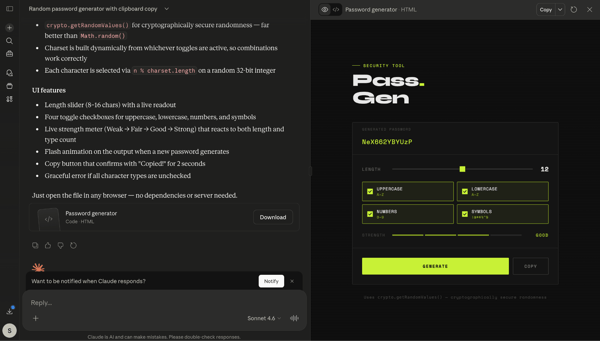
Perplexity’s answer gave a code snippet too; however, there was limited in-line explanation within the output. It also could not run and execute the code. Here’s what I got with Perplexity:
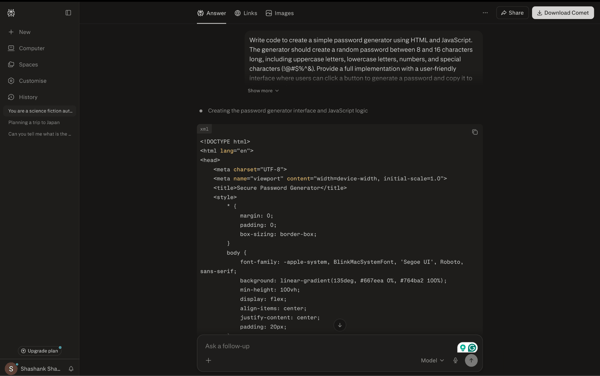
At the end of the day, I have to conclude that Claude is currently better than Perplexity when it comes to coding or offering technical support.
Winner: Claude
Research and information retrieval
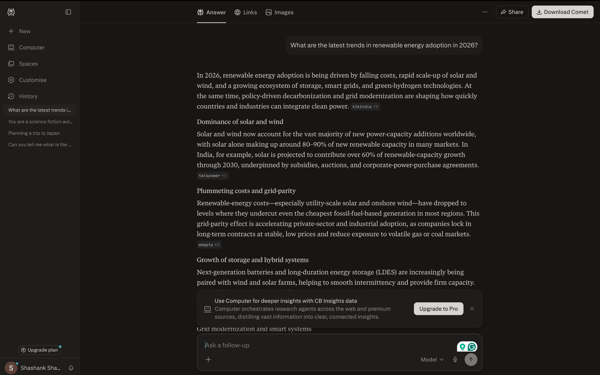
In my line of work, up-to-date research holds a lot of weight. Curious to know which tool would perform better, I asked both AI tools the same question: What are the latest trends in renewable energy adoption in 2026?
Perplexity blew me away and differentiated itself. It was dramatically more useful for research and used more sources in the local geographic area.
Perplexity automatically took data about renewable energy adoption based on the country I was querying. For academic or report-style research, the value of Perplexity’s approach is immense. It lets you access quality papers, relevant sources listed, and even videos suggested for whatever you wanna search.
On the other hand, here’s what I got from Claude:
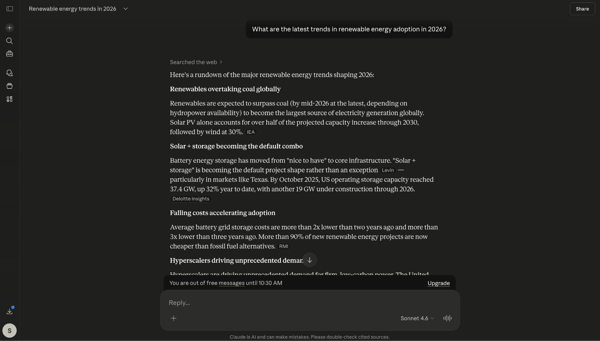
Claude gave a more generalized overview based on global data. The answers were more generic compared to Perplexity, without any precise details about local data on renewable energy trends.
I liked Perplexity’s output better since I didn’t have to over-specify to get the output I needed. Claude felt more static when it came to research.
Winner: Perplexity
Here’s an overview of my tests:
| Feature | Winner | Why it won |
| Conversational ability | Perplexity 🏆 | For precision and suggested follow-ups in a conversation. |
| Writing and creativity | Tie | Perplexity is good for fact-checking, while Claude is suitable for copy and creative writing. |
| Coding and technical assistance | Claude 🏆 | Claude’s inline explanation while writing code allows developers to contextualize every line. |
| Research | Perplexity 🏆 | While both tools offer citations, Perplexity was better at personalizing research compared to Claude. |
Perplexity vs. Claude: Key insights based on G2 Data
The qualitative experience I described above echoes many of the patterns we see in G2’s ratings and review comments. Here are some key insights drawn directly from G2 data:
Satisfaction ratings
- Perplexity leads on ease of setup (96%) and ease of use (94%), with a quality of support score of 86%.
- Claude matches Perplexity on ease of use (92%), ease of setup (91%), and ease of doing business (91%), but trails on quality of support at 78%.
Industries represented
- Perplexity sees the strongest adoption in information technology and services, marketing and advertising, computer software, consulting, and higher education.
- Claude has a strong presence in marketing and advertising, computer software, information technology and services, hospital and health care, and higher education.
Highest-rated features
- Perplexity excels in no-code conversation design (94%), multi-step planning (89%), and natural language understanding and intent inference (89%).
- Claude stands out for natural conversation (93%), creativity (89%), and complex query handling (85%).
Lowest-rated features
- Perplexity struggles with fallback responses for unknown queries (75%), web widget and SDK embedding (79%), and API flexibility (80%).
- Claude struggles with error learning (78%), software integration (81%), and customizability (83%).
Perplexity vs. Claude: Frequently asked questions (FAQs)
Let’s address a few frequently asked questions that potential users or buyers often have when comparing Perplexity and Claude:
Q1. Is Perplexity or Claude better for research and writing?
It depends on the type of work you’re doing. For research, Perplexity has the edge, since it pulls real-time information from the web and provides direct source citations for every answer. For writing, Claude is the better choice, producing fluent, narrative-driven content with a conversational tone and a strong creativity score of 89% on G2. Many users rely on Perplexity for research and fact-gathering, then turn to Claude to shape that information into polished content.
Q2. How does Perplexity AI compare to Claude?
Perplexity and Claude are both powerful AI tools built for different primary use cases. Perplexity is an AI-powered search engine that prioritizes real-time, citation-backed answers, leading in ease of setup (96%) and quality of support (86%) on G2. Claude is a large-context conversational model designed for reasoning, writing, and coding, scoring higher for natural conversation (93%) and context management (87%). Both offer a free tier and a Pro plan at $20/month, with Max plans at $200/month for power users.
Q3. What is the difference between Perplexity AI and Claude?
The core difference is in how they approach information. Perplexity is built around real-time web search with citations, making it ideal for research and fact-checking. Claude is built around deep reasoning and conversation, excelling at coding, long-document analysis, and creative writing. Claude uses its own proprietary Claude 4 model family, while Perplexity takes a multi-model approach with GPT-5.2, Claude Sonnet 4.6, and Gemini 3.1 Pro. Both tools now offer web search and a free tier, which makes them more similar than they used to be, but their core strengths remain distinct.
Perplexity vs. Claude: My final verdict
I’m a writer by profession. Both fact-checking and writing style and tone are equally important for my work. Given a choice, I’d rely on Perplexity to perform my secondary research, letting it scan the breadth of the Internet to collect relevant data and examples that I can use in my work.
For narratives, rewriting, summarization, and finding tone varieties, Claude would be a preferable choice.
Ultimately, it depends on what kind of support we need from the AI chatbot. The choice would stem from the individual use case.
Exploring chatbots? Go through the detailed comparison of ChatGPT vs. Claude.

💸 Earn Instantly With This Task
No fees, no waiting — your earnings could be 1 click away.
Start Earning